Focus on Russia's Economy
Author: Klaus Dormann
At the end of the year, the latest weekly report from the BOFIT research institute of the Finnish central bank provided a review of the highly “mixed” performance of Russian economic output since 2021. On Friday, when it cut its key interest rate again, the Russian Central Bank provided insight into how it assesses inflation and growth trends in Russia. During his annual press conference, President Putin offered an overview of how he views current economic developments. New outlooks on future economic developments were published by, among others, the “Eurasian Development Bank” and the “Institute for Economic Forecasting of the Russian Academy of Sciences.”
BOFIT: Mixed Trends in Russian Economic Output
The research institute of the Finnish Central Bank highlights that the growth of the Russian economy, which reached +4.3% in 2023 and +4.1% in 2024, was also driven in 2025 by the strong increase in production in defense-related sectors.
BOFIT reports: According to the Federal State Statistics Service (Rosstat), real gross domestic product grew by +1.0% year-over-year from January to September 2025. According to an estimate by the Ministry of Economic Development, this growth rate was also achieved in the period from January to October. The trend in overall economic output was twofold: the “defense industries” continued to record rapid growth, while production in other sectors stagnated or declined.
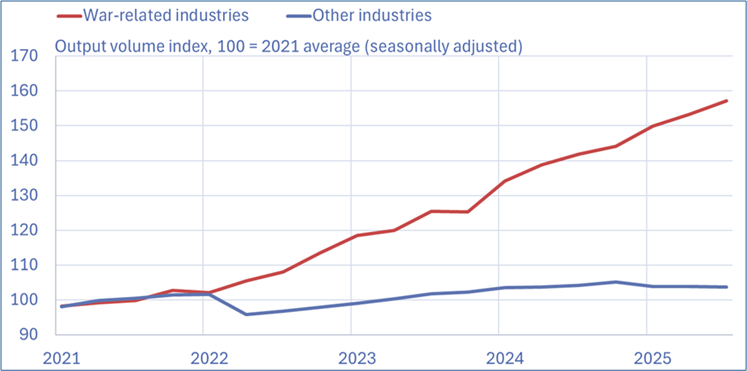
In the following BOFIT chart, the red line shows the sharp increase in production in “war-related sectors” as estimated by BOFIT. Compared to the pre-war year of 2021, their production has now risen by nearly 60 percent. To this end, BOFIT has calculated an index of production for three sectors of the “manufacturing industry” that supply the military, as well as for services provided to the military. According to the figure, production in the remaining sectors of the “civilian economy” has risen by only about 4 percent since 2021 (blue line).
Russian GDP growth continues to follow a two-track path,
with war-related sectors growing faster than civilian sectors
. Indices of production trends, annual average 2021=100 (seasonally adjusted)
Sources: CEIC, Rosstat, BOFIT
BOFIT, Bank of Finland: Russia’s GDP growth modest and government deficit on the rise, Dec. 19, 2025
Government spending is rising, and the deficit is growing faster than planned in 2025
Preliminary data from the Ministry of Finance show that spending in the Russian federal budget rose by 12.5% year-over-year from January to November (1Prime.ru). Regarding budget trends through the end of the year and into next year, BOFIT notes:
Spending growth has slowed in recent months. According to the budget plan updated in November, the federal budget deficit is expected to be around 5.7 trillion rubles, or 2.6% of GDP, this year. However, this would require a significant cut in spending in December. However, spending in December is expected to exceed the plans once again. As a result, the budget deficit is likely to rise more sharply than expected in 2025.
For the coming year, the budget plan calls for a nominal increase in government spending of about 4%. This would correspond to real stagnation in spending. As in previous years, however, the plan is likely to be updated over the course of next year. The development of Russia’s public finances remains dependent, among other things, on fluctuations in oil prices and oil production volumes.
Tight capacity, rapidly rising wages, falling inflation
BOFIT points out that many industries are currently suffering from a labor shortage. Production capacities are reportedly operating at full capacity. Wages and prices for means of production have risen sharply.
At the same time, however, BOFIT notes that the annual increase in consumer prices in Russia slowed to around 7% in November (Rosstat: Nov. 25/Nov. 24: +6.6%). In BOFIT’s view, the Russian Central Bank acted only “cautiously” in cutting its key interest rate from 21% in June to 16.5% in October.
According to BOFIT, “several experts” expect the inflation rate to fall to 5 to 6% next year. The Russian Central Bank’s analyst survey conducted in early December revealed that participants, on average, expect consumer prices to rise by +5.5% in 2026 (2025/2024: +8.8%). For December 2026, they expect an annual inflation rate of +5.1%.
According to the survey, consumer prices in December of the current year, 2025, will still be 6.3% higher than a year ago.
Sberbank expects an inflation rate of just 5.7% in December 2025
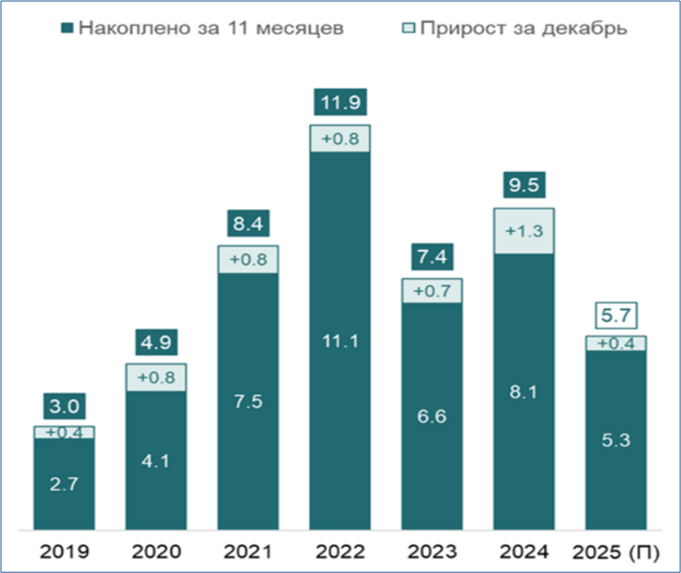
According to Sberbank’s “Center for Macroeconomic Research,” the annual increase in consumer prices is estimated to reach just +5.7% in December 2025, compared to +9.5% in December 2024. This inflation rate would be the lowest in the last five years.
The following chart from Sberbank shows the expected decline in the annual inflation rate from +9.5 percent in December 2024 to an estimated +5.7 percent in December 2025. According to Sberbank’s estimates, the price increase in December will contribute 0.4 percentage points to this annual inflation rate of +5.7 percent (upper light-colored portion of the bar).
Year-over-year increase in consumer prices in December, in percent
arb.ru; Sberbank Analysis: Inflation in Russia will reach 5.7% by the end of the year—a five-year low, Dec. 15, 2025.
With the COVID-19 pandemic and the start of the war in Ukraine, the annual rise in consumer prices had accelerated to 8.4% in December 2021 and to 11.9% in December 2022. According to Sberbank, the average annual inflation rate for the period from 2021 to 2025 was 8.7%, compared to 3.6% for the period from 2017 to 2020. Over the past five years, from 2021 through 2025, consumer prices have risen by a total of approximately +50%.
However, Sberbank now sees the inflation rate on track for a “steady return” to the central bank’s target of 4 percent.
The Central Bank lowered the key interest rate again by only 0.5 percentage points
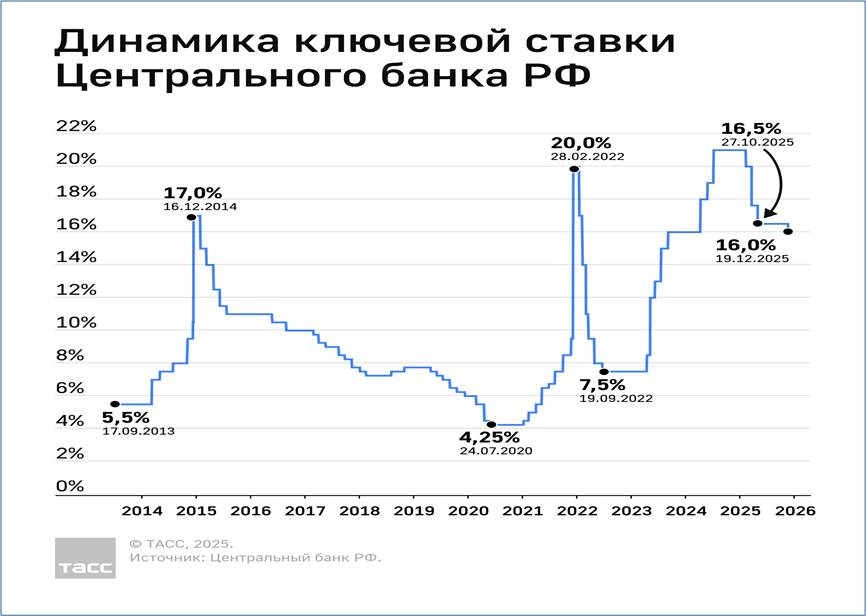
To combat rising inflation, the Russian Central Bank had raised its key interest rate in October 2024 to a long-term high of 21 percent. Over the course of 2025, it lowered the rate from 21% before June 9 to 16% in the last ten days of December.
Trend in the Russian Central Bank’s key interest rate since 2013
TASS: Central Bank press conference on the key interest rate, Dec. 19, 2025
Regarding the key interest rate cut of 0.5 percentage points to 16.0 percent decided on Friday, the “Moscow Times” reports, among other things: The rate cut had been widely expected. An increasing number of voices in the Russian business community are warning that a combination of high interest rates and an overvalued ruble could trigger a “perfect storm” that could stifle investment and weigh on economic growth.
In its press release on the key interest rate cut, the Central Bank reiterated that it would maintain its restrictive monetary policy for an “extended period” to bring down inflation.
According to the Central Bank, the annual inflation rate stood at 5.8% in mid-December and is expected to remain below 6% at least until the end of the year. Regarding the expected price trend, the central bank also stated that the 2-percentage-point increase in the value-added tax effective January 1, 2026, would result in a short-term rise in inflation. After that, the rate of price increases would decline again. However, according to the central bank, inflation expectations have risen slightly, which could hinder a sustained slowdown in the rise of consumer prices.
Central Bank: Economic growth continues at a “moderate” pace
According to the Central Bank’s forecasts published at the time of the key interest rate cut in late October, Russia’s gross domestic product will grow by only +0.5 to +1.0 percent in 2025. In 2026, the Central Bank expects growth of +0.5 to +1.5 percent.
Regarding the current trend in aggregate economic output, Friday’s press release states:
“While economic growth is continuing at a moderate pace, developments are uneven across individual sectors. Domestic demand is being supported by rising household incomes, increased lending, and higher government spending.”
Central Bank Governor Nabiullina commented on economic developments in the fourth quarter during the press conference (video):
“High-frequency data show that economic growth accelerated slightly in the fourth quarter of 2025 compared to the previous quarter, including in mining and quarrying as well as in manufacturing. Growth in consumer spending remains strong after having slowed slightly in the first half of 2025. This trend is particularly pronounced in the restaurant industry and a range of other services, as well as in the non-food sector. In recent months, consumer growth has been further boosted by increased demand for cars in anticipation of the recycling fee hike.”
According to the central bank’s press release, the situation in the labor market is gradually easing. Surveys indicate that the proportion of companies facing labor shortages is steadily declining. Companies are planning more moderate wage adjustments for 2026 than in the 2023–2025 period. At the same time, the Central Bank notes that unemployment is at a historic low. Wage growth continues to outpace labor productivity growth.
The Central Bank’s next interest rate decision is scheduled for February 13.
The RSPP business association called for a larger interest rate cut
One day before the 0.5 percentage point interest rate cut, Alexander Shokhin, president of the Russian Union of Industrialists and Entrepreneurs, called for a full percentage point cut, according to the Telegram channel vestifinance. He said:
“To be honest, we don’t expect a rate cut of 0.5 percentage points, but rather a full percentage point. Why? Because inflation began to fall faster at the end of the year than was forecast in September. In September, we expected inflation to be between 7% and 7.5% by year-end; now it is below 6%. However, with inflation at 6%, an interest rate of 16.5% is too high.”
Shokhin also emphasized that an interest rate cut is no guarantee of a solution to companies’ credit and liquidity problems. Due to the tightening of regulatory requirements by government authorities on borrowers and banks, a slight reduction in the key interest rate will not improve overall borrowing opportunities.
The president of the business association also noted:
“According to our surveys of RSPP members, around 40% of companies report having problems with payment defaults by business partners. That is a significant figure; it is the highest level since 2021.”
Following the 0.5 percentage point cut in the key interest rate, Shokhin stated, according to an RSPP press release on December 19:
“The decision by the Board of the Central Bank of Russia to lower the key rate to 16% was the most predictable in recent times. It is important that this trend continues—this is the fifth consecutive rate cut. However, given the noticeable slowdown in inflation at the end of the year, the decision could have been more radical—the current gap between the 16% key rate and the 6% inflation rate is too wide. Furthermore, the risks of accelerated inflation early next year due to the VAT increase are low, as confirmed by the minimal price increases following the last VAT increase (effective January 1, 2019). We therefore hope for a more ambitious next decision.”
How quickly Russia’s economic growth slowed
In the first quarter of 2025, Russia’s total economic output still rose by +1.4 percent compared to the first quarter of 2024. By the third quarter, the annual growth rate had fallen to just +0.6 percent.
Real Gross Domestic Product
Changes from the same quarter of the previous year in percent
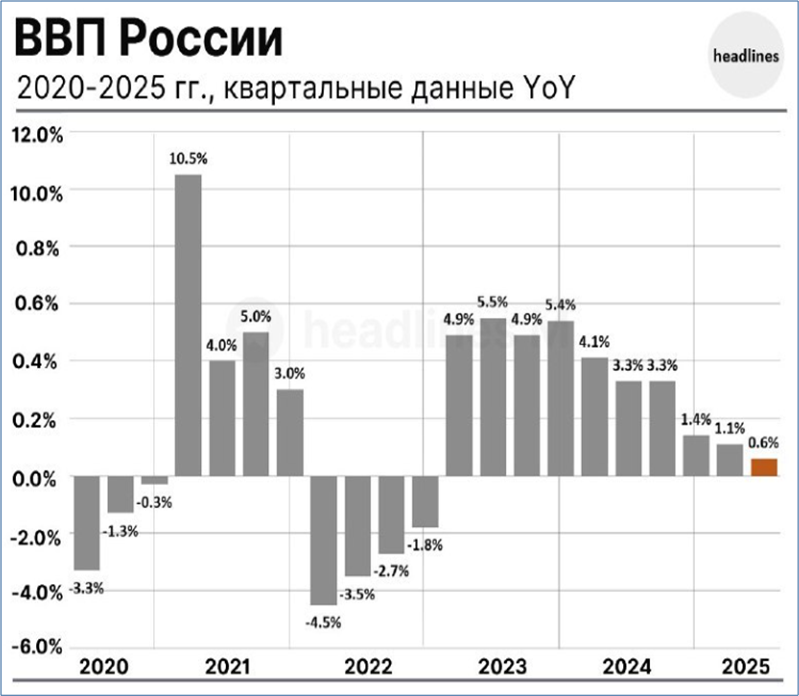
t.me/s/vestifinance_ru: On the right track: The Eurasian Development Bank (EDB) has halved its growth forecast for Russian GDP in 2025 to 1%, 12/18/25
President Putin: The slowdown in growth was “a deliberate step”
At his annual press conference with questions from citizens, President Putin addressed this year’s decline in economic growth right at the start of his remarks on the development of the Russian economy. He expects Russia’s economic growth to be 1 percent year-over-year in 2025 compared to 2024. At the same time, he pointed out that the Russian economy grew by a total of 9.7 percent in 2023, 2024, and 2025, while the eurozone grew by a total of 3.1 percent.
Putin emphasized that the slowdown in growth should be viewed in the context of the fight against inflation:
“This year’s 1 percent growth and the overall growth trend are the result of targeted measures by the government, the Central Bank, and the state leadership to combat inflation. Overall, we have managed to accomplish this task, as the goal was to reduce the inflation rate to no more than 6 percent. We now see that the inflation rate will continue to fall to around 5.7–5.8 percent by the end of the year. The slowdown in economic growth was a deliberate step… .”
However, the Russian government did not factor in a decline in economic growth from +4.3 percent in 2024 to just +1.0 percent in 2025 until late September in its budget planning. Previously, it had officially assumed that the economy would still grow by +2.5 percent this year.
President Putin’s track record for 2025: “The
economy and financial system are stable and fully under control”
Regarding the development of production in key sectors, the President highlighted:
Industrial production rose by about 1 percent overall, with manufacturing output increasing by 3.1 percent.
Agricultural production increased by 3.3 percent.
In housing construction, approximately 103 to 105 million square meters were completed in 2025 (“Slightly less than in 2024, but still impressive,” according to Putin).
Regarding developments in the labor market, wages, and labor productivity, Putin noted:
“We have succeeded in achieving good real wage growth. While the growth rates are no longer as high as in the previous year, in my opinion they still represent solid real wage growth. Adjusted for inflation, wages rose by 4.5 percent.
Unfortunately, we must openly admit that labor productivity growth over the same period was rather modest at just 1.1 percent. Of course, we should strive to improve this ratio in favor of higher labor productivity.
Last year, the unemployment rate stood at a historic low of 2.5 percent. This year, it has fallen further to 2.2 percent.
Overall, these are excellent indicators.”
Putin views the development of public finances as follows:
“The federal budget deficit stands at 2.6 percent. We expect it to fall to 1.6 percent next year and to 1.5 percent within the next three years. This is a positive sign, especially given the continued very low level of public debt, which is among the lowest among industrialized nations.
We estimated yesterday that public debt currently stands at 17.7 percent and is not expected to rise above 20 percent over the next three years.”
Putin’s conclusion:
“Taken together, all of this indicates that the economy and the financial system are stable and fully under the control of the government and the central bank.”
The Eurasian Development Bank also expects slightly higher growth in 2026
The Almaty, Kazakhstan-based “Eurasian Development Bank” largely shares the Russian government’s growth forecasts for 2025 and 2026. It, too, expects growth in the Russian economy to accelerate slightly next year to +1.0 percent following a decline this year. In the winter edition of its biannual “Macroeconomic Outlook,” the EDB forecasts the following for Russia:
Economic growth will pick up to +1.4% in 2026. In 2027 and 2028, growth of around 2 percent will be achieved in each year thanks to continued economic stimulus programs and a recovery in lending.
The rise in consumer prices will slow to 5.5% by the end of 2026. The VAT increase and labor shortages will keep inflation above the 4% target. By the end of 2028, however, the inflation rate will fall to 4.5%.
The key interest rate will fall from an annual average of 19.2 percent in 2025 to 14.4 percent next year.
The ruble is expected to appreciate to an annual average of 85 rubles per U.S. dollar in 2025. A period of depreciation is expected from 2026 to 2028. In 2026, the average annual exchange rate is expected to be 94 rubles per dollar due to lower oil prices, a gradual interest rate cut, and a decline in foreign exchange sales by the Russian Central Bank.

Eurasian Development Bank: Macroeconomic Outlook 2026–2028, Dec. 18, 2025
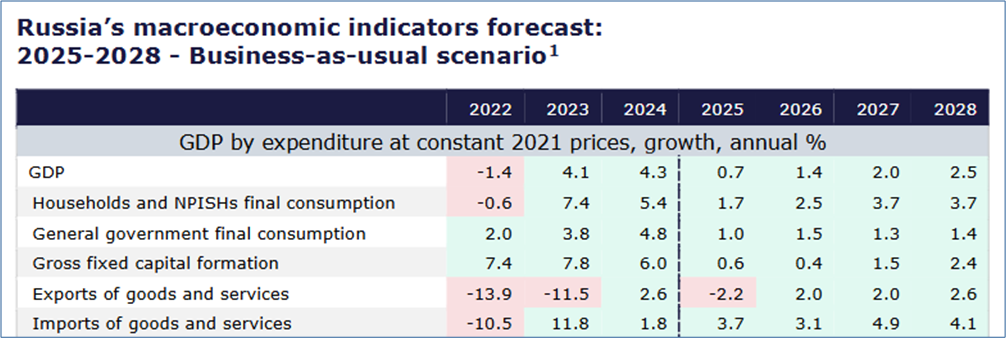
The Institute for Economic Forecasting of the Russian Academy of Sciences expects growth of only +0.7 percent for 2025
According to the “Institute for Economic Forecasting of the Russian Academy of Sciences” (IEF-RAS), “all major risks” to the development of the Russian economy materialized in 2024 and 2025:
Demographic trends are exacerbating the labor shortage.
The technological gap with industrialized nations and China is widening.
Export revenues from hydrocarbons and raw materials are declining.
Defense spending is rising, and the pressure from sanctions is increasing.
In mid-September, the IEF had still projected Russian economic growth for 2025 at +1.2 percent. The institute has now revised this forecast down to +0.7 percent in its new “Quarterly Forecast.”
According to the institute, the main reasons for the economic slowdown in 2025 were “the continued implementation of an extremely restrictive monetary policy and (to a lesser extent) the decline in hydrocarbon production and exports.”
Forecast of real gross domestic product growth from 2025 to 2028
: Year-over-year changes in percent
Institute for Economic Forecasts of the Russian Academy of Sciences: Russia: Quarterly Economic Forecast, Issue No. 68; English summary, Dec. 16, 2025
In 2026, growth will accelerate to only 1.4 percent
Three months ago, the IEF still expected economic growth to pick up to +2.1 percent for 2026. Now it anticipates a growth rate of only +1.4 percent for next year.
The institute currently sees a combination of “restrictive monetary policy” and “tightened fiscal policy” in Russia. Taxes would be raised and budget expenditures significantly reduced. Given the current external economic situation and restrictive monetary policy, this tightening of fiscal policy is the only way to ensure a balanced budget.
The IEF cites “a rapid easing of monetary policy in the first half of 2026” and a restoration of export growth—which, according to the institute’s forecast, is expected to have fallen by 2.2 percent in 2025—as the most important economic policy measures at present. First, consumption growth would need to accelerate; only then could investment growth pick up again.
According to the IEF, the economic growth of +1.4 percent expected in 2026 can be secured through growth in private household consumption, government spending, and exports. Once the “investment hiatus” ends, Russia’s overall economic growth could rise again to 2 percent or more starting in 2027.
Recommended reading:
- The Moscow Times: Russian Central Bank Slashes Key Rate to 16%, Dec. 19, 2025
- Finanzen.ch: Russia cuts key rate by 50 basis points as expected, 12/19/25
- Olga Belenkaya, FG Finam: The Central Bank is pursuing monetary easing but rejects an “autopilot mode,” 12/19/25
- TASS.ru; Eulalia Samedova: Costly Inflation: How the Central Bank Has Performed This Year, 12/19/25
- bne IntelliNews: Russian President Putin says inflation will fall to 5.7%, Dec. 19, 2025; bne Editorial Team Moscow: The Russian Central Bank cuts its key rate by 50 basis points to 16%, but remains cautious, 12/19/25
- news.tek.fm: The Russian Central Bank cuts its key interest rate to 16% and forecasts a decline in inflation, 12/19/25
- en.kremlin.ru: Results of the Year with Vladimir Putin. Vladimir Putin answered questions from journalists and the people of Russia in a live broadcast; transcript with video, Dec. 19, 2025
- Focus.online; Paul Nikolas Hinz: Putin holds propaganda press conference on the war in Ukraine – expert provides quick analysis. A political expert calls it “a rallying speech.” Minute-by-minute transcript of the event, Dec. 19, 2025
- Focus.online; Christoph Sackmann: Only $40 per barrel now. Oil crash hits Russia hard: Putin’s main source of revenue dries up, with reader debate; 12/19/25
- Eurasian Development Bank: Macroeconomic Forecast 2026–2028, Dec. 18, 2025
- t.me/s/vestifinance_ru: On the right track: The Eurasian Development Bank (EDB) has halved its growth forecast for Russian GDP in 2025 to 1%, Dec. 18, 2025
- Politkom.ru; Marina Voitenko: Systemic Tasks of Structural Transformation, Dec. 18, 2025
- Expert.ru; Ekaterina Futurova, “Expert”: Getting on a positive track. How to boost GDP growth, Dec. 17, 2025
- Vedomosti: Belousov: Defense Ministry spending amounted to 7.3% of GDP in 2025, Dec. 17, 2025
- Finmarket.ru: GDP growth in 2025 will fall short of the Ministry of Economic Development’s 1% forecast, according to projections by IEF-RAS and Raiffeisen, Dec. 17, 2025
- Forbes.ru; Angelina Krechetova: Analysts doubt the possibility of 1% economic growth in Russia in 2025; Dec. 17, 2025
- Kommersant, Artem Chugunov: Growth is almost imperceptible, 12/16/25
- news.tek.fm: Russia’s GDP growth in the third quarter of 2025 was 0.6%, Dec. 16, 2025
- Nezavisimaya Gazeta, Mikhail Sergeev: Russia celebrates the New Year amid a slowing economy. Weekly consumer spending in December will be lower than in 2024, 12/16/25
- Institute for Economic Forecasts of the Russian Academy of Sciences: Russia: Quarterly Economic Forecast, Issue No. 68; English summary, Dec. 16, 2025
- Podcast “Tsars, Data, Facts” by the German-Russian Chamber of Foreign Trade; Ben Aris, BNE IntelliNews, on frozen Russian assets in the EU: Russian Frozen Money: Europe’s Tough Decision, 40 min, Dec. 15, 2025
- arb.ru; Sberbank analysis: Inflation in Russia will reach 5.7% by the end of the year—a five-year low, Dec. 15, 2025.
The day's most important Russian economic stories. Free, in your inbox three times a week.
Mon, Wed, Fri. Double opt-in, no tracking, unsubscribe anytime. By subscribing you consent to the processing of your email address as described in our Privacy Policy.