Fast Food in Russia: Growth, Price Pressure, Expansion Eastward
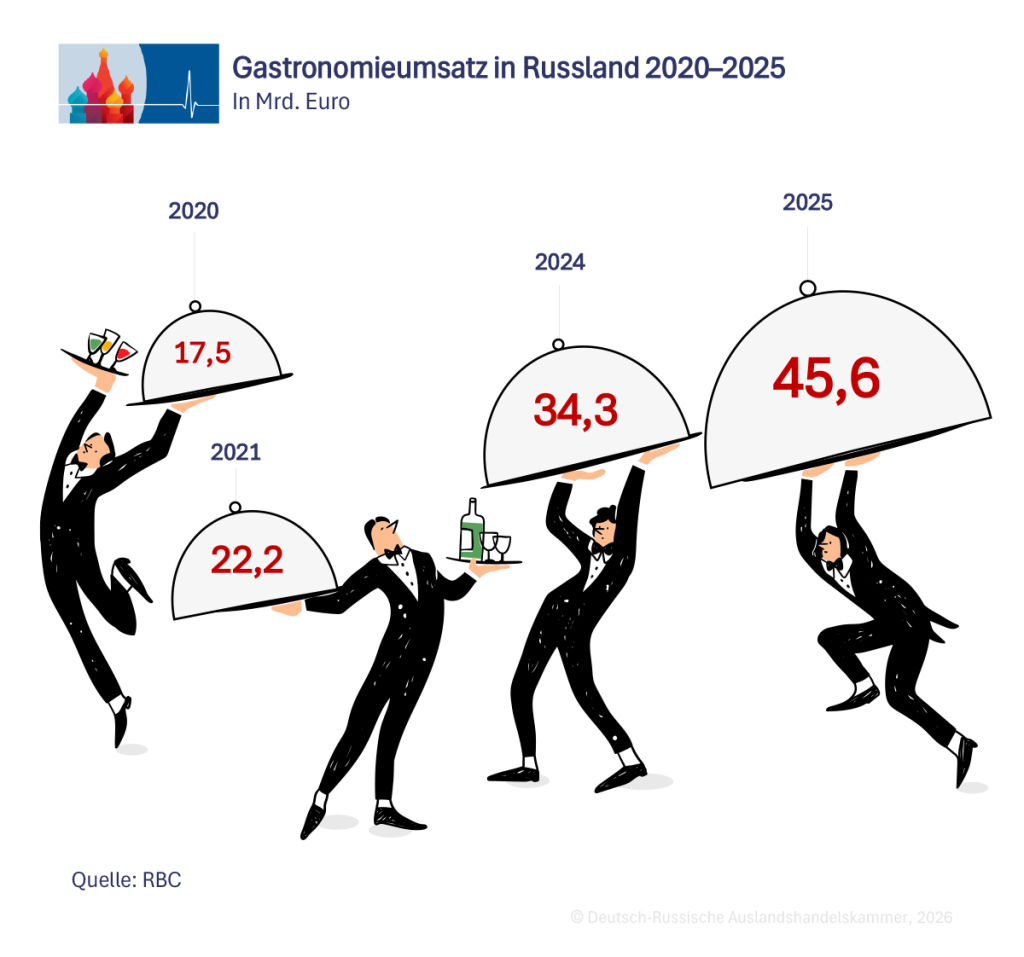
According to market research firm BusinessStat, Russia’s restaurant market has doubled since 2021, reaching 4.29 bio rubles in revenue—equivalent to approximately 45 billion euros. No segment is driving this boom as strongly as fast food: Fast-food restaurants are the only format reliably gaining customers, while traditional restaurants are losing them. Around 115,000 chain locations are competing for customers. Four years after the withdrawal of Western brands, the growing market is primarily in the hands of Russian owners.
Higher Revenue, Hardly Any More Customers
The nominal growth of the Russian fast-food market is impressive, but the real growth is more modest. Last year (2025), restaurant revenue grew by 8.7% to 4.29 bio rubles, but the increase came almost entirely from price hikes: According to an analysis by the point-of-sale service provider Saby, the average check rose by 11% to 1,492 rubles (approx. 15.70 euros). The number of guests at traditional restaurants declined, while fast-food restaurants saw a 7% increase in visitors.
Graphic: German-Russian Chamber of Foreign Trade
Fast food is thus the driving force behind the industry: The average receipt rose by 10% to 563 rubles (6 euros), and the purchase frequency increased by 7%, reports the parliamentary newspaper “Parlamentskaya Gazeta.” The number of food service establishments exceeded 240,000, with a growing disparity between regions: In Chechnya, the number rose by 30.2%; in Dagestan, by 25%; and in the Samara Region, it fell by 12.1%.
The number of Asian brands has more than doubled to 71 compared to the period before 2022, reports the industry portal Sostav. Since 2022, demand in the food service sector has shifted toward the mid-range and budget segments. Booming domestic tourism, new food courts, and the expansion of street food have supported consumer spending.
For 2026, the Moscow business newspaper Kommersant expects price increases of up to 20%, driven by wages, rents, and food costs. Supermarket food has now become the fiercest competitor to fast food: 51.5% of Russians buy ready-made meals at retail outlets, and the ready-to-eat market grew by about 18% to over 1.12 bio rubles (11.8 billion euros).
From Pushkin Square to Retreat: The History of McDonald’s in Russia
The first McDonald’s in the Soviet Union opened on January 31, 1990, as a Soviet-Canadian joint venture in the former Café Lira—with 900 seats, it was the world’s largest McDonald’s restaurant at the time, according to the Moscow city portal The City.
As early as the morning, more than 5,000 people were waiting, with the line stretching all the way to Novopushkinsky Square. By evening, the restaurant had served more than 30,000 guests—a world record for the chain. A Big Mac cost 3.75 rubles, one twenty-fifth of the average Soviet salary of 150 rubles. Thirty thousand Muscovites applied for 600 jobs.
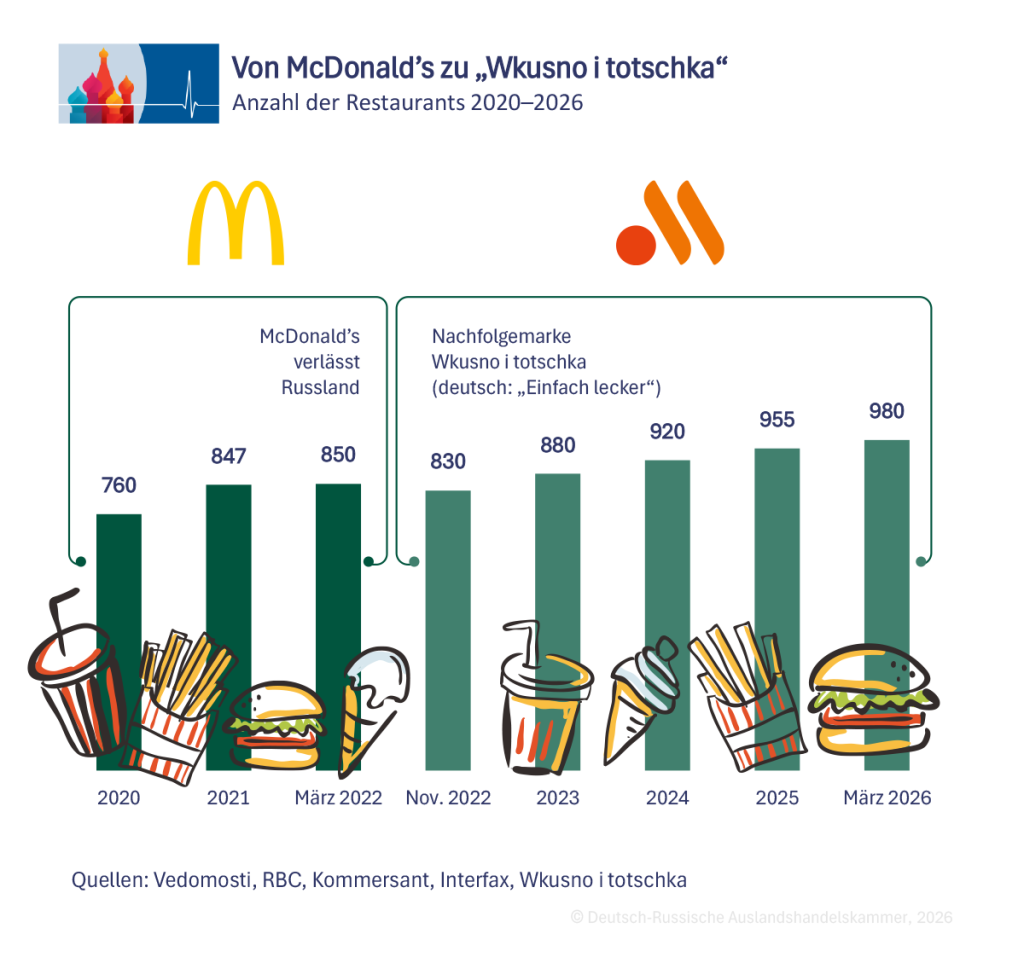
The American burger chain expanded rapidly across the vast Russian empire: When the company announced its withdrawal in May 2022 after more than 30 years, it operated 850 restaurants with 62,000 employees. The buyer was Siberian entrepreneur and McDonald’s franchisee Alexander Gowor; according to the Moscow business newspaper Kommersant, the contract includes a buyback option over 15 years.
Graphic: German-Russian Chamber of Foreign Trade
The Fateful Year 2022: The Americans’ Successors
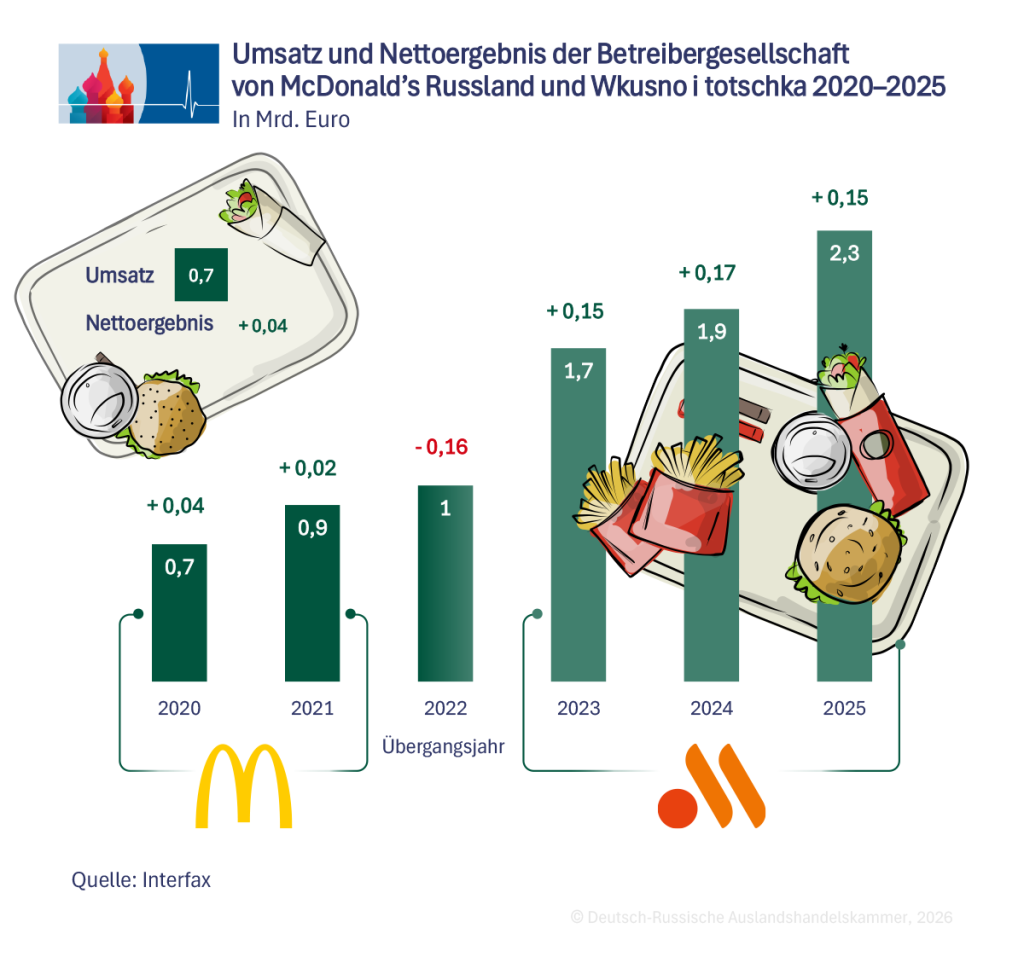
Wkusno i totschka (“Simply Delicious”) has not only maintained the McDonald’s network but also expanded it. In the first quarter of 2026, the Russian burger chain will operate around 980 restaurants in 66 regions, with revenue of 218.6 billion rubles in 2025 (2.3 billion euros) and a 16.7% increase over the previous year, reports the Interfax news agency.
In its first year of operation in 2022, according to the business portal RBC, the company posted a loss of 11.3 billion rubles—more than 150 million euros at the exchange rate at the time. In the following years, however, the Russified company became profitable and generated millions in profits.
Last year, net profit fell by 15.1% to 14.4 billion rubles (152 million euros) because costs grew faster than revenue. By the end of 2026, the chain plans to expand into Kyrgyzstan, and CEO Oleg Parojew dismisses the Americans’ questions about a potential return as settled: “As far as I can tell, no one has any doubts anymore that we’re here for the long haul,” he told Kommersant.
The other successors are in a similarly stable position. Rostic’s, the successor to KFC under the operating company Unirest, leads the chain rankings with 1,257 locations (as of 2025) and opened around 80 restaurants in 2025 alone. Stars Coffee, which emerged from Starbucks, plans to open 45 new franchise locations by the end of 2026, according to the Russian edition of the American business magazine Forbes. Burger King remained in the country and expanded to 880 locations—even though its net profit plummeted by 61% in 2025 to around 8 million euros, reports the business portal vc.ru.
Graphic: German-Russian Chamber of Foreign Trade
Big Hit vs. Big Mac: Prices and Costs
The Big Hit, the successor to the Big Mac at Wkusno i totschka, costs around 220 rubles (approx. 2.30 euros) according to the chain’s menu portal. In Germany, customers have to pay 6.30 euros per Big Mac, and in the U.S., 6.22 U.S. dollars (about 5.40 euros), according to the Big Mac Index published by the British magazine The Economist. On its global scale—ranging from Switzerland at $9.04 to Indonesia at $2.38—the Russian Big Hit would be near the lower end.
Coffee, bakeries, street food: the trends of the moment
Beyond the burger giants, the market is shifting toward new concepts. With 1,153 locations, the Coffee Like chain is almost on par with the market leaders, while bakery chains such as Chlebniza (970 locations) and Buchanka (545) are rapidly expanding their presence: Grab-and-go concepts lead the way in new store openings in the industry, according to a survey by the industry magazine FoodService.
Street food is growing the fastest: The dual brand TscheburekMi/Senjor Djoner expanded by 12.7% to 463 locations, turning chebureks and döner into a franchise product. The most striking trend comes from the east: the number of tea houses has more than doubled within a year, while traditional sushi chains shrank by 7.5% and pizzerias by 6.7%.
Established brands are also getting in on the action with new formats: Rostic’s is testing coffee zones in its own restaurants, while Stars Coffee is focusing on franchise expansion. Dodo Brands is building Drinkit, a fully digital coffee brand: there are now 253 shops in Russia, plus branches in Kazakhstan and Dubai. Orders are placed exclusively via app or terminal. The chain is expanding very rapidly. From January to May 2026 alone, 33 locations were added in Moscow. Since March 2026, Drinkit has also become the first Russian chain since Teremok’s withdrawal to venture into the U.S., opening a branch in West Hollywood, run by longtime Dodo franchise partner Ilya Farafonov, with an investment of about $400,000 and Russian classics like Raf coffee on the menu, according to the industry portal Klenmarket. Drinkit CEO Alexander Umarov aims to grow to 3,000 coffee shops by 2028, he told the trade portal Retail Tech.
The losers are independent businesses: While chains are expanding, the total number of restaurant locations fell by 3.1%. The market is consolidating amid declining foot traffic and rising costs.
Russian Fast Food: From the Blini Stand to Manhattan
Alongside the successors to Western fast-food chains, chains that emerged in Russia since 1990 are also growing. Almost all of their founding stories begin in the crisis year of 1998.
Teremok, founded by Mikhail Goncharov as a blini kiosk, operates 349 locations in Russia. Revenue last year totaled 25 billion rubles (266 million euros), a 17.3% increase from the previous year, according to the industry portal Retail.ru. For 2026, Goncharov plans to launch bar concepts featuring rare teas and cocktails made according to Russian recipes.
Kroschka Kartoschka, founded in the same year by Andrei Konontschuk and Vitaly Naumenko, brought stuffed baked potatoes to the exits of the Moscow Metro. The potato vendors started with two street stands, and the first franchise licenses were sold to friends for $15,000.
The most successful Russian fast-food story comes from the provinces: Dodo Pizza, founded in 2011 by entrepreneur Fyodor Ovchinnikov in the northern city of Syktyvkar in the Komi Republic, was the first Russian chain to combine a pizza franchise with its own IT platform; with 1,156 locations and 20.4% growth, it is the market’s number two. What sets these pizza makers from the far north apart is that every branch discloses its sales figures in real time.
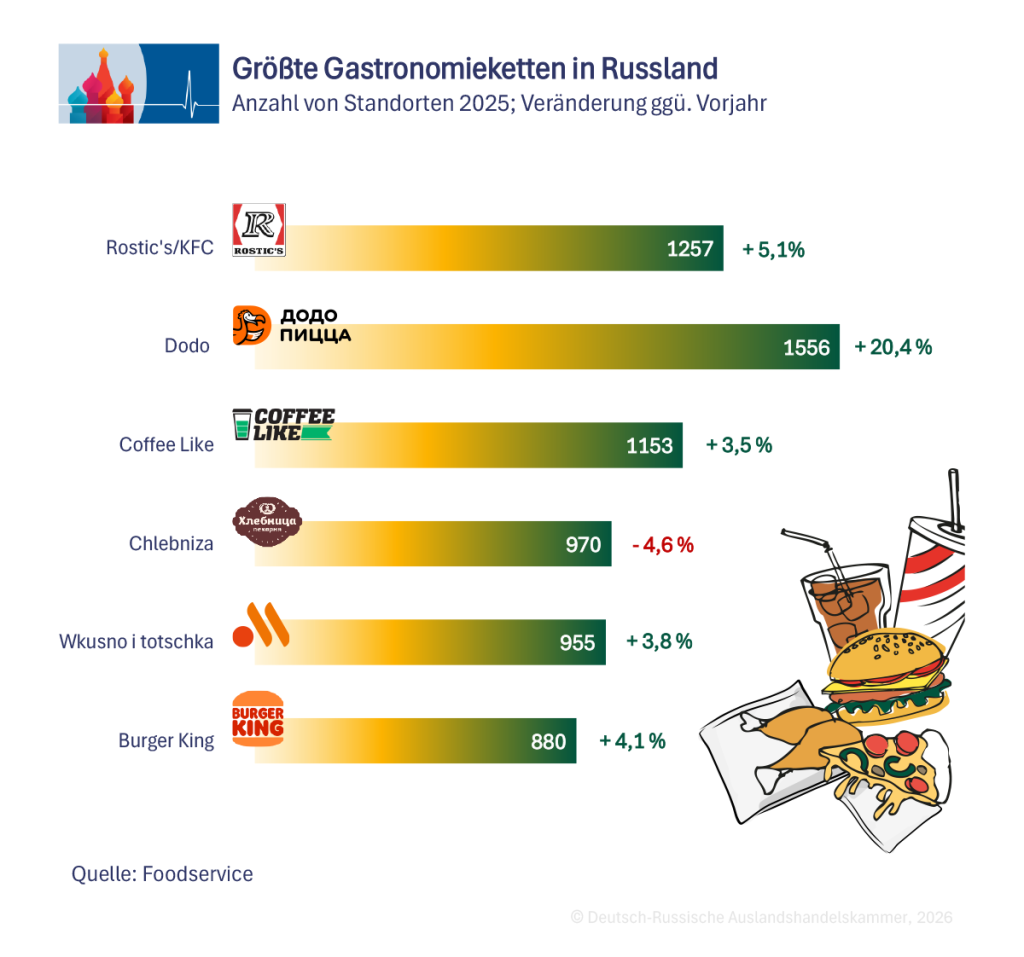
Graphic: German-Russian Chamber of Foreign Trade
Russian fast-food chains made an early attempt to break into the Western market—with mixed results. Goncharov opened two Teremok branches in Manhattan in 2016 and closed them again in June 2018: “We encountered open hostility,” he told RIA Novosti at the time, referring to the New York City Department of Health.
Dodo made further inroads: Brighton, Hangzhou, the U.S., and the Baltic states are listed as locations in the company report, but the current expansion map points primarily south and east: According to its current strategy, Dodo operates over 1,300 pizzerias in 25 countries, is targeting $1.5 billion in system-wide revenue, and is growing primarily in Turkey, the United Arab Emirates, Qatar, Uzbekistan, and Kazakhstan. By 2030, the goal is to reach 4,000 locations, 1,000 of which will be outside Russia. Russian fast food is expanding where political friction is low: in CIS countries, the Persian Gulf, and Asia. Wkusno i totschka is also following this path with its planned market entry into Kyrgyzstan.
Delivery Services and Digitalization as Growth Drivers
According to research agency Data Insight, 64% of Russian restaurants offer delivery; in cities with populations of over one million, the figure is as high as 72%. On average, delivery accounts for more than a quarter of orders, and in the Moscow metropolitan area, nearly 30%.
Fast-food chains are driving the shift toward delivery services: 78% of them deliver food, compared to 59% of independent restaurants. When it comes to ordering options, aggregators led by Yandex Eda dominate with 49%, while proprietary apps and websites account for 36%. Phone orders have dropped from 53% to 42% since 2021. So-called “dark kitchens”—kitchens dedicated solely to delivery with no dining area—are on the rise.
Consumption has become “fragmented,” says delivery marketing manager Yevgeniya Grets of Parlamentskaya Gazeta. Single-person households are driving personalization and smaller order sizes. To combat cost pressures, chains are upgrading their technology: AI-powered demand forecasts and streamlined menus are expected to cut food costs by 5% to 15%.
Comparison with Germany: Half the Market, Double the Population
The German foodservice market is significantly larger per capita than the Russian one. According to industry data from the Federal Association of System Catering, German chain restaurants generated 36 billion euros in revenue in 2025, 4% more than in 2024.
This means chain restaurants account for 41% of the total out-of-home dining market of 88.6 billion euros. They account for 47% of all restaurant visits.
In Germany, too, the increase in revenue came solely from higher spending per visit; the average check of 7.15 euros is 33% higher than the 2019 level. The 18- to 29-year-olds make up the largest group of diners at 27%. Germany is far ahead in terms of chain density: McDonald’s alone operates 1,364 restaurants for a population of 84 million, serves 1.85 million guests daily, and generated 5.19 billion euros in revenue last year—more than double that of Wkusno i totschka. Investments of 3 billion euros in 500 new restaurants have been announced.
The top spots in the German fast-food market are firmly in American hands. McDonald’s, with 1,364 restaurants, is followed by Burger King with over 750 and Subway with around 680 locations. KFC’s fried chicken restaurants number just over 200, according to the industry portal Preisemenu.
The largest German providers operate in a league below the U.S. giants: The snack chain BackWerk has about 300 locations, while the fish-and-chips chain Nordsee, the oldest domestic chain restaurant in the market, operates about 250 locations.
Source: German-Russian Chamber of Foreign Trade, Fast Food in Russia: Growth, Price Pressure, Expansion to the East, August 19, 2026.
This article was prepared for the German-Russian Chamber of Foreign Trade.