Armenia’s “Crossroads of Peace”: Infrastructure as a Foundation for Peace?
An exclusive interview with Viktor Yengibaryan, the Armenian ambassador to Germany. The interview is conducted by OW writer Jonas Prien.
In the fall of 2023, the Armenian government presented its ambitious “Crossroads of Peace” project. The goal is to establish sustainable peace in the South Caucasus through infrastructure, economic integration, and open borders. But how realistic is this initiative, and what role does Europe play in it?
Prien: What are the Armenian government’s goals with the “Crossroads of Peace” project?
Our government’s most important goal is peace in our region. And we can already say: We have essentially achieved this goal. Of course, it takes time to institutionalize peace. We are engaged in a constructive dialogue with Turkey and hope to establish diplomatic relations soon. Progress is also being made with Azerbaijan, as we have already initialed a peace treaty, supported by U.S. President Donald Trump, among others. A key step now is opening the borders. This is precisely where the “Crossroads of Peace” concept comes in: It aims to create regional connections, promote economic interdependence, and stabilize peace.
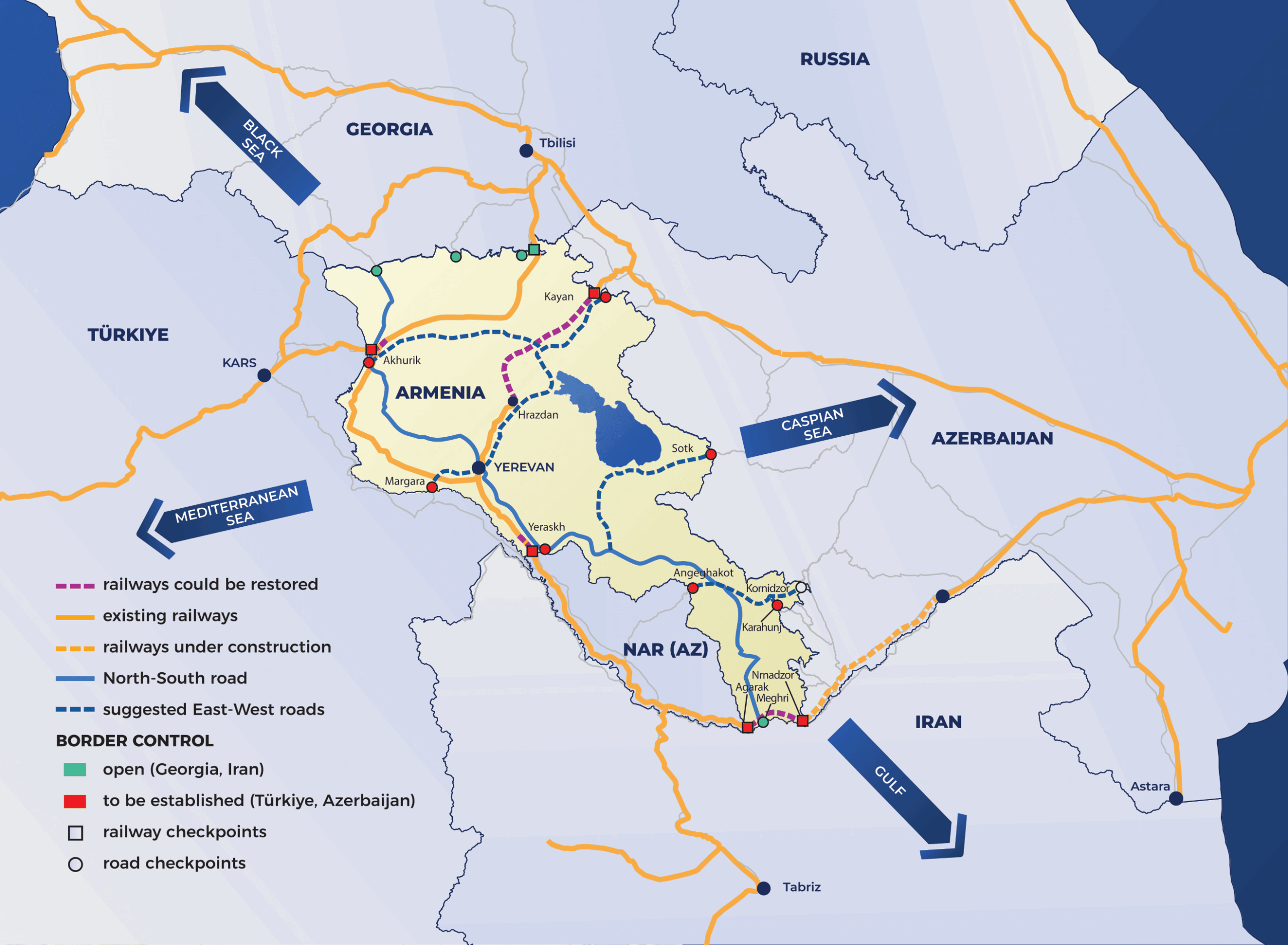
The “Crossroads of Peace” is intended to improve trade throughout the region and thereby strengthen security and trust. (Source: Armenian Government)
Prien: Is this primarily about infrastructure?
Exactly. It is based on clear principles: sovereignty, territorial integrity, respect for the national jurisdiction of the respective states, and mutual equality. Specifically, the focus is on revitalizing transportation routes, particularly 19th-century railway connections that have been out of service since the collapse of the Soviet Union.
Plans include, among other things:
- A rail link from Baku through Armenian territory to Nakhchivan
- Additional routes within Armenia via Nakhchivan, as well as toward Georgia and Turkey
- In the long term, a connection from Central Asia to Europe
- Highways, energy infrastructure, pipelines, and power grids
- A multimodal dry port in Gyumri
Prien: When could these projects become a reality?
We expect that the most important railway connections can be completed within three years. A company has already been established in collaboration with American partners, and a feasibility study is currently underway. The focus is primarily on rehabilitation and selective new construction.
Prien: What role does energy infrastructure play?
A very significant one. We want to connect our power grid to European frequencies. With support from Germany and KfW, a corresponding transmission grid is already being built.
We also plan to strengthen our connections with Georgia, Turkey, and Azerbaijan, expand solar energy (already over 20% of the energy mix), and produce green hydrogen. Armenia can thus not only serve as a transit country from Central Asia to Europe, but also become an energy producer in its own right.
Prien: How exactly do infrastructure projects foster trust?
We are focusing on economic interdependence. The first steps are already visible. Armenia has imported oil and gasoline from Azerbaijan for the first time. In addition, grain has entered the country via Azerbaijani territory. This makes trade more diversified and cheaper. We have also offered to let Turkey and Azerbaijan use our territory for transport. There is also progress on the social front: civil society delegations are visiting each other. This builds lasting trust.
Prien: What are the biggest challenges?
We must first learn to live in peace. That may sound strange here in Europe, but since our independence, an entire generation has suffered from the conflict. That is why it is important to anchor peace not only politically but also socially
Prien: What economic prospects are emerging for Armenia?
Our closed borders have long led to an isolated economic structure, with a strong focus on IT, for example. Now new opportunities are emerging in manufacturing and trade. Initial investments demonstrate the potential. NVIDIA plans to invest over four billion U.S. dollars. Another five billion could follow in the energy sector. Armenia is currently an attractive investment destination. Tourism is, of course, also a very important part of this. Most European tourists come from Germany.
Prien: What does the opening of transport routes mean for the South Caucasus?
It is not a zero-sum game. All countries benefit from the opening, including Georgia, Azerbaijan, and Turkey. Declining political risks encourage investment. Thanks to reforms in the areas of the rule of law and democracy, we saw 7.5% growth last year. This shows how powerful signals of peace can be.
Prien: What role do Germany and the EU play?
Armenia’s long-term goal is integration into the European Union. Germany is a key player in this process as Armenia’s most important economic partner in the EU. We see great potential for joint projects, particularly in the fields of hydrogen, energy, and infrastructure.
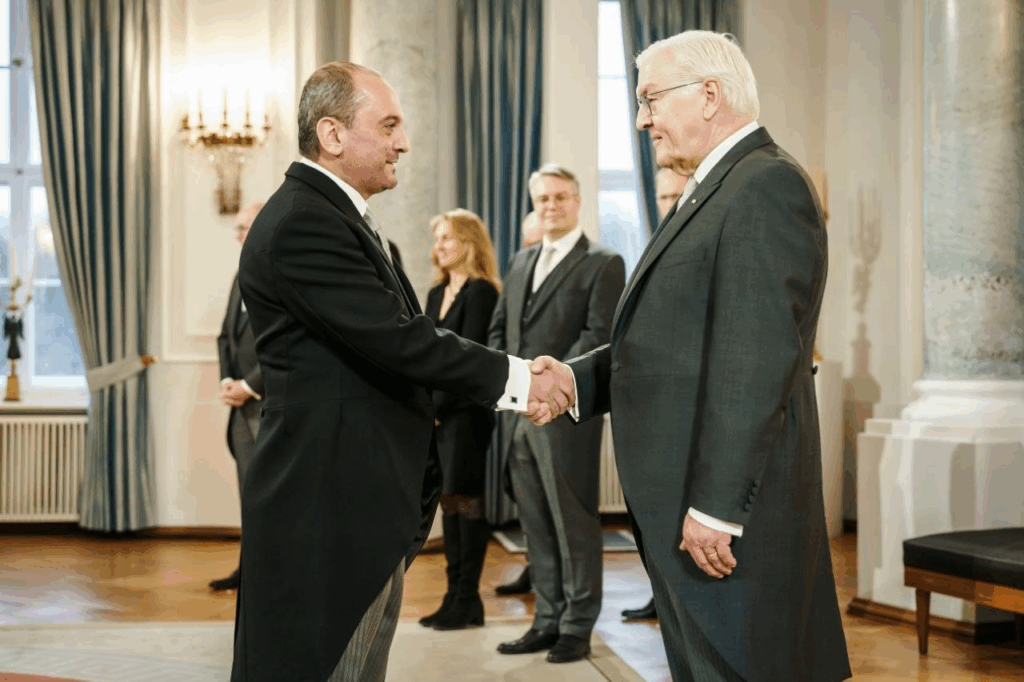
Prien: What role can Armenia play geopolitically in the future?
As part of the so-called “Middle Corridor,” we can make trade between Europe and Asia more efficient. Current flight routes already show that the South Caucasus is increasingly becoming the central axis between the two regions.
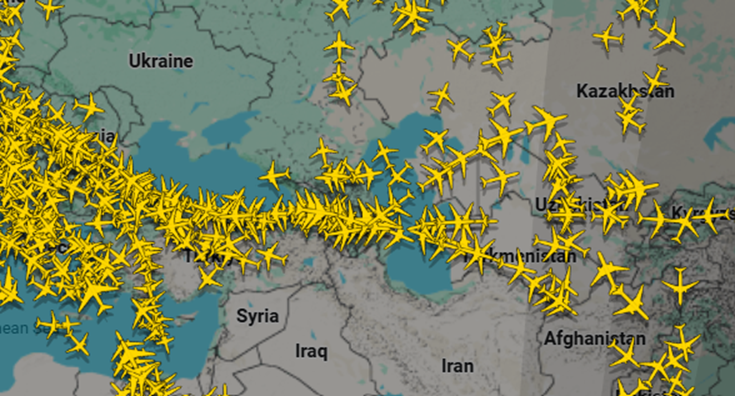
Flights on March 27, 2026: The South Caucasus has become a central hub for air traffic (Source: Flightradar)
Prien: Is this a snapshot or a long-term trend?
Above all, it shows how important our region is as an alternative route. Of course, we would hope that our neighbors also live in peace. With further infrastructure development, this role will only grow stronger. Peace is the crucial foundation for this.