The State vs. Business: Receivership and Nationalization in Russia
Since April 2023, the Kremlin has been using Presidential Decree No. 302 to place Western companies in Russia under external administration. The decree is officially a response to Western sanctions and actions targeting Russian assets abroad. So far, 29 foreign companies have been affected; in a few cases, the external administration has been lifted. At the same time, Russia is resorting to special decrees and, increasingly, to court rulings that can also lead to permanent expropriation.
On April 25, 2023, Russian President Vladimir Putin signed Decree No. 302 of that year. Its title is “On the Temporary Administration of Certain Assets.” The decree allows for the imposition of external administration on companies from so-called “unfriendly countries”—that is, the West, including Asian countries such as Japan and South Korea. The decree cites the violation of Russian property rights in these “unfriendly” countries as a prerequisite for third-party administration. It also states that the mere threat of such a violation is sufficient grounds.
Response to Asset Seizures in the West
The measure is explicitly described as a response to “unfriendly actions by the West that violate international law.” Russia had previously lost control of several of its state-owned enterprises in Europe. For example, in 2022, Germany placed the German refineries of the oil company Rosneft under state trusteeship, as well as Gazprom Germania. The German subsidiary of the Russian natural gas giant was renamed Sefe and was ultimately nationalized in November 2022. Seizures of Russian assets also occurred in other countries, such as Poland, the U.S., and Canada. Even more significant is the fact that, after 2022, Western countries froze approximately $300 billion in Russian central bank funds, about two-thirds of which are held in Belgium. The funds remain the property of Russia for the time being, although discussions about expropriation in favor of Ukraine arise time and again. In addition, billions in assets belonging to Russian entrepreneurs and private investors have been frozen in the West.
In addition to this general authorization for the external administration of Western companies, Decree No. 302 also contains a list of specifically affected assets. It identifies the assets to be placed under external administration, as well as their owners. Furthermore, the list names a “temporary administrator” for each case. The list contains no further details, including no indication of the rationale for placing the respective companies under third-party administration.
The first version of the list, published as part of Decree No. 302, included the Russian subsidiaries of the Düsseldorf-based energy group Uniper and the Finnish utility Fortum. The Property Management Agency Rosimushchestvo was designated as the administrator. Every subsequent case of external administration has since been ordered in a separate presidential decree amending this list.
Graphic: German-Russian Chamber of Foreign Trade
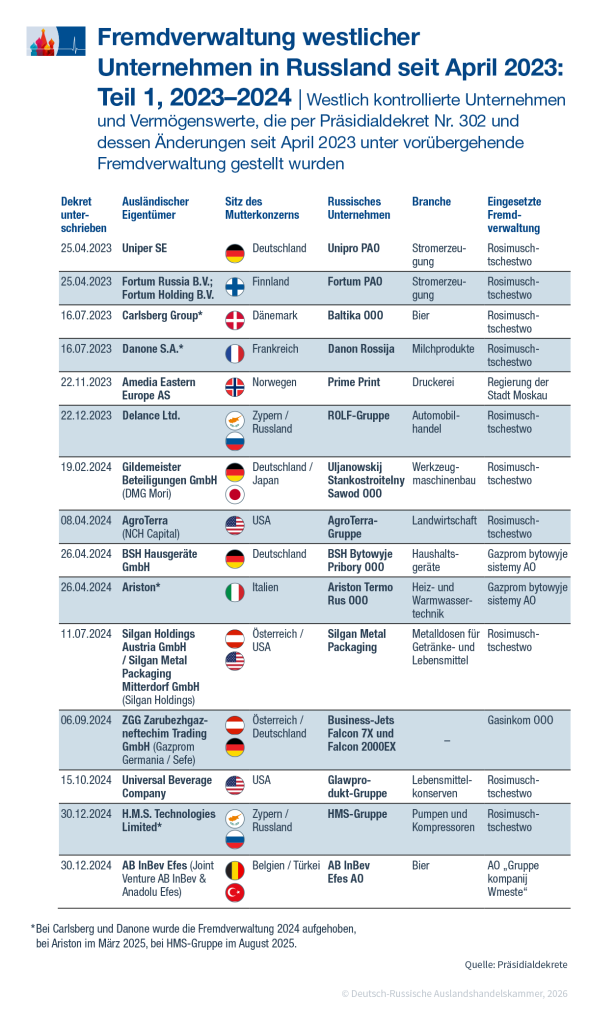
29 foreign companies affected so far
To date, the assets of 29 foreign companies have been placed under external administration pursuant to Decree No. 302. This is the result of an analysis of the amendment decrees issued to date, the complete list of which is maintained by legal portals. Two of the companies—Fortum and the American-Austrian metal packaging manufacturer Silgan—were affected twice. In February 2024, a factory belonging to the Japanese-German machine tool manufacturer DMG Mori also made the list, and in April of the same year, the Russian operations of the German home appliance manufacturer BSH Hausgeräte, which is part of the Bosch Group, were added. At the end of December 2024, there was another high-profile case involving the Russian operations of the Belgian beer giant AB InBev. The case involved its joint venture with the Turkish beverage group Anadolu Efes. Together, they operated several breweries in Russia under the name AB InBev Efes. The Kremlin transferred their shares to the little-known Russian holding company GK Wmeste.
Stada Loses Assets Worth Billions
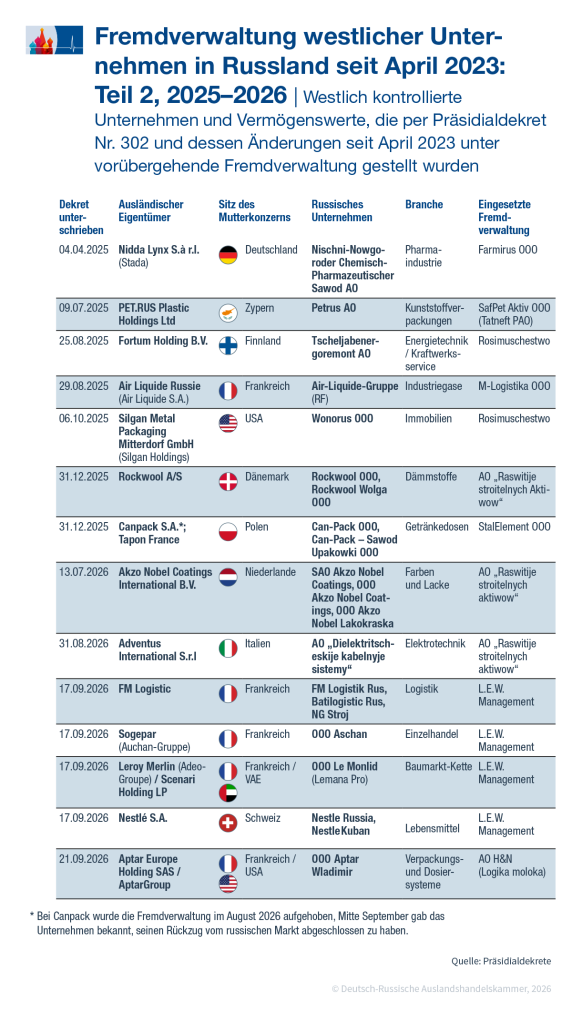
Last year, the Russian subsidiaries of two other major European companies were added to the list of entities under external administration. In April 2025, it was the turn of the German pharmaceutical group Stada and its Russian pharmaceutical manufacturer Nischpharm. The Kremlin appointed the Russian company Pharmirus as Nischpharm’s temporary administrator. The Frankfurt-based Stada Group, which at the time was owned by the American investment fund Bain and the Luxembourg-based fund Cinven, had shown no signs of wanting to divest itself of Nischpharm; on the contrary, it had ensured in Germany and the European Union that additives needed for drug production in Russia could continue to be supplied to Russia. Prior to being placed under external administration, Nischpharm had also been controlled by the two private-equity firms.
In August of last year, a decree placed the Russian operations of the French industrial gas manufacturer Air Liquide under the administration of a little-known company called M-Logistika. Everything indicates that it was founded specifically for this purpose.
External Administration Gains Momentum Again
In 2026, such cases began to increase again. In January, the Kremlin transferred several Russian factories belonging to the Danish insulation manufacturer Rockwool and the Polish beverage can manufacturer Canpack to local companies. In addition to the timing, there is another commonality that distinguishes these cases. Unlike most Western companies previously affected by Decree No. 302, Rockwool and Canpack—like Stada/Nischpharm—had not announced a withdrawal from Russia.
Since July, seven more companies have been added to the list. On July 13, the Dutch paint and coatings manufacturer Akzo Nobel was affected. On August 31, DKS, a Russian manufacturer of cable support systems owned by the Italian company Adventus International, followed. In both cases, the administrator is the company Rasvitie Stroitelnykh Aktyvov (RSA), which had already taken over Rockwool’s Russian subsidiary.
On September 17, the largest round of external administration to date took place under Decree No. 302. It affected the French conglomerates Auchan, Leroy Merlin, and FM Logistic, as well as the Swiss food company Nestlé. The Kremlin placed all four under the control of a single administrator: L.E.W. Management, a company registered in 2024, whose general director had been appointed just one week before the decree was issued. For the first time, the Kremlin openly cited political motives. Kremlin spokesman Dmitry Peskov stated that the decision took into account the companies’ origins in “unfriendly countries” that were “actively” involved in hostilities against Russia. Like Rockwool and Canpack, none of the four companies had announced a withdrawal from Russia.
By Presidential Decree No. 674 of September 21, 2026, 100% of the shares in Aptar Vladimir OOO held by Aptar Europe Holding were placed under the temporary administration of АО H&N. The decree directly supplements the existing Decree No. 302 of April 25, 2023. Aptar is an international manufacturer of dispensing, closure, and packaging systems, particularly for cosmetics, pharmaceuticals, food, and other consumer goods. Aptar Vladimir is the Russian manufacturing company. For 2025, it is reporting revenue of approximately 1.75 billion rubles (approximately 18 million euros) and net income of 537 million rubles (5.5 million euros). H&N is the corporate structure that emerged from the former Russian Danone business and is thus—unlike L.E.W. Management—an already established player.
Terminated Receiverships
In four cases so far, external administration has subsequently been lifted. The first companies to be placed under external administration after Uniper and Fortum were, in July 2023, the Danish brewing group Carlsberg and the French food giant Danone, whose Russian holdings were transferred to Rosimushchestvo for administration. In Carlsberg’s case, this involved Baltika, Russia’s largest brewery; for Danone, the external administration covered, among other things, 18 dairy product factories.
For Danone, the external administration was lifted on March 13, 2024, just a few days before the announcement of the sale of Danone Russia to a Russian company. In the case of Carlsberg as well, the lifting of external administration in December 2024 paved the way for the subsequent sale to Russian investors. Although Decree No. 302 grants the external administrator extensive rights, such as the authority to replace management, the administrator is not permitted to sell the assets entrusted to him.
The Canpack case recently followed the same pattern. In August 2026, Putin again lifted the external administration of the two Russian plants. On September 10, the company finalized the sale to a Russian entrepreneur, as reported by the business newspaper Vedomosti.
Graphic: German-Russian Chamber of Foreign Trade
The Ariston Special Case: Return to Italian Owners
The case of the Italian heating technology manufacturer Ariston is unique. In April 2024, its Russian subsidiary, along with BSH Home Appliances, was transferred by decree to a subsidiary of the state-owned natural gas company Gazprom for administration. In March 2025, the Kremlin lifted the temporary administration of Ariston Thermo Rus. As the legal portal Pravo.ru noted, this marked the first time a foreign owner regained control of its Russian assets without selling them immediately afterward.
Ariston subsequently announced that it would resume its business operations in Russia under local management. Russian media described this as the first “return” of a Western company to Russia—a characterization that is incorrect, as legal expert Dmitry Shunayev explains. He argues that the imposition of external administration should not be equated with the withdrawal of the affected foreign owner.
Special Measures Against Fraport and Wintershall
In recent years, the Kremlin has taken action against foreign companies even without resorting to Decree No. 302. On November 30, 2023, the Kremlin transferred the voting rights of the foreign owners at St. Petersburg’s Pulkovo Airport to Russian companies. The German airport operator Fraport, which held a 25% stake and was the largest Western investor in Pulkovo, was also affected. At the end of 2024, Fraport sold its stake to a company from Oman.
Three weeks later, on December 19, the Russian president dissolved the joint ventures between the oil and gas companies Wintershall DEA of Germany and OMV of Austria and Gazprom. This affected not only voting rights but also stakes in oil and gas projects in Siberia. The decree transferred these stakes to newly established, wholly Russian-owned companies. The Western companies may be compensated at a later date, though the proceeds from any potential sale would be held in frozen accounts in Russia. Wintershall DEA and OMV had already written off their Russian holdings.
In its decrees targeting Fraport, Wintershall DEA, and OMV, the Kremlin also cited Western sanctions against Russia. However, the “special measures” were justified on the grounds of protecting Russia’s national interests. In both cases, the argument went, Western sanctions had made it impossible for the foreign owners to continue operating the airport or developing the gas fields safely. This, they argued, necessitated intervention.
Wave of Nationalizations via the Courts
Most cases of nationalization in Russia do not occur by presidential decree but rather by court order, usually at the request of the Prosecutor General. The most prominent case last year was Moscow’s Domodedovo Airport. It was transferred to the state by court order in June 2025. The nationalization of the company—considered strategic—was justified, among other things, by the allegation that the billionaire and founder of the current airport, Dmitry Kamenshchik, had concealed his foreign citizenship. According to media reports, the country in question is Cyprus. Other prominent cases of nationalization by court order in the past two years included the Chelyabinsk Electrometallurgical Plant, a chemical company in the Caucasus republic of Bashkortostan, and the Solikamsk Magnesium Plant. In these cases, the Prosecutor General’s Office accused the owners of violations during the privatization process in the 1990s.
In some cases, companies that the Kremlin had previously placed under external administration via Decree No. 302 were also affected. Examples include the canned food manufacturer Glawprodukt and the car dealer Rolf. Both were first placed under the administration of Rosimushchestvo by decree and later transferred to state ownership at the request of the Prosecutor General’s Office. In the case of Rolf, the authorities justified this by claiming that its founder, Sergei Petrov, had allegedly engaged in business activities while serving as a Duma deputy. In the case of Glawprodukt, however, the key factors were control by a U.S.-based ownership structure, unauthorized capital outflows abroad, and the need to secure the food supply.
Last year, nationalization gained significant momentum. According to calculations by the Moscow law firm NSP, assets totaling 3.12 trillion rubles (32 billion euros) were transferred to state ownership in 2025. Domodedovo Airport is likely to account for just under a third of that amount. In 2024, the total value of the affected assets stood at 690 billion rubles (7.1 billion euros). In total, courts have awarded the state assets worth approximately 6.5 trillion rubles (67 billion euros) since 2022.
Source: German-Russian Chamber of Foreign Trade, State vs. Companies: Receivership and Nationalization in Russia, September 21, 2026.
This article was prepared for the German-Russian Chamber of Foreign Trade.