How is Russia's economy doing? What are the government and experts telling voters?
Author: Klaus Dormann
The Duma elections, which had been underway since Friday, concluded on Sunday. At the start of the elections, President Putin had also commented on current developments in the Russian economy. According to Reuters, during a government meeting on economic issues, he stated that GDP growth in 2026 would be “within 1%” of the government’s expectations. Inflation is gradually falling and is under control, the president told voters. However, Russian consumer sentiment is still much worse than it was in the summer of 2025.
Economy Minister Maxim Reshetnikov had already stated in early September at the Eastern Economic Forum in Vladivostok that his ministry now expects economic growth of 0.6% this year, which is a slightly stronger increase in gross domestic product than the government had forecast in the spring (+0.4%).
Vasily Astrov, a Russia expert at the “Vienna Institute for International Economic Comparisons,” also continues to expect economic growth to slow this year from 1.0% to 0.6%. Analysts surveyed by Interfax in early September forecast an average GDP increase of 0.5% for 2026.
President Putin: Economic Development Is in Line with Our Expectations
President Putin stated on September 17 at a government meeting that Russia’s economic development generally meets the government’s expectations. According to estimates, GDP growth in 2026 will be up to one percent (According to the English translation of the speech published on the Presidential Administration’s website, Putin said: “According to estimates, total GDP growth for the current year will be within one percent. This roughly corresponds to the forecast that formed the basis of budget projections for the current year.” en.kremlin.ru)
The president highlighted the relatively positive trends in employment, income, and consumption. He noted that the unemployment rate, at 2.3% in July, was near a historic low. Wages rose by 6.5% in real terms in the first half of the year (see the following table, last row). The stable labor market and rising incomes also had an impact on consumer demand. Retail sales increased by 5.4% in the first seven months of this year (see third row).
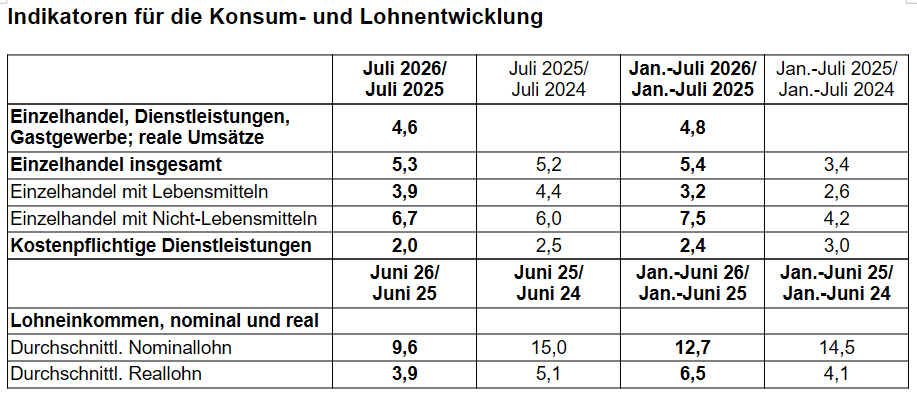
Source: Finam.ru: July Results: Industry Stagnates, Labor Market Cools Off. 09/03/26
President Putin did not analyze the “red figures” in the manufacturing sector
The President did not address the minimal growth in overall industrial production (Jan. through July: +0.1%) and the “red figures” for production in the “mining” sector (which also includes oil production), the transportation sector, the construction industry, and agriculture, the President did not, however, address these issues in the introduction to the “Economic Cabinet” deliberations published by the Presidential Administration.
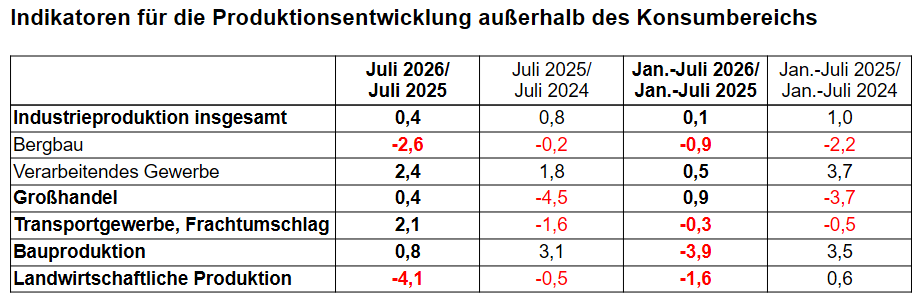
Source: Finam.ru: July Results: Industry Stagnates, Labor Market Cools Off. 09/03/26
Chris Weafer: Russia’s Economy Is Stable but Not Growing
“The Independent” quotes assessments of current economic trends in Russia by Chris Weafer, CEO of the consulting firm Macro-Advisory Ltd., which operates throughout the former Soviet Union and Eurasia:
Weafer sees Russia’s economy as being in a state of “tolerable stability.” He says the mood among the population is “grumbling.” He notes: “The economy is under pressure—it’s stagnating, which means it’s stable but not growing.” “But it’s not facing a recession either.”
Most people are “not that heavily affected” by the Ukrainian attacks on Russia, Weafer says. While the fuel shortage and the destruction of warehouses belonging to the online retailer “Wildberries” have made the war more visible to the public, they do not constitute a crisis. The fact that people’s shopping habits have been disrupted does not change public support for the Kremlin (see also earlier video interviews with Chris Weafer by Dmitri Alperovitch).
The Levada Center’s Consumer Confidence Index fell into negative territory
However, the consumer sentiment index compiled by the Levada Center, an independent Russian polling institute, fell to 94 points in June 2026.
Values below 100 index points indicate that negative assessments predominate among consumers. Since late 2022, the index had risen into positive territory above 100 points, temporarily reaching 117 points. Since mid-2025, however, it had been falling steadily. In August 2026, however, it rebounded from 94 to 99 points.
Levada Center: Consumer Sentiment in Russia
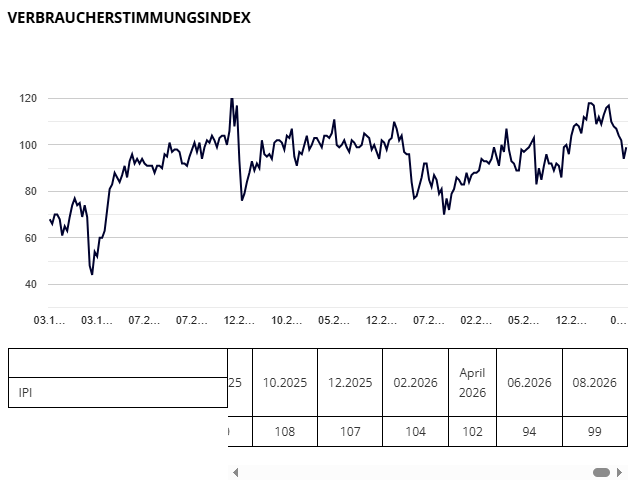
Levada Center: Socioeconomic Indicators; September 20, 2026
Recommended Reading: In early September, Re:Russia published a detailed analysis of public opinion surveys on political developments in Russia.
Putin: Inflation Has Been Falling Steadily
During government consultations, President Putin pointed out the decline in the inflation rate since the second quarter of 2025:
“Inflation is generally under control. It has been steadily declining since the second quarter of last year. On September 14, it stood at 6.2 percent. That is significantly lower than a year ago. As a reminder: In the first quarter of 2025, inflation was in the double digits at 10.3 percent. The efforts of the Central Bank and the Russian government in this area are clearly having an effect.”
However, in his opening statement, Putin did not mention the foreseeable price-driving consequences of the upcoming increase in municipal rates for housing and services on October 1.
Since early 2026, the inflation rate has remained virtually stagnant
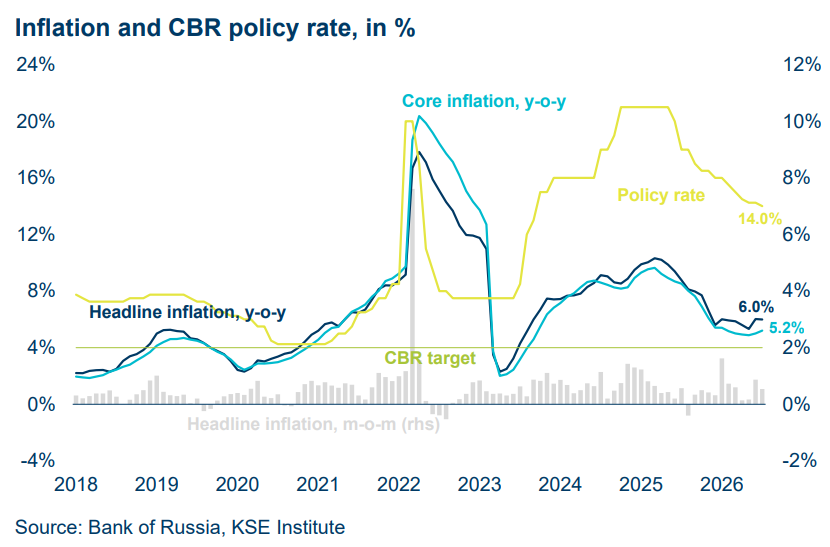
In the following figure from the monthly “Russia Chartbook” published by the Ukrainian “Kyiv School of Economics,” the black line shows the decline in the annual increase in consumer prices mentioned by President Putin. Since the turn of the year 2025/2026, however, the annual inflation rate has stagnated at just under 6 percent, with only minor fluctuations. The rapid decline observed during 2025 did not continue into 2026.
The figure primarily compares the trend in the inflation rate (“headline inflation”) with the trend in the key interest rate, the “policy rate” (yellow line).
The black line shows how the overall consumer price index has changed compared to the same month of the previous year (“headline inflation”). In July 2026, this annual inflation rate fell to 6.0% (left scale; see also FocusEconomics).
The light blue line shows the price trend of “core inflation,” which excludes products with particularly volatile price movements from the index basket.
The gray bars show the percentage change in the Consumer Price Index (“headline inflation”) from the previous month (right scale). In addition, the green line represents the Russian Central Bank’s target inflation rate of 4 percent per year (“CBR target,” left scale).
Inflation Rate and Key Interest Rate of the Russian Central Bank, in %
KSE Institute: Russia Chartbook by KSE Institute: Energy Price Moderation Returns Pressures; Budget Deficit Grows, September 3, 26
“Headline inflation” (total basket of goods): black line; “Core inflation” (basket of goods excluding volatile components): light blue line;
“Headline inflation” and “Core inflation” show annual changes in % (left scale)
“Policy rate”: Russian Central Bank’s key interest rate per year (left scale)
“Headline inflation,” gray bars; month-over-month change in consumer prices in % (right scale)
Putin sees positive trends in government revenue
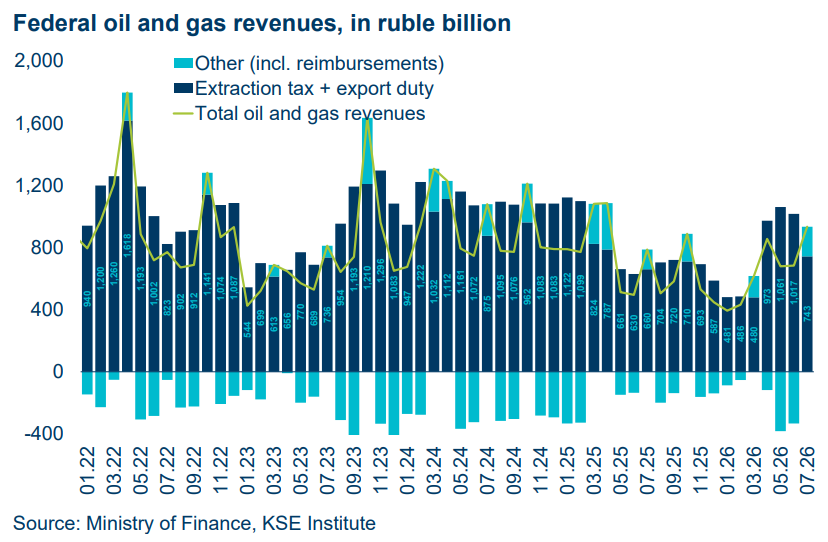
Regarding budget developments, Putin noted that the federal budget recorded a surplus of 606 billion rubles in August. His comment:
“Revenues from outside the oil and gas sector—that is, revenues that do not depend on developments in the global hydrocarbon market but are determined by the dynamics of our domestic market—contributed significantly to this result. In the first eight months of this year, these revenues rose by more than 18 percent.”
The President emphasized the benefits of the sharp rise in oil prices for Russia:
“We expect government revenues from oil and gas to rise in the coming months as well. This, in turn, will allow us to replenish the National Welfare Fund, which, as you know, serves as a kind of safety net for public finances.”
Revenues from the oil and gas sector in the federal budget, in billions of rubles, through July 2026
Kyiv School of Economics Institute: Russia Chartbook by KSE Institute: Energy Price Moderation Returns Pressures; Budget Deficit Grows, September 3, 2026
According to Putin, preliminary government estimates indicate that the federal budget will run a deficit of about 2 percent of GDP in 2026. The government is basing this on a “very conservative oil price forecast” of around $50 per barrel. The National Welfare Fund is expected to grow significantly as a result (see also Marketscreener/Reuters).
Central Bank Advisor Tremasov: There Will Be a Spike in Inflation on October 1
According to the Russian Central Bank’s medium-term forecast published in July, the annual inflation rate in Russia will range between 6 and 7 percent in December.
Kirill Tremasov, former director of the Monetary Policy Department and, since September 2024, an “advisor” to the Central Bank president, told Interfax on the sidelines of the International Industry and Energy Forum in Tyumen on September 16 that the increase in municipal rates for housing and energy costs, scheduled for October 1, 2026, is likely to raise the annual inflation rate by 0.7 percentage points. He explained it this way:
“We currently have an annual inflation rate of 6.3%, and the rate increase has been postponed until October. If the increase had actually taken effect on July 1, we would already be at an inflation rate of 7%.”
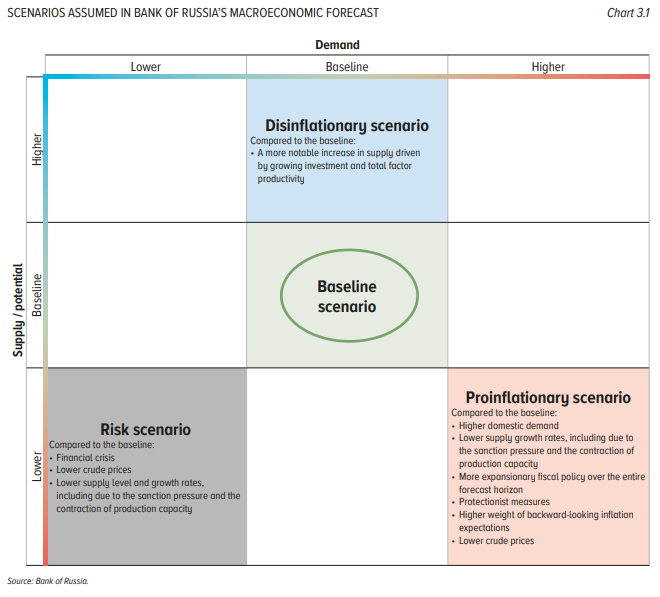
Overall, Tremasov said, the Russian economy continues to develop within the Central Bank’s baseline scenario forecast. He noted that the Central Bank also presents alternative scenarios for economic development in its monetary policy guidelines: a risk scenario, a pro-inflationary scenario, and a disinflationary scenario.
Russian Central Bank Scenarios for the Development of Demand and Supply
Bank of Russia: Monetary Policy Guidelines for 2027–2029; August 31, 26
Tremasov noted that financial market participants had recently been wondering whether the Russian economy had been moving toward an inflationary scenario. That would require a more restrictive monetary policy, Tremasov said. He emphasized: “We continue to adhere to the baseline scenario, but there has likely been a slight shift toward an inflationary scenario.”
wiiw Economist Astrov: The Russian Economy Remains Stagnant
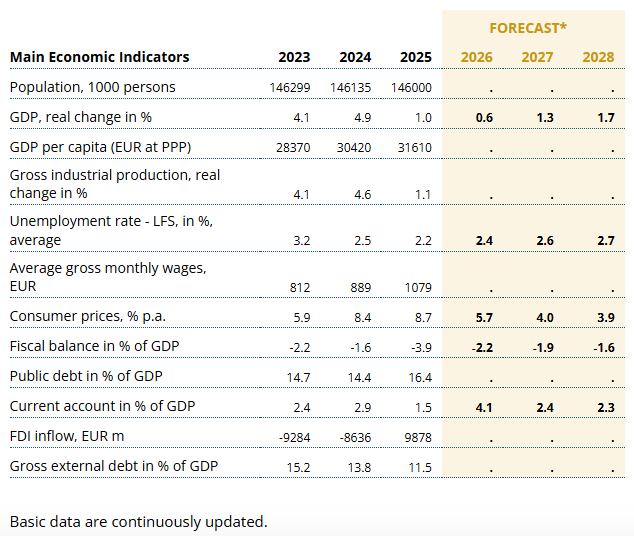
Shortly before the Russian Duma election, Vasily Astrov, a Russia expert at the Vienna Institute for International Economic Comparisons (wiiw), also commented in detail on the development of the Russian economy in an interview with the Austrian news agency APA. He explained that Russia’s economic output is expected to grow by only 0.6 percent in 2026. His growth forecast thus fully aligns with the government’s forecast.
Astrov is thus sticking for the time being to the wiiw’s “summer forecast” for Russia’s economic growth in 2026—0.6 percent—which was published in early July. “At the moment, I believe that the stagnation will continue,” Astrov said. The wiiw’s “Fall Forecast” is scheduled to be released on October 21, two days before the Russian Central Bank’s new forecast.
wiiw: Country Overview Russia
wiiw Country Overview: Russia
Astrov: “Highly Restrictive Monetary Policy” Is Slowing Russia’s Economy
Astrov attributes the current economic slowdown primarily to high interest rates. “It’s not the sanctions, it’s not the war—it’s the Russian Central Bank’s very restrictive monetary policy.”
The key interest rate currently stands at 14 percent, while inflation remains at 6 percent. With inflation at 6 percent (as in July 2026), a key interest rate of 14 percent translates to a real interest rate of 8 percent.
Astrov believes that President Vladimir Putin implicitly supports Central Bank Governor Elvira Nabiullina in her course of action to combat inflation. The reason for this is also psychological in nature. “Traumatic experiences during the hyperinflation of the 1990s” continue to have an impact on the Russian leadership.
At the same time, according to Astrov, government war financing is not at risk despite rising deficits. Russia’s public debt stands at a very low 16 percent of gross domestic product (see the wiiw Country Overview: Russia above). The government borrows money primarily from domestic banks.
According to wiiw estimates, total defense spending amounts to 7 to 8 percent of GDP. Of this, 2 percentage points go toward soldiers’ pay.
According to Astrov’s assessment, the direct contribution of defense and weapons production to total economic output is sometimes overestimated—it accounts for only about 2 percent of GDP.
How are Russian consumers faring?
When asked how a typical Russian household is currently faring economically, Astrov offered a nuanced response: Compared to the situation two years ago, consumer households are worse off, but compared to the period before the war in Ukraine, they are better off. He attributes this to the boom in 2023, 2024, and early 2025, with GDP growth rates of 4 to 5 percent per year, which were achieved as a result of high war spending.
Astrov points out that lower-income groups are benefiting financially from the war to a particularly large extent: Contract soldiers receive a monthly salary of 2,000 euros, lump-sum payments averaging 10,000 to 20,000 euros upon signing their contracts, and compensation of up to 150,000 euros in the event of death or serious injury.
How are employment, emigration, and immigration trending?
With an official unemployment rate of 2.2 percent, the labor market is effectively at full employment, says Astrov. However, he notes that this is primarily due to demographic factors such as the ongoing decline in the birth rate.
Emigration, on the other hand, is not a major problem for Russia. Until the start of the war, Russia had even been the world’s second-largest destination for immigrants after the United States. Workers had immigrated primarily from the CIS states.
However, following the Islamist terrorist attack on Crocus City Hall in 2024, the government made life much more difficult for immigrants and imposed employment bans on foreign workers in numerous regions. This has put a strain on some industries, such as courier services. There were about 20 million Muslims living in Russia.
Ukraine’s drone attacks are bringing the war to Russia
According to Astrov, the war with Ukraine is increasingly affecting the Russian population directly through gasoline supply shortages caused by the destruction of Russian refineries. Warehouses belonging to major online marketplaces such as Wildberries and Ozon have also been attacked (see also the ntv video featuring Astrov).
Ukrainian long-range drones are now reportedly capable of covering distances of 1,000 to 1,500 kilometers, enabling them to reach oil ports near St. Petersburg or refineries in Omsk. This has led to a 20 to 30 percent drop in Russian gasoline production, which is why gasoline must be imported from Belarus, Kazakhstan, and India.
Since 90 percent of Russian grain exports used to pass through the Black Sea and that route is now blocked, Russia must now rely on Baltic Sea ports.
At the same time, Astrov points out that the population is nevertheless not “war-weary.” On the contrary: According to surveys by the independent Levada Center, the percentage of the population that supports continuing the war until all war aims are achieved has recently risen from 24 to 31 percent.
Astrov: “I’m not a big fan of sanctions”—why Russia is coping relatively well with the sanctions
Astrov doubts the effectiveness of Western economic sanctions: “I’m not a big fan of sanctions.” He argues that sanctions often have a counterproductive political effect, fuel anti-Western sentiment, and serve as a convenient excuse for the Russian government to blame for economic problems.
The Russian economy quickly overcame the crisis phase of 2022, when GDP contracted by more than 1 percent, through adjustment measures. Without the participation of key countries such as China, India, Turkey, or the United Arab Emirates (UAE), the sanctions would have little effect.
According to Astrov, the reason Russia is able to weather Western economic sanctions relatively well is that the Russian economy is extremely adaptable and organized along market-economy lines. Small and medium-sized enterprises, in particular, play a central role in circumventing Western sanctions via third countries.
However, the sanctions are pushing Russia into an increasingly one-sided dependence on China. Beijing is exploiting its market power, dictating price cuts on Russian crude oil, and taking an extremely hard line in negotiations over the construction of a second gas pipeline from Western Siberia—which is why no agreement has yet been reached.
A peace agreement would trigger only a short-term “negative shock”
A possible ceasefire or peace agreement with Ukraine would represent a negative shock for the Russian economy in the short term, Astrov explained. In the first year following such an agreement, the absence of military pay (which accounts for about 2 percent of GDP) would eliminate part of the demand stimulus.
In the medium to long term, however, peace would be clearly positive for the Russian economy. The main reason would be the easing of U.S. sanctions promised by the U.S. president. Russia would then regain access to cutting-edge Western technology for oil and gas production in Eastern Siberia and the Arctic, as well as to the procurement of civilian aircraft and spare parts.
Vasily Astrov also commented on the effectiveness of the sanctions in particular in the latest episode of the podcast by the Austrian newspaper “Die Presse” on September 17, 26, in a conversation with Eduard Steiner and Prof. Gerhard Mangott: Russophobia in Europe: Why Is Putin Both Overestimated and Underestimated?
Recommended Reading
German-Russian Chamber of Foreign Trade
- Eastern Economic Forum 2026: Quotes and Results, September 8, 26
- Consumption Instead of Investment: Potential Growth in Russia Higher Than in Germany, September 3, 26
- New Russian Economic Model Aims to Bring About a Turnaround, August 28, 2026
- Alexander Schochin: “We will never return to business as usual,” August 25, 2026
Podcasts, Videos
- russland.capital: Putin Sees Inflation Under Control—Higher Rates Still Ahead, September 18, 2026; featuring a russland.ru video with German subtitles: Putin Holds Meeting on Economic Issues; September 18, 2026
- “Die Presse” correspondent Stefan Scholl on the news podcast “Was wichtig ist”! In conversation with Klemens Patek: Is Putin going all out now? In Russia, everyone is just waiting to see what happens after the elections; with transcript; also on YouTube; 22 min, September 18, 2026
- Prof. Gerhard Mangott, University of Innsbruck, and economist Vasily Astrov (WIIW) in conversation with Eduard Steiner on the “Die Presse” podcast “Gas, Sanctions, Oligarchs”: Russophobia in Europe: Why is Putin both overestimated and underestimated? Also on YouTube, 44 min., Sept. 17, 26
- ZDF heute; Auslandsjournal, Felix Klauser: Shortages, Fear, and Explosions. Ahead of the September 20 elections, a persistent fuel crisis and attacks on logistics centers are taking a toll on the daily lives of many people in Russia, 8 min., September 9, 2026
State Duma Election; Political Context
- BR24: Russia
- Handelsblatt, dpa: Parliamentary Elections in Wartime. Voting in Russia ends—how will Putin’s party fare? President Putin seeks to have his war course endorsed. September 20, 2026
- The Independent; David McHugh: Putin’s war economy is under strain. One thing is keeping it afloat. Frictions in Russia’s wartime economy are growing; September 19, 2026
- ORF.at, News: Duma Election as a Kremlin Simulation, September 18, 2026
- CNBC; Sam Meredith, Anniek Bao: Putin braces for election stress test as Russians ‘feel the pain’ of a struggling economy; Sergei Guriev told CNBC that Russians are increasingly feeling the economic pain of the war in Ukraine as growth stalls, taxes rise, and the Kremlin runs a significant budget deficit; September 17, 2026
- Handelsblatt+; Vera Fromm, Carsten Volkery: Putin Critic Khodorkovsky: “Almost the Entire Russian Elite Is Against the War.” He explains what the Russian parliamentary election reveals, how he assesses Putin’s mental state, and what he considers to be the West’s “fundamental error in reasoning.” September 17, 2026
- dekoder; Anton Himmelspach, Dmitry Kartsev: Duma election without voters. Duma election: The candidates did not appear in the studio. The Kremlin is banking on voter demobilization, September 16, 2026
- Tagesschau.de; Interview with Prof. Andreas Heinemann-Grüder by Stefan Schlag, NDR Info: Russia’s Tactics Against Ukraine: “It’s the Transition to a War of Annihilation”; 09/15/26
Overall Economy
- realnoevremya.ru; Alsu Sabirzanova: Russia’s GDP grew by 0.6%. Consumer demand remains robust; Government meeting on the current economic situation; September 17, 26
- en.kremlin.ru; Speech by President Putin: Meeting on economic issues; September 17, 2026
- Interfax.com: Russia’s GDP growth will be within 1% in 2026, inflation ‘under control’ and gradually decreasing – Putin. September 17, 2026
- de.marketscreener.com; Reuters: Putin: Russia’s budget deficit expected to be around 2% of GDP in 2027, September 17, 2026
- Interfax.ru; Kirill Tremasov, advisor to the Central Bank governor, at the TNF-2026 International Industry and Energy Forum in Tyumen: The economic situation remains within the Central Bank of Russia’s baseline scenario forecast despite the shocks; September 16, 2026; Interfax.ru: Indexing rates for housing and utilities will increase inflation by 0.7 percentage points, bringing it closer to the upper limit of the Central Bank’s 7% forecast; September 16, 2026
- Reuters; Gleb Bryanski: Russians make the best of a struggling economy before the vote; September 15, 2026; see also: Global Banking & Finance; September 16, 2026
- New Eurasian Strategy Center; Sergey Aleksashenko: 2.5 Years Behind Itself: Russia’s GDP in the Short and Long Run. Rosstat has published its first estimate of GDP for the second quarter of this year using the output approach, which shows the sectors in which value added was generated, September 16, 2026
- Merkur.de; Felix Busjaeger: Russia’s Economy Under Pressure: Electricity Prices Rising, Skilled Workers Leaving—Economist Warns of Social Crisis, September 15, 2026
- Salzburger Nachrichten; APA interview with Vasily Astrov: wiiw economist Astrov: Russian economy in stagnation, September 14, 2026; see also: OE24.at: Just before the election. Expert: Here’s How Putin’s Economy Is Really Doing; September 4, 2026
- Kommersant: Rosstat: Annual inflation rate rose to 6.33% in August; September 11, 2026
- BOFIT, Bank of Finland: BOFIT Weekly: Rapid emergence of e-commerce in Russia, September 11, 26
- russland.capital: Russia is recalculating: More digital wealth, more visible consumption of raw materials. Rosstat plans to gradually transition GDP calculations to a new international standard; September 10, 26
- russland.capital: Fewer Russians are considered poor—real income growth remains low; September 10, 2026
- Merkur.de; Mark Simon Wolf: The war in Ukraine is becoming increasingly costly for Russia: How long can Putin afford his war economy? September 10, 2026
- CBC News; Briar Stewart: Ukraine has been trying to bring the war to Russia. More Russians are beginning to feel the impact. The summer was marked by fuel shortages and drone attacks on warehouses; 09/09/26
- Nezavisimaya Gazeta; Vladimir Polkanov: The Russian Central Bank Is Falling Short of Expectations. The High Policy Rate Is Hindering the Resumption of Investment Growth. 09/09/26
- Nezavisimaya Gazeta; Mikhail Sergeev, Head of the Economics Desk: Consumer demand is already providing less support to the economy. 09/08/26
- Kommersant; Artem Chugunov: Investment spending has fallen for the fifth consecutive quarter. Declining profits and investment in equipment are worsening the investment outlook. 09/08/26
- Telepolis; Josephine Bollinger-Kanne: The Far East as an Economic Engine: Putin Bets on Investment and Energy, September 8, 2026
- elitetrader.ru; Sergey Blinov: Macro Review No. 36 (2026), Sept. 8, 2026
- CMASF: Trends in the Russian Economy, 09/08/26
- Timothy Ash; @tashecon blog: The Long War Poses Economic Risks for Putin, September 6, 2026
- Bond Guide; Denis Kasyanchuk, Economic Briefing “The Bell”: Russia: The Bad News Is Now Official, 09/05/26
- russland.capital: The “patient investor” is getting restless: Russia is seeking its citizens’ money, September 5, 2026
- russland.capital: Slowdown as Planned: Putin Defends Investment Slump and Budget Deficit, September 4, 2026
- russland.news: Far East Forum 2026: Grand Plans Meet an Overcooled Economy, September 4, 2026
- KSE Institute: Russia Chartbook by KSE Institute: Moderating Energy Prices Bring Back Pressures; Budget Deficit Grows, 09/03/26
Economic Forecasts
- Interfax.ru: The President expects Russian GDP growth to be within 1% in 2026. September 17, 2026
- Interfax.ru: Indexing of housing and utility rates will increase inflation by 0.7 percentage points, bringing it closer to the upper limit of the Central Bank’s 7% forecast; September 16, 2026
- Institute for Economic Forecasting of the Russian Academy of Sciences (IEF-RAS): Short-Term Analysis of GDP Trends; September 11, 2026
- Vedomosti: How will Russia’s GDP growth trend until the end of the year? The Ministry of Economic Development has raised its economic growth forecast for 2026, said Maxim Reshetnikov. September 2, 2026; Tsargrad: The Ministry of Economic Development forecasts GDP growth of 0.6% for Russia in 2026. September 2, 2026
- Bank of Russia: Macroeconomic Survey of the Bank of Russia, analyst survey; September 2, 2026
- Institute for Economic Forecasting of the Russian Academy of Sciences (IEF-RAS): Quarterly Forecast of Macroeconomic Indicators of the Russian Federation, excerpt in English dated 09/03/26 from a forecast in Russian dated 09/01/26
- russland.capital: Russia’s Central Bank: The more realistic scenario is not the “base” scenario, September 7, 2026
- Raiffeisenbank, Fokus-Pocus: Central Bank: Pro-inflationary scenario is the most likely alternative to the baseline scenario, September 1, 2026
- Bank of Russia: The Main Guidelines of the Unified State Monetary Policy for 2027 and the Period 2028–2029; Press Release, English; PDF: Monetary Policy Guidelines for 2027–2029; August 31, 2026
Energy Sector, Fuel Supply
- Frankfurter Rundschau; Bedrettin Bölükbasi: Why the attacks on Russia’s economy play into Putin’s hands—a dangerous strategy? September 16, 2026
- Future of Energy: European Court of Auditors: EU Is Moving Too Slowly to Wean Itself Off Fossil Fuel Imports from Russia, September 10, 2026
- Telepolis; Josephine Bollinger-Kanne: The Far East as an Economic Engine: Putin Bets on Investment and Energy, September 8, 2026
- KSE Institute: Russian Oil Tracker August 2026: Strikes on oil infrastructure and the diesel export ban reduced crude and oil product shipments through the Black Sea by 26% and 47%, respectively, September 2, 2026
Foreign Trade, Sanctions
- BBC, Bernd Debusmann: Trump Signs Sweeping Russia Sanctions Bill, September 19, 2026
- Charlotte Observer; Patricia Zengerle, Reuters: U.S. House passes Russia sanctions bill championed by Graham, sending it to Trump, September 17, 2026
- RBC.ru: The U.S. House of Representatives has passed Graham’s sanctions bill against Russia. 262 members of Congress voted in favor, 159 against. September 17, 2026;
- RBC.ru: Axios reported a split within the Democratic Party over the “hellish” sanctions against Russia. September 15, 2026
- bne Intellinews; Ben Aris: Russia’s oil refining is down, but shortages are driving up revenues anyway, CREA Monthly Report on Fossil Fuel Exports, September 11, 2026
Monetary Policy
- Politkom.ru; Nikita Maslennikov: The regulatory authority took a tactical pause; September 17, 2026
- russland.capital: Putin Sees Inflation Under Control—Higher Rates Still Ahead, 09/18/26
- Interfax.ru: Indexing rates for housing and utilities will increase inflation by 0.7 percentage points, bringing it closer to the upper limit of the Central Bank’s 7% forecast; September 16, 2026
- russland.capital: Expensive Gas, Expensive Loans: Russia’s Central Bank Pauses Interest Rate Cuts; with a russland.ru video of the Central Bank’s press conference, September 12, 2026
- russland.news; Video: Central Bank President on monetary policy; press conference on the results of the Monetary Policy Committee meeting. Participants include Bank of Russia Governor Elvira Nabiullina and Bank of Russia Deputy Governor Alexei Zabotkin; September 12, 2026.
- bne intellinews, Ben Aris: Russia’s Central Bank Stops Cutting Rates and Blames the Refineries, September 11, 26
- Finam.ru; Olga Belenkaya: Why did the Russian Central Bank leave the interest rate at 14%? What will shape decisions for the rest of the year? 09/11/26
- Finam.ru; Olga Belenkaya: The Russian Central Bank expects a pause in key interest rate cuts and a toughening of rhetoric. The regulator has once again failed to provide a clear signal regarding future measures. September 11, 2026
- Handelsblatt: Russian Central Bank maintains high key interest rate. 09/11/26
- Bank of Russia: Statement by Bank of Russia Governor Elvira Nabiullina following the Board of Directors meeting on September 11, 2026, September 11, 2026
- Bank of Russia; Press Release: Bank of Russia Keeps Key Rate at 14.00% p.a., September 11, 2026
Fiscal Policy; National Budget
- Yahoo Finance; Reuters: Putin says Russia’s 2027 budget deficit is expected to be around 2% of GDP, September 16, 2026
- U24 Media; Katherina Popilnichenko: War in Ukraine. Russia Spends a Record $125 Billion on the Military in the First Half of 2026, Nearly 44% of the Federal Budget, September 9, 2026
- Finam.ru; Olga Belenkaya: Thanks to dividend income, the Ministry of Finance was able to achieve a budget surplus in August, September 9, 2026
- Kommersant.ru: Russia’s budget deficit totaled nearly 6 trillion rubles in the first eight months. Russia’s budget deficit reached 2.5% of GDP in the first eight months; September 9, 2026
- Meduza.io: Russia’s budget deficit has reached 2.5% of GDP since the start of the year; September 9, 2026
- Janis Kluge, German Institute for International and Security Affairs (SWP): Russian military spending soars, upending the Kremlin’s budget plans; Point of View, 09/04/26
- Finanzmarktwelt; Josephine Bollinger-Kanne: Russia: Oligarchs “Bleeding” for Putin’s War. Voluntary payments from large corporations to the state have increased tenfold within a few months; Aug. 18, 26