BRICS Summit: United Against Tariffs and Sanctions, Divided on Artificial Intelligence
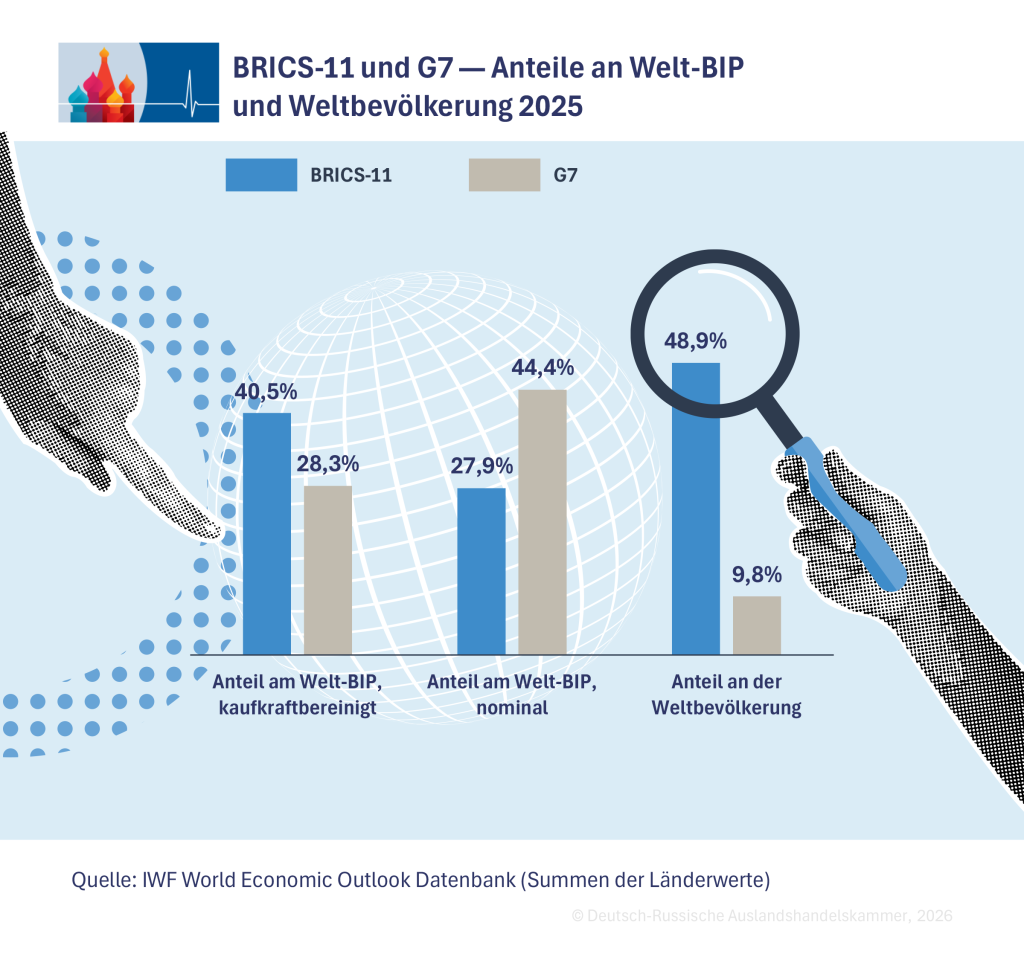
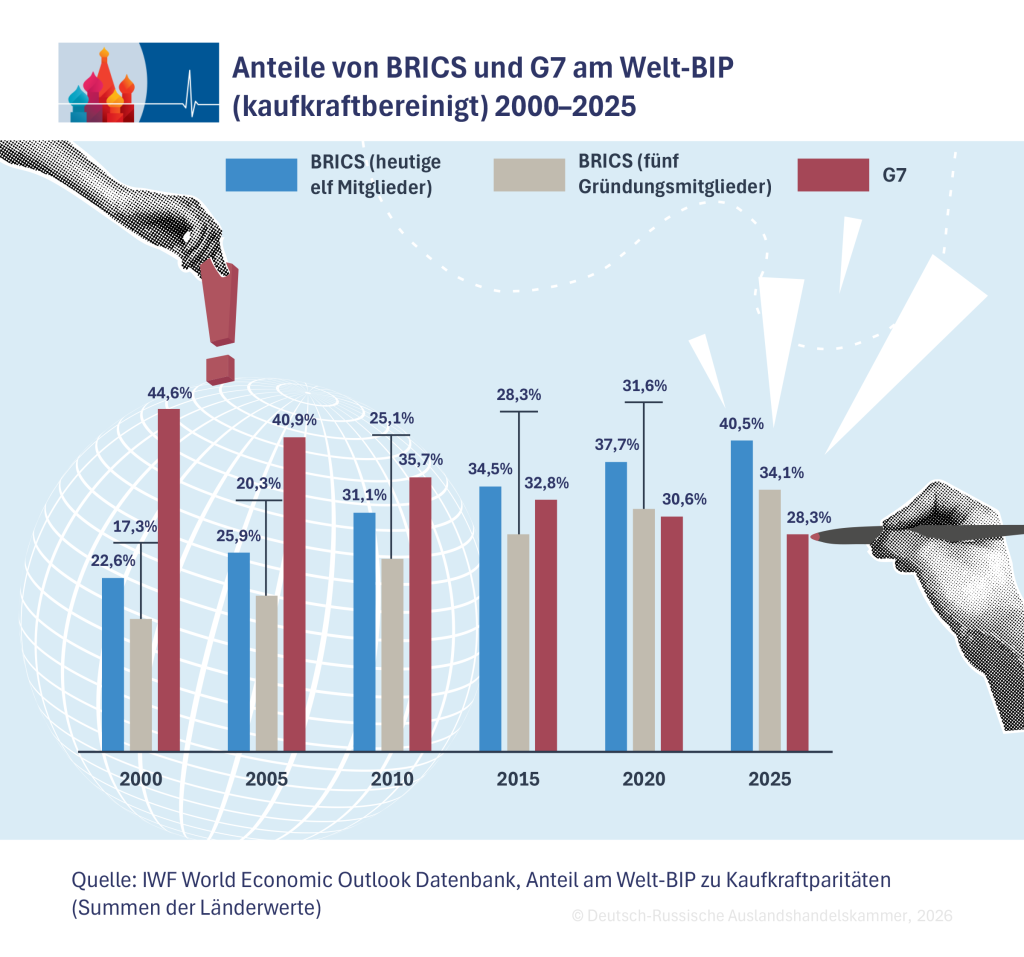
According to the International Monetary Fund’s database, the BRICS countries account for 48.9% of the world’s population and, in terms of purchasing power parity, 40.5% of the global economy, while the G7 accounts for 28.3%. At their 18th summit in New Delhi, which concluded on Sunday, the eleven members of the group barely translated this influence into joint decisions.
The 140 paragraphs of the Delhi Declaration condemn unilateral tariffs and secondary sanctions without naming the U.S. On artificial intelligence—the focus of India’s presidency—the declaration refers to the decisions made at the 2025 Rio summit and sets no new standards. The joint payment system, which has been under discussion since 2024, remains the task of a working group that is to “continue the discussions.” The group did not admit any new members. China will assume the presidency next year.
Background: The largest BRICS summit since the group’s founding
Eleven members, ten partner countries, and UN Secretary-General António Guterres gathered in New Delhi on September 12 and 13.
Vladimir Putin traveled with Foreign Minister Sergey Lavrov and about 300 business representatives, reported the Moscow business newspaper Kommersant. Xi Jinping visited India for the first time since 2019, while Iranian President Massoud Peseshkian visited for the very first time. Brazil, three weeks before its presidential election, sent only Foreign Minister Mauro Vieira, and the United Arab Emirates sent Crown Prince Khaled bin Mohammed.
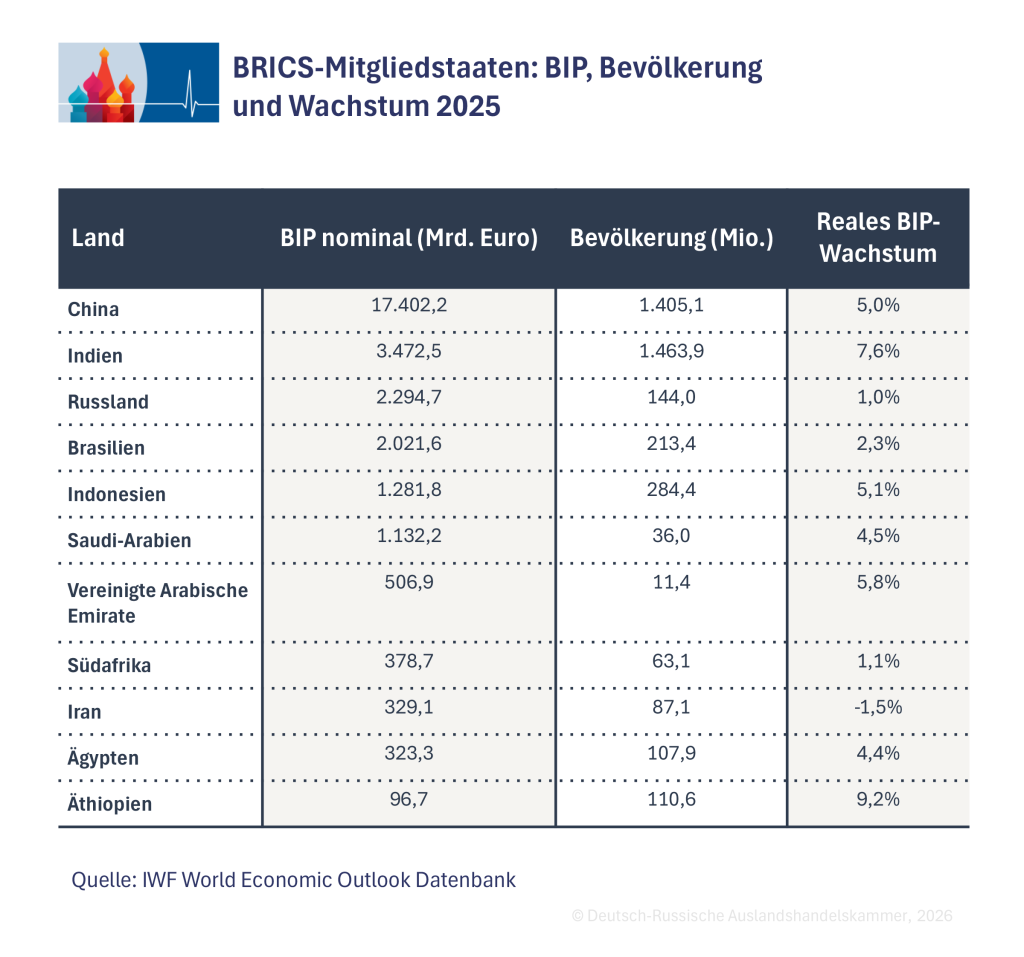
The joint statement was only finalized after an all-night session. In May, the foreign ministers’ meeting ended without a final document because Iran and the United Arab Emirates could not agree on wording regarding the Middle East. According to the Indian news agency PTI, the “sherpas”—that is, the chief negotiators—negotiated until 4:00 a.m.
Paragraph 28 of the declaration this time calls for “the greatest possible restraint” in the Middle East and urges ensuring “the smooth flow of global trade, supply chains, and energy supplies.” On the sidelines, Iranian President Peseschkian and UAE Crown Prince Khaled met for the first time since the start of the war. The Emirati news agency WAM cited de-escalation and regional stability as the topics of their discussion.
Putin used the plenary session to settle scores with the West. “The formation of a multipolar world is not without difficulties,” he said, according to the Kremlin transcript. “It faces resistance from those who are accustomed to thinking in colonial terms, dividing the world into a ‘blooming garden’ and a ‘wild jungle,’ and living at the expense of others.” All means are being employed: “Trade wars, illegitimate sanctions, attempts at economic coercion and blackmail, interference in internal affairs, and outright rudeness.”
National currencies dominate Russia’s trade with BRICS countries
90% of all Russia’s payments with BRICS countries are conducted in national currencies. Kremlin spokesperson Dmitry Peskov cited this figure on September 8 in a statement to the RIA Novosti news agency. Russia is not pursuing a targeted de-dollarization policy. “Since they won’t let us use their currencies, we’re using ours,” Peskov explained.
About 96% of trade in goods between Russia and India is conducted through rupee-ruble mechanisms, said Ivan Nosov, head of Sberbank’s branch in India. According to Russian figures, trade between Russia and India reached $58.6 billion in 2025, equivalent to 52 billion euros. In the first half of 2026, it was 8% higher than in the same period the previous year, according to Yuri Ushakov, the Russian president’s foreign policy advisor.
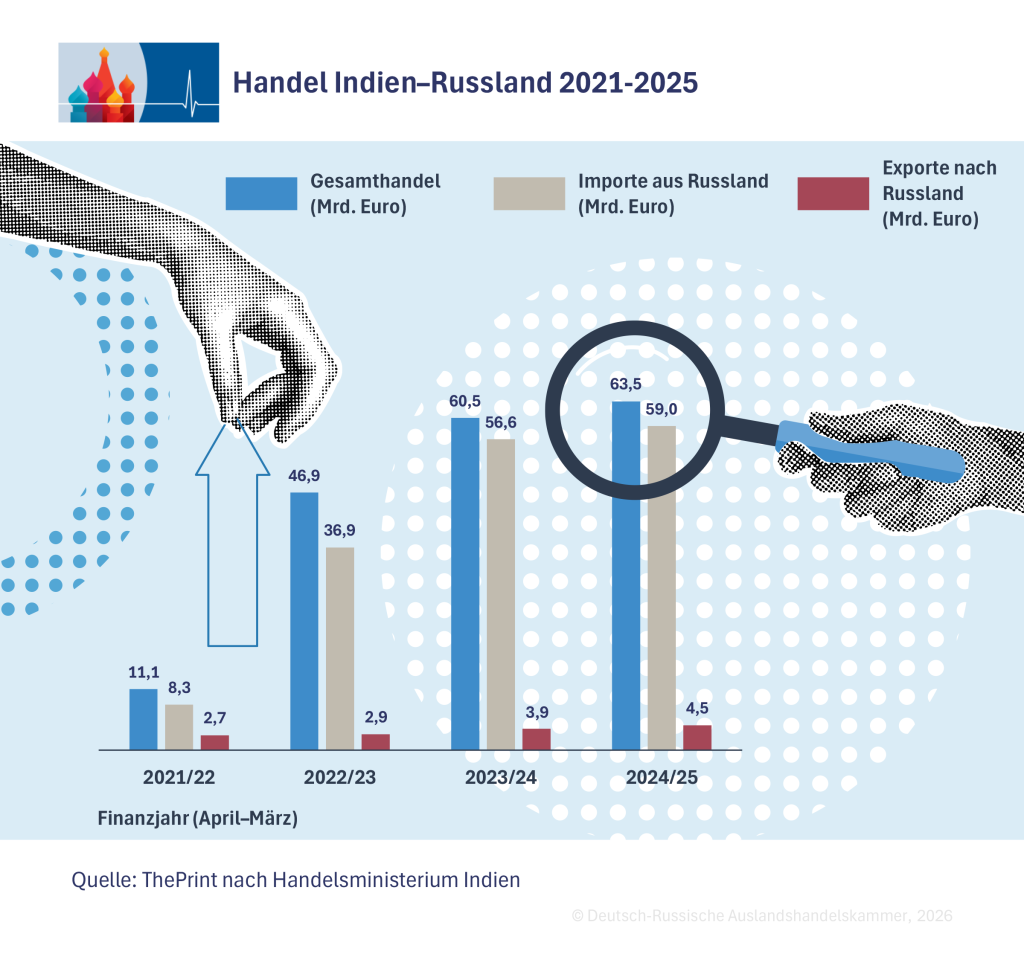
Indian statistics, however, reveal the imbalance: In fiscal year 2024/25, India imported $63.8 billion worth of goods from Russia (59.0 billion euros), including $56.9 billion worth of crude oil, and exported only $4.9 billion worth of goods. On September 11, Modi and Putin set a target of $100 billion in trade by 2030, equivalent to 86.3 billion euros.
According to data from market analyst Kpler, India imported 2.6 million barrels of Russian crude oil per day in July and 2.1 million barrels in August, reported the Indian business newspaper Business Standard. In July, Russia accounted for 51% of India’s crude oil imports for the first time, according to the Reuters news agency.
Oil: China Is the Main Market, Russia the Largest Supplier
Oil is the economic linchpin of the group. The BRICS countries account for more than 43% of global oil production and 44% of reserves; for natural gas, they account for around 36% of production and 53% of reserves, according to the Frankfurter Allgemeine Zeitung. Paragraph 64 of the Delhi Declaration accordingly states that fossil fuels will “continue to play an important role in the global energy mix, particularly for emerging and developing countries.” “Trade in oil and gas among the BRICS countries has intensified significantly in recent years,” comments Tatiana Mitrova of Columbia University’s Center on Global Energy Policy. She attributes this not to integration within the group, but to the crises in the oil market: “BRICS is a very artificial alliance of countries that have little in common.”
China is the center of gravity for this trade. In 2025, the People’s Republic consumed about 17 million barrels of oil per day; only the U.S. consumed more. According to data from the Chinese Customs Administration, Russia supplied 100.9 million metric tons of crude oil to China in 2025, accounting for 17.4% of China’s crude oil imports. It was followed by Saudi Arabia with 80.8 million metric tons (14.0%), Malaysia with 64.7 million metric tons (11.2%), Iraq with 64.6 million metric tons (11.2%), Brazil with 47.2 million metric tons (8.2%), and the United Arab Emirates with 37.5 million metric tons (6.5%). Four of the six largest suppliers are BRICS members.
Payment Systems: From Kazan to Rio to Delhi—No Decision Reached
In 2024 in Kazan, the heads of state and government had decided to examine “the feasibility of an independent cross-border settlement and custody infrastructure, BRICS Clear,” as an alternative to SWIFT. Russia’s proposals, BRICS Bridge and UNIT, have been considered so far.
No decisions were made in Delhi either. According to paragraph 90 of the declaration, “the work to examine the cross-border interoperability of payment and messaging channels” is noted, as are “the discussions on promoting trade settlements and investments in the national currencies of the BRICS countries, while respecting national priorities and recognizing that there is no one-size-fits-all approach.” A task force is to develop solutions that are “fast, cost-effective, more accessible, efficient, transparent, and secure.” In paragraph 94, the reference to BRICS Clear has been replaced by the intention to “examine possible suitable formats for a dialogue on settlement and custody infrastructure.”
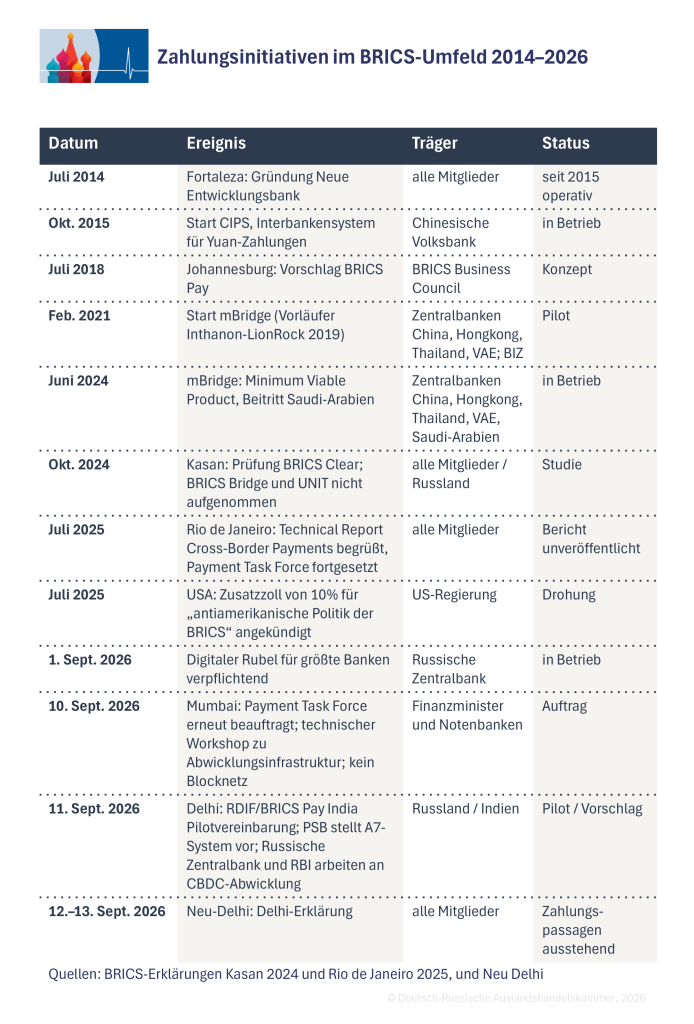
In paragraph 93, the New Investment Platform remains at the “technical level,” while the BRICS multi-guarantees in paragraph 102 are limited to “pilot transactions.” There are no targets, timelines, or a decision regarding a joint payment platform.
Kremlin spokesman Dmitry Peskov interpreted the outcome more positively on Sunday: “The declaration includes the points that are important to us: joint settlement centers, a joint investment platform, and a joint platform for settlements in national currencies,” he said. The text refers to dialogue formats and ongoing discussions. According to the Indian business daily *Business Standard*, India had advocated for bilateral links between central bank digital currencies ahead of the summit but rejected a bloc-wide network as an alternative to SWIFT as well as a common currency. The Moscow daily Kommersant concluded that BRICS Pay remains at the level of a “fintech startup.”
Since a blockchain-based solution has not materialized, Moscow is focusing its efforts on bilateral solutions with India. Sberbank CEO German Gref reported on September 11 that the Russian and Indian central banks are working on the use of the digital ruble and e-rupee in bilateral trade. In his view, this would be a breakthrough for faster and cheaper payments. He no longer considers the surplus of rupees in Russian bank accounts to be a serious problem, as the funds can be invested in Indian government bonds. The digital ruble has been mandatory for Russia’s largest banks since September 1, 2026; smaller banks will follow a year later.
U.S. Tariff Policy and the Sanctioning Russia and Iran Act
The reason for India’s reluctance lies in Washington. In July 2025, Donald Trump announced additional tariffs of 10% on supporters of the “anti-American policies of the BRICS.” Paragraph 21 of the Delhi Declaration responds with “serious concern over the increase in unilateral tariff and non-tariff measures that distort trade and are inconsistent with WTO rules,” and in paragraph 22 condemns “unilateral coercive measures that contravene international law, including unilateral economic sanctions and secondary sanctions.” The criticism is directed at the U.S., though it does not explicitly name the country.
The Sanctioning Russia and Iran Act is on the agenda of the U.S. House of Representatives on September 14, the Reuters news agency reported. The Senate had passed the bill in August by a vote of 86 to 11. It authorizes the president to impose tariffs of up to 500% on Russian goods and up to 100% on imports from the five largest importers of Russian oil and gas. China and India are specifically named in the text. Trump may suspend the tariffs, but is not required to do so. For New Delhi, this means that any wording in the Delhi Declaration that could be interpreted as the establishment of a BRICS payment system to rival the dollar would have served as evidence in Washington of the “anti-American policy” that Trump had cited to justify his 2025 tariff threat.
India has therefore chosen a path that continues settlement in local currencies without explicitly naming them: links between individual central banks operate outside the U.S. banking system, bear no BRICS name, and do not appear in any declaration as a common currency or common network.
Carbon Border Adjustment Mechanism: Criticism of Brussels
In paragraph 108, the BRICS members reject “unilateral, punitive, discriminatory, and protectionist measures that are inconsistent with international law, such as carbon border adjustment mechanisms.” Such measures undermine developing countries’ efforts to combat the effects of climate change. Paragraph 21 refers to “protectionism under the guise of environmental goals.” This refers to the EU’s carbon border adjustment mechanism, which has been in effect in its final form since January 1, 2026: Importers of cement, iron and steel, aluminum, fertilizers, electricity, and hydrogen must purchase and surrender allowances for the emissions contained in the product.
Artificial Intelligence: A Call for Its Own Rules, but Little Substance in the Resolution
Russian Deputy Foreign Minister Sergey Ryabkov announced on September 7 that the BRICS countries would take a stronger stance on artificial intelligence than the G7. The declaration, in paragraph 81, remains a voluntary commitment: “We commit to implementing the BRICS Heads of State and Government Declaration on the Global Governance of Artificial Intelligence.” This refers to the Rio 2025 document, which relies on the United Nations as a framework and emphasizes national regulatory sovereignty.
On September 3, legal scholar Hriday Sarma, who researches energy issues in Greater Eurasia, described what is at stake from an Indian perspective in the Russian journal *Russia in Global Affairs*. “In the emerging digital order, the Global South will have to develop rules rather than follow those developed by other countries,” writes Sarma.
According to his data, 98% of subsidies for AI-related goods flow to high-income countries. Private AI investment in 2025 amounted to $285.9 billion (€253.5 billion) in the U.S. and $12.4 billion (€11.0 billion) in China. Sarma proposed a four-part agreement for the Delhi Summit: common principles for cross-border data transfers; compatible standards for labeling synthetic content based on the Chinese model; a common position on the protection of intellectual property in model training; and minimum requirements for security and incident reporting for high-performance AI systems.
None of the four elements appear in the declaration. The closest reference is in paragraph 120, which acknowledges “risks of appropriation and misrepresentation of knowledge, heritage, and cultural values” in datasets and AI models.
German and Western Assessments: An Alliance Lacking Clout
German and Western analysts interpret the Delhi Declaration as evidence of the limitations of the BRICS group of nations.
Rolf Langhammer of the Kiel Institute for the World Economy described BRICS+ in April 2026 as a “fair-weather event.” He wrote: “The desired multipolarity is not over. It has merely receded further into the distance.” South Asia expert Chietigj Bajpaee explained four days before the summit that, from New Delhi’s perspective, the group was moving “in the wrong direction” and needed “more substantial results” than mere declarations. He sees the dividing line between Brazil and India on one side—which view the BRICS as an economic project—and China and Russia on the other, which use the BRICS for geopolitical purposes. India has reframed the debate over moving away from the dollar as one about transaction costs in bilateral trade. Other experts note that expectations for the group “often exceed what it can realistically deliver.” The CIPS and SPFS transaction systems are “far from” being able to compete with SWIFT’s more than 11,000 affiliated banks, and the move away from the dollar is happening “slowly and gradually.”
The German press focuses on India–China relations. The Handelsblatt interprets Xi’s first trip to India in seven years as a continuation of a rapprochement forced by Trump’s tariff policy: Following the clashes along the disputed Himalayan border in 2020, New Delhi had suspended visas, canceled direct flights, and banned Chinese apps such as TikTok. The summit serves as an opportunity for both sides to normalize relations.
The news portal t-online sees the real power struggle of the summit as taking place between the current host, India, and the future host, China. China wants to position the BRICS as a counterweight to the U.S. and strengthen the yuan through shared financial systems. India wants to maintain a forum of the Global South that is neither Western nor anti-Western.
China’s trade surplus with India of more than $100 billion (88.7 billion euros) is a strategic problem for New Delhi, according to t-online, and Russia is increasingly unable to provide a counterbalance because it is economically dependent on Beijing. The litmus test will come in 2027: With the chairmanship, “Beijing can set the agenda itself and drive initiatives forward,” and India must show whether it has limited Chinese influence or merely postponed it.
In a study by the Friedrich Naumann Foundation dated August 27, FDP foreign policy expert Bijan Djir-Sarai draws the following political conclusion: Europe must “make a better offer to the countries of the Global South than the BRICS” and ratify the EU trade agreement with India.
Source: German-Russian Chamber of Foreign Trade, BRICS Summit: United Against Tariffs and Sanctions, Divided on Artificial Intelligence, September 15, 2026.
This article was prepared for the German-Russian Chamber of Foreign Trade.