Minister Raises GDP Forecast for 2026 to 0.6 Percent — Bucking the “Trend”
Author: Klaus Dormann
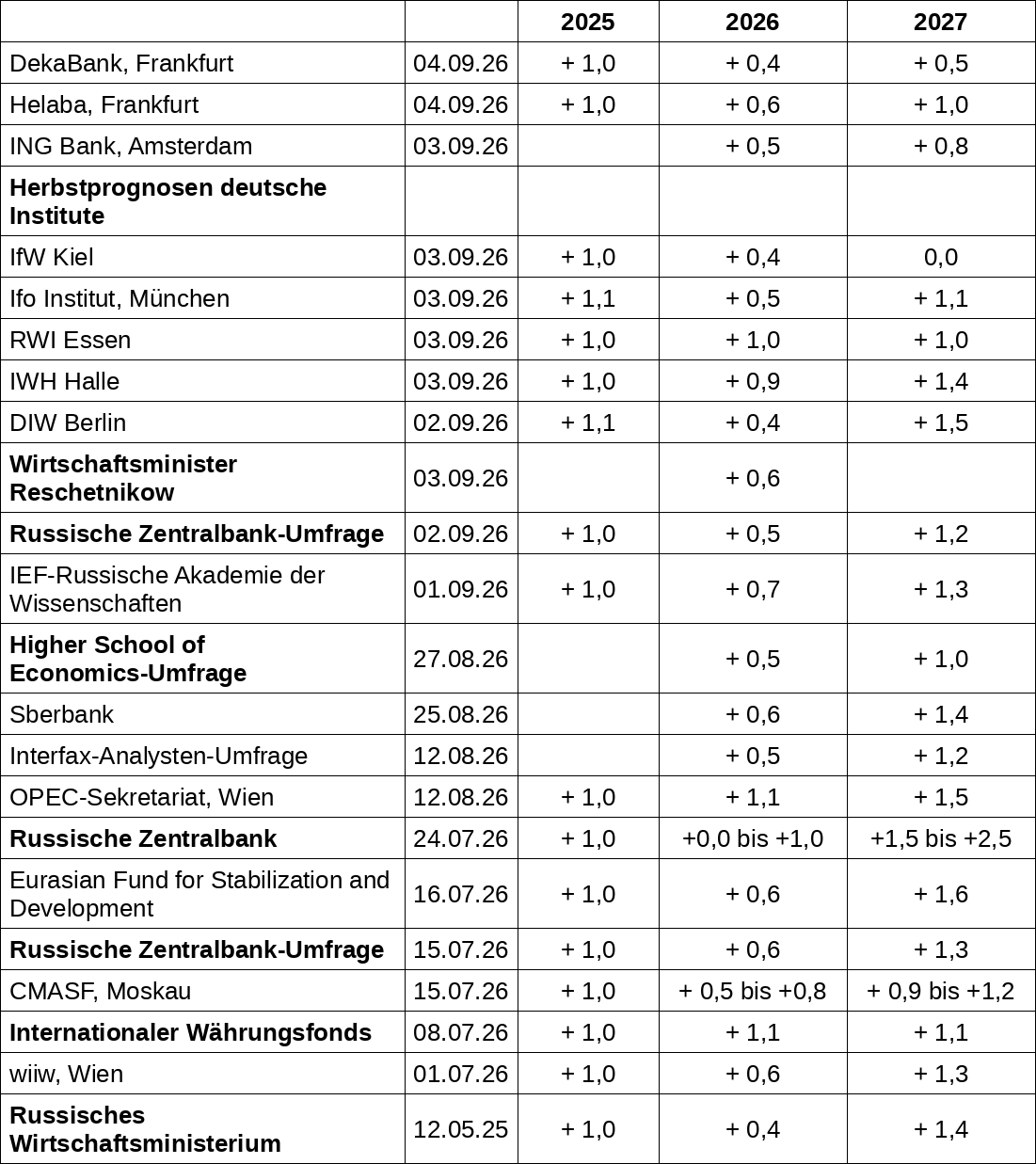
In May, the Russian Ministry of Economic Development unexpectedly lowered its forecast for this year’s Russian economic growth sharply, from 1.3% to 0.4%. At the time, very few experts had anticipated such weak growth. However, Economy Minister Reshetnikov has now raised this forecast slightly to 0.6%. He announced this at the Eastern Economic Forum in Vladivostok.
Most growth forecasts from banks and research institutes, however, continue to show a slow “decline.” The median of forecasts in analyst surveys conducted by leading institutions recently fell to just 0.5%. The ministry’s new economic forecasts are scheduled to be published in full in mid-September to serve as the basis for budget deliberations.
Growth of 0.6 percent was achieved in the first seven months
By slightly raising the GDP forecast, the minister likely also aims to boost sentiment in the Russian economy. He was likely encouraged by the fact that, according to the ministry’s estimates, total economic output in the first seven months was still 0.6% higher year-over-year (despite a 0.2% decline in the first quarter).
At the same time, however, the inflation rate is falling more slowly than expected, and the budget deficit is likely to be much higher than planned this year. In light of growing criticism, including from within the Russian business community, President Putin once again firmly defended the course of Russia’s monetary and fiscal policies in Vladivostok.
The analysts’ “consensus” for 2026, however, has fallen to 0.5% growth
According to recent analyst surveys, real gross domestic product growth in 2026 will be slightly lower than the minister’s new forecast, at just 0.5%. This is partly the result of the Russian Central Bank’s analyst survey published in early September. A survey published in late August by the Economic Research Institute at Moscow’s “Higher School of Economics” also indicates that growth of only 0.5% is now expected.
For next year, analysts in both surveys expect only a slight acceleration in growth. The HSE survey anticipates a return in 2027 to the 1.0% growth rate achieved in 2025. Participants in the Central Bank survey expect economic growth of 1.2% next year.
GDP Forecasts for Russia, 2025–2027
Year-over-year change in real gross domestic product, in percent
According to the surveys, Russia’s growth will remain weak by global standards in 2028 and 2029 as well. In 2029, it will reach 1.8% according to the Central Bank survey and 1.7% according to the HSE survey.
The Institute for Economic Forecasting of the Russian Academy of Sciences (IEF-RAS) continues to expect 0.7% growth
In its forecast updated in early September, the Institute for Economic Forecasting of the Russian Academy of Sciences (IEF-RAS) maintains growth expectations that are similarly low to those of three months ago. It continues to assume that real gross domestic product growth will slow to 0.7% in 2026. The institute has raised its growth forecast for 2027 from 1.1% to 1.3% (GDP, first row of the table below).
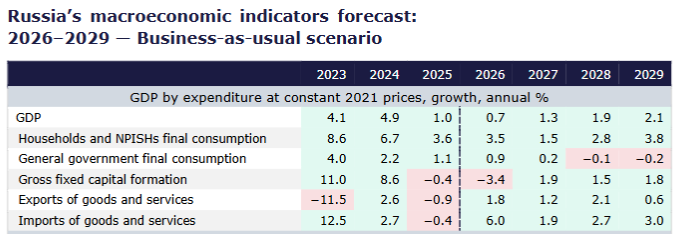
IEF-RAS: Quarterly Forecast of Macroeconomic Indicators of the Russian Federation, Excerpt; September 1, 2026
According to the IEF forecast, the drivers of growth in 2026 will be private household consumption (+3.5%) and government consumption (+0.9%). Gross fixed capital formation, on the other hand, will decline significantly (-3.4%). Nor is any growth stimulus expected from the “external sector.” Exports are rising much more slowly (+1.8%) than imports (+6.0%).
IfW Kiel: “The Russian Economy Is Increasingly Under Strain”
In its forecast for global economic development published in early September, the Kiel Institute for the World Economy describes the current state of the Russian economy in the second and third quarters of 2026 as follows:
“The Russian economy is increasingly under strain. Although the Federal State Statistics Service reported a surprisingly strong economic expansion for the second quarter—with gross domestic product rising by 1.3 percent year-over-year, following a 0.2 percent decline in the previous quarter—
However, it is questionable whether this increase can be sustained. This is because the economic fundamentals have weakened significantly. Fiscal reserves are largely depleted, the banking system is coming under increasing pressure, and resources are being diverted on an ever-larger scale to the continuation of the war against Ukraine.
Most recently, the direct consequences of the war have also hampered economic activity. In July and August, a successful Ukrainian drone campaign targeting oil and gas infrastructure, logistics centers of major online retailers, and maritime traffic likely dealt a severe blow to the economy.
A sharp decline in oil refinery production has led to nationwide fuel shortages; the loss of large quantities of merchandise has left numerous small retailers bankrupt and reduced the population’s ability to consume; and attacks on ships and port facilities have hampered exports and supply chains in some parts of the country. As a result, aggregate economic output in Russia is likely to have fallen noticeably in the third quarter.”
The IfW Kiel forecasts that Russia’s economic growth will fall to 0.4% this year. In contrast, the RWI Essen expects the Russian economy to return to growth of 1.0% in 2026.
According to the Kiel Institute, Russia’s gross domestic product will stagnate completely in 2027. The Berlin-based DIW, however, expects growth to accelerate from 0.4% in 2026 to 1.5% in 2027.
Russian Central Bank: “What the Trends Say”
In the run-up to its next key interest rate decision on September 11, the Russian Central Bank again published the report “What Do the Trends Say” from its “Department of Research and Forecasting” in early September, addressing current macroeconomic developments. The report contains a remarkably high number of references to the impact of the war in Ukraine on production and prices. The press release accompanying the report and the “Executive Summary” (published in English) highlight, among other things, the following trends in inflation and growth.
The seasonally adjusted rate of price increase remained at around 11½ percent in July
In July 2026, the year-over-year increase in the consumer price index slowed slightly to 5.98 percent, according to a July 12 announcement by the Federal State Statistics Service (Rosstat) (down from 6.02 percent in June, Finmarket.ru).
However, according to the Central Bank’s data, the inflation rate is nearly twice as high when calculated “at the current margin” by extrapolating the seasonally adjusted month-over-month increase in the Consumer Price Index in July (compared to June) to an annual rate. This seasonally adjusted annual rate (SAAR) rose to 11.6% in July for all goods and services (June: 11.4%). This is shown by the gray bars in the following figure from the central bank’s press release.
Seasonally Adjusted Consumer Price Trends
Seasonally adjusted month-over-month changes extrapolated to an annual rate
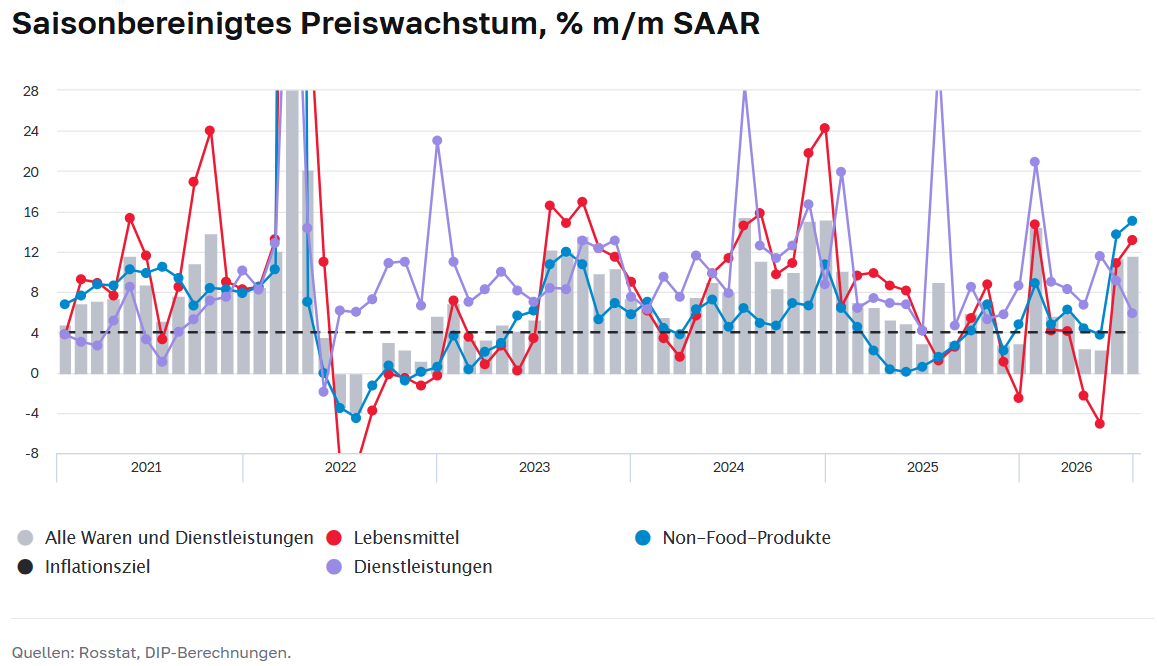
Bank of Russia, News: Talking Trends: Price and GDP Growth Driven by Transitory Factors, September 1, 26
The annual rate of price increases for non-food items (blue line: 15.1%) and food (red line: 13.2%) accelerated further in July. By contrast, the rate of price increase for services fell again (purple line: 5.9%).
Central Bank: “One-time factors” and the weak ruble are driving inflation
According to the Central Bank, the sharp rise in consumer prices continued in August as well. Regarding the causes, the Central Bank states that the high level of inflation is still largely attributable to “one-time inflation drivers” on the supply side (rising prices for fuel as well as for fruits and vegetables).
However, “general inflationary pressure” also increased during July and August. The Central Bank points out that, as a result of higher fuel prices, there are “second-round effects” on price trends in sectors that use fuel.
In addition, the weakening of the ruble exchange rate is driving up prices. In the spring months, however, the ruble’s appreciation had actually dampened inflation.
According to the central bank, inflation expectations among households and businesses—which had risen sharply in July—did decline in August. However, they remain above the average level seen in the first half of the year.
“Moderate economic growth” continues
According to the Central Bank, the preliminary estimate for GDP growth in the first half of the year is 0.6% year-over-year. It notes that the Russian economy is continuing its “moderate growth” overall—with the exception of those sectors where production capacity and infrastructure have been “damaged.”
In the third quarter, according to the Central Bank, a slowdown in seasonally adjusted growth of the Russian economy is possible, although economic sectors are likely to continue to perform very differently. Growth continues to be concentrated in sectors focused on “public contracts.” However, a clear upward trend is also emerging in the investment and consumption sectors.
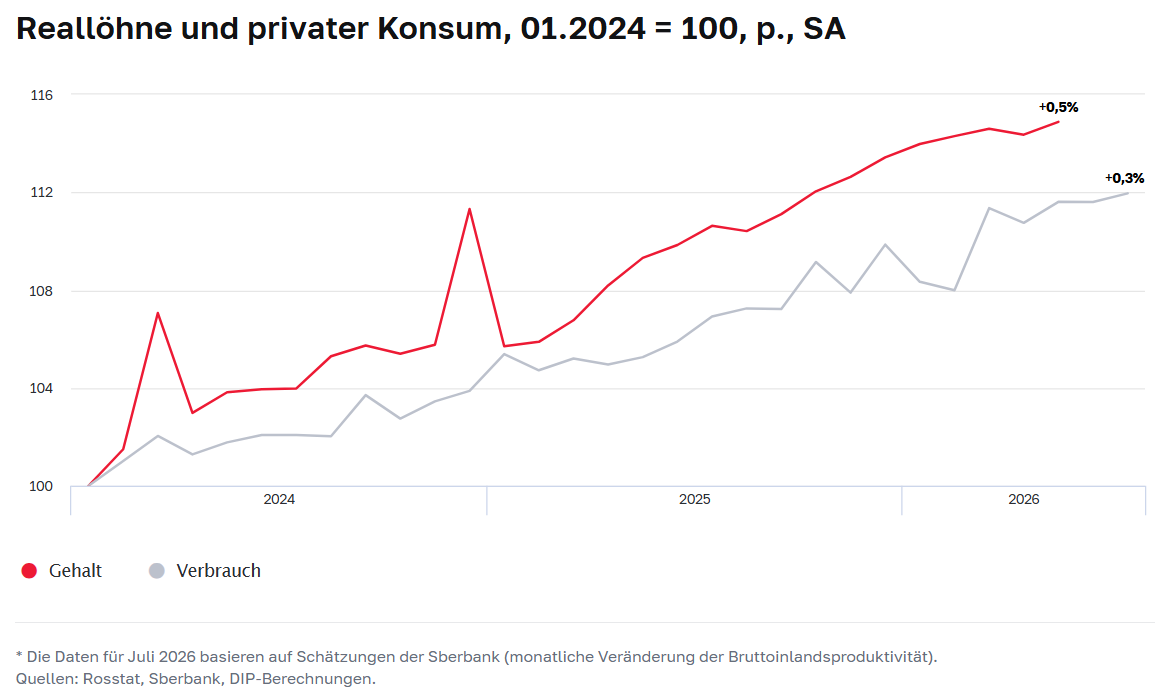
Despite modest wage increases, private consumption is growing strongly
The Central Bank notes a “sustained, gradual normalization of the labor market.” Wage growth has slowed both in nominal and real terms. The gap between wage increases and productivity growth has narrowed.
At the same time, however, domestic demand continues to grow. Signs of this include, among other things, high levels of lending to businesses and growth in private consumption in July and August.
According to the central bank’s assessment, the growth in household consumption points to a gradual decline in the savings rate. The central bank cites “increased uncertainty” in general as a possible cause. The increase in purchases of durable goods by private consumers could be driven by “precautionary motives.” However, the declining savings rate is also attributable to the interest rate cuts over the past six to twelve months, combined with the renewed rise in inflation expectations in July and August.
The following chart from the central bank shows the seasonally adjusted trend in real wages through May 2026 and in private consumption through July 2026.
Seasonally Adjusted Trends in Real Wages and Private Consumption
January 2024 = 100
Bank of Russia, News: Talking Trends: Price and GDP Growth Driven by Transitory Factors, September 1, 2026
Central Bank Deputy Governor: The scope for interest rate cuts has narrowed
The Central Bank will decide on the future path of the key interest rate on September 11. At the end of July, it had lowered the key interest rate by only 0.25 percentage points, from 14.25 percent to 14 percent.
Central Bank Deputy Chairman Alexei Sabotkin stated in late August, during the presentation of the monetary policy guidelines for 2027 through 2029, that the scope for further interest rate cuts has narrowed. As early as July, the central bank had already recognized that its options for easing monetary policy were limited. It therefore raised its interest rate forecasts for this year and next.
The current “fuel crisis” is complicating efforts to curb inflation. Rising gasoline and diesel prices are not only having a direct impact on the consumer price index; through transportation, production, and delivery costs, higher fuel prices are also driving up the cost of other goods (russland.capital).
Central Bank Survey: Higher Inflation and Slower Growth Expected
In the central bank’s analyst survey conducted at the end of August, participants further lowered their forecasts for Russian economic growth, presumably largely due to the Ukrainian attacks on Russian refineries and storage facilities. Despite the weaker growth, however, they also expect higher inflation rates than previously anticipated.
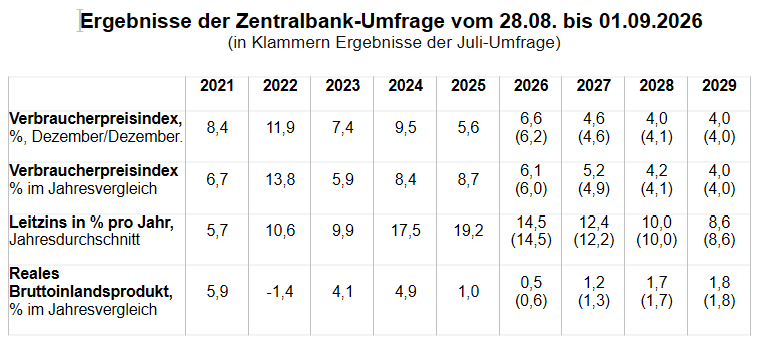
On average, analysts have raised their forecast for the rise in consumer prices by the end of 2026 to 6.6% (July survey: 6.2%). By the end of 2027, they still expect the inflation rate to fall to 4.6%. For 2026, analysts now expect an average annual inflation rate of 6.1% (July survey: 6.0%). In 2027, prices are expected to rise by 5.2% (July survey: 4.9%).
Analysts continue to estimate the average annual key interest rate for 2026 at 14.5%.
Compared to the July survey, participants have slightly lowered their forecasts for economic growth in 2026 and 2027. In 2026, the economy is expected to grow by only 0.5%, and in 2027 by 1.2%.
Bank of Russia: Macroeconomic Survey of the Bank of Russia, September 2, 2026
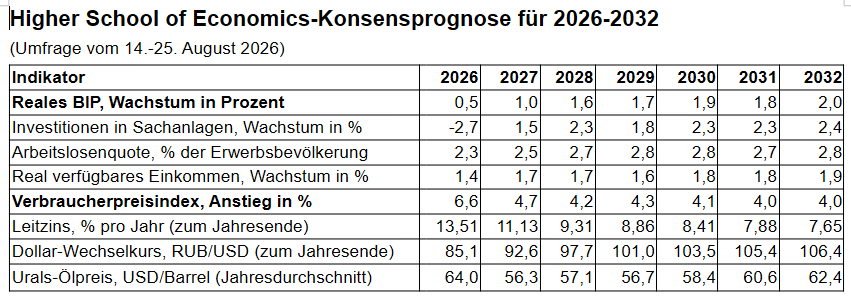
Long-term economic outlook through 2032 according to the HSE survey
The above results of the Central Bank’s survey regarding the outlook for inflation, the key interest rate, and growth largely align with the results of the analyst survey conducted by Moscow’s “Higher School of Economics” in the second half of August.
The HSE survey indicates the following long-term outlook for the development of the Russian economy over the next six years: Economic growth will rise to 1.0% in 2027 and will not reach 2.0% again until 2032. Investment will grow at a similarly slow pace—following a decline in 2026. The low unemployment rate will rise to 2.8% by 2029 and then remain virtually unchanged. Real disposable income will increase annually by between 1.4% and 1.9%. Starting in 2028, the rise in consumer prices will be barely higher than the inflation target of 4%. The key interest rate will not fall below 10% at the end of the year until 2028. Starting in 2029, the ruble will depreciate against the dollar at a slower rate than in 2027 and 2028. The annual average price of Urals crude oil will be around $60 per barrel through 2032.
Higher School of Economics, Analyst Survey Aug. 14–25, 2026: Consensus Forecast; Aug. 27, 2026
Where will Russia’s economy stand in the summer of 2026?
Last week, the German business magazine russland.capital highlighted the following developments regarding inflation, growth, and investment in articles dated September 2 and 4 covering the “Eastern Economic Forum” in Vladivostok:
Monetary policy has remained extremely restrictive to date. Despite several cuts, the key interest rate still stands at 14%. The annual inflation rate stood at 6% in July, well above the central bank’s target of 4%. The central bank expects the inflation rate to be between 6 and 7% by the end of 2026. As a result, loans remain expensive for businesses and consumers.
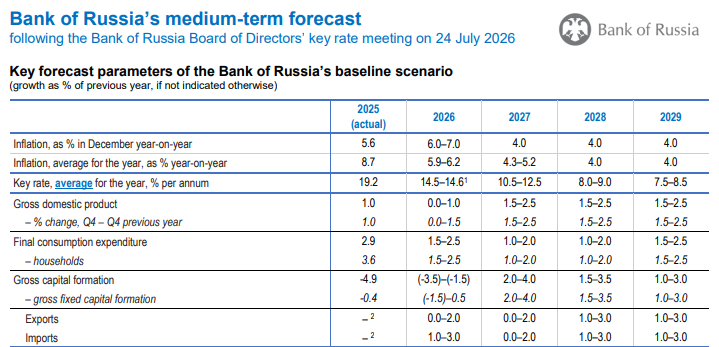
According to the Russian Central Bank’s July 2026 forecast, gross domestic product is expected to grow by only zero to one percent (fourth row in the table below).
For gross fixed capital formation, the central bank’s forecast range for 2026 extends from a decline of 1.5% to a minimal increase of 0.5%. Total capital formation (“gross capital formation”) could even decline by 1.5 to 3.5 percent.
Medium-Term Forecast of the Russian Central Bank (Excerpt)
Russian Central Bank: Bank of Russia’s medium-term forecast following the Bank of Russia Board of Directors’ key rate meeting on July 24, 2026; excerpt; July 24, 2026
Sharply declining investment and an unexpectedly high budget deficit
russland.capital draws attention to the unexpectedly sharp decline in investment: According to Rosstat, investment in fixed assets fell by 9.9% in real terms in the first half of 2026 compared with the same period a year earlier. In the first quarter, the decline had been 14.3%, and in the second quarter, 6.6%. Investment had already fallen by 2.3% in 2025 (Vedomosti).
Olga Belenkaya, chief economist at the brokerage firm Finam, cites profit trends as a key reason for the decline in investment in her analysis of economic developments in July: Corporate net profit fell by 13.3% in the first half of 2026 compared to the previous year. The “manufacturing sector” recorded the largest decline (-27.1%), while net profit in the commodities sector rose by 49.6% compared to the previous year (Interfax.ru). Other causes of the weak investment were high interest rates on loans, a lack of equity capital, and insufficient customer demand.
According to russland.capital, based on preliminary data from the Ministry of Finance, the federal budget deficit rose to approximately 6.5 trillion rubles, or 2.8% of GDP, during the period from January to July. The projected deficit for the entire year was only 3.8 trillion rubles, or 1.6% of GDP.
Revenues did rise by 8.8% to 22.1 trillion rubles in the first seven months. However, expenditures rose much more sharply, by 14.5%, to 28.6 trillion rubles. The Ministry of Finance attributes part of the budget shortfall to advance payments and the early financing of government contracts.
According to russland.capital, a large portion of aggregate demand thus continues to depend on high government spending. While this has stabilized production and employment, it has simultaneously tied up labor, capital, and industrial capacity for government purposes.
Looking back at developments since the start of the war in Ukraine, russland.capital notes: Russia’s economy has weathered the sanctions imposed since February 2022, the loss of numerous Western sales and procurement markets, and the withdrawal of many foreign companies better than many observers had initially expected. New trade routes have been established. A significant portion of production has been reoriented toward the needs of the state and the defense industry.
“Adaptability,” however, “does not automatically mean healthy economic development,” russland.capital emphasizes.
President Putin defended monetary and fiscal policy in Vladivostok
President Putin also participated in the economic forum in Vladivostok. russland.capital reported on this:
“Russian President Vladimir Putin portrayed the decline in investment and the weak economy as largely intended consequences of the fight against inflation. At the Eastern Economic Forum in Vladivostok, he also defended the Central Bank’s persistently high interest rates and described the sharply rising budget deficit as ‘not critical.’
Putin said that the government and the central bank have so far managed to navigate economic policy “between Scylla and Charybdis.” On the one hand, inflation must be reduced; on the other hand, the economy must not be allowed to cool down too much. According to him, the inflation rate currently stands at 6.3 percent. There had been a risk of a much more severe spike in inflation, but it had been averted.
Putin explicitly acknowledged that investment in Russia had recently declined. However, he said this was primarily the result of the “deliberate policy” pursued by the government and the central bank to curb inflation. High interest rates, he argued, are therefore not a negative development but rather part of a necessary stabilization policy. In his words, injecting additional cheap money into the economy would be dangerous because it could accelerate inflation once again. The president argued that long-term investment planning is virtually impossible with double-digit inflation rates.”
YouTube video by russlandRU featuring questions for Putin starting at min. 44; transcript from the Presidential Administration in English
russland.capital summarizes Putin’s speech as follows:
“The president does not deny the problems: investment is falling, loans remain expensive, the economy is barely growing, and the state is spending considerably more than it takes in. However, he presents this development as a controlled maneuver. The economic slowdown does not appear to be a consequence of war, sanctions, labor shortages, and rising government spending, but rather the necessary price of a systematic fight against inflation.”
In conclusion, russland.capital states:
“Whether the government and the central bank will actually manage to navigate between Scylla and Charybdis remains to be seen. For now, at any rate, Russia is not navigating between growth and stability, but between weak investment and persistent inflation.”
Economic Performance Through July: Consumer-Oriented Sectors Drove Growth
In late August and early September, the Russian Federal State Statistics Service (Rosstat) released data on economic performance in July. Olga Belenkaya, chief economist at the brokerage firm Finam, has conducted a detailed analysis of how the key economic sectors performed in July and since the beginning of 2026.
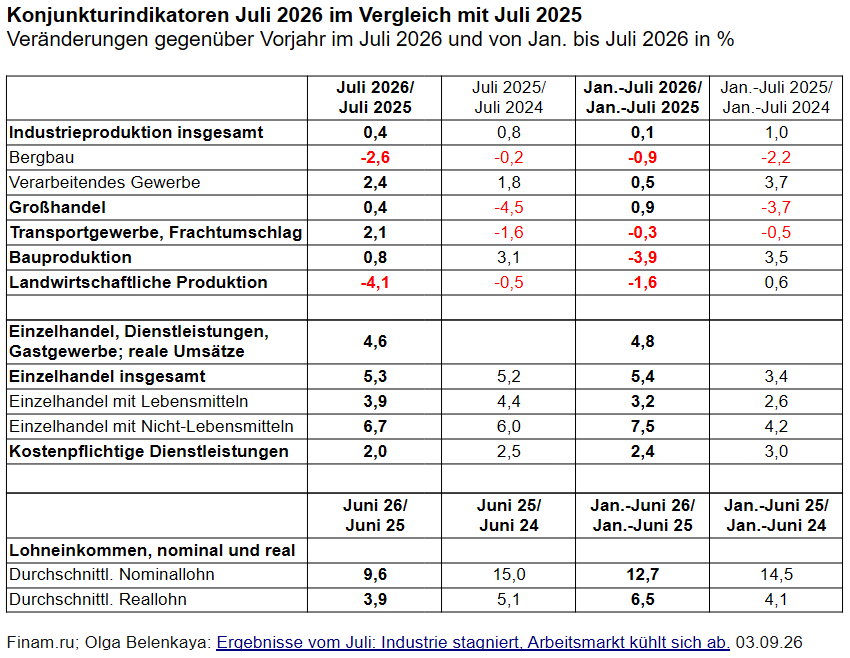
A look at the performance of the major sectors over the first seven months of the current year indicates that overall economic growth was driven primarily by trends in household consumption.
From January through July, the only sectors showing strong year-over-year growth were real retail sales (+5.4%) and the provision of fee-based services (+2.4%). According to Belenkaya, however, this growth in consumption has slowed over the course of the year. She attributes this to a weakening labor market and slower growth in real incomes.
Industrial production, on the other hand, remained virtually flat overall in the first seven months compared with the previous year, rising by only 0.1%. With production in the “mining” sector declining by 0.9%, production in the “manufacturing” sector from January through July was only 0.5% higher than in the previous year. The decline in the “Production of Coke and Petroleum Products” sector slowed only slightly in July 2026 compared to July 2025, to -19.3%. In June, production in this sector had fallen even more sharply, by 21.3%.
The increase in real wholesale sales reached 0.9% in the first seven months. At the same time, freight volume in the transportation sector fell by 0.3%.
Construction output was (given the slump in investment) nearly 4% lower in the first seven months than a year ago, while agricultural output fell by 1.6%.
Finam.ru; Olga Belenkaya: July Results: Industry Stagnates, Labor Market Cools Off, 09/03/26
The strong growth in retail and services was driven by a sharp rise in real wages. On average, they were 6.5% higher in the first six months than in the previous year. Furthermore, according to Belenkaya, people are saving less. Growth in household spending in the first half of 2026 significantly outpaced growth in cash income.
Belenkaya estimates that the Russian economy as a whole will grow by 0.3 to 0.8% in 2026. She expects an inflation rate of 6.5 to 7% by the end of the year. Finam’s chief economist emphasizes: Economic development will be influenced in particular by the course of the war with Ukraine, the effectiveness of countermeasures against Ukrainian attacks on infrastructure, and the time required to restore damaged production capacity.
Recommended Reading
German-Russian Chamber of Foreign Trade
- New Russian Economic Model Aims to Bring About a Turnaround, Aug. 28, 26
- Alexander Schochin: “We will never return to business as usual,” August 25, 2026
Podcasts, Videos
- Joe Blogs: Russia Confirms Damage is Spreading, Central Bank Publication “What the Trends Say”; Video, September 5, 26
- Joe Blogs: Russian Economy Enters Death Zone, Video, September 3, 2026; Analysis of an article published by “The Economist” by Alexandra Prokopenko, a fellow at the Carnegie Russia Eurasia Center in Berlin: Russia’s Economy Has Entered the Death Zone, February 16, 2026; 20min.ch published a German translation of the article: “The Russian Economy Has Entered the Death Zone,” February 25, 26
- Prof. Gerhard Mangott, University of Innsbruck, and economist Vasily Astrov (wiiw) in conversation with Eduard Steiner on the “Die Presse” podcast: Is Putin living in mortal fear? And are he and his Western opponents still acting rationally? September 2, 26
- Janis Kluge, German Institute for International and Security Affairs (SWP), on the Deutsche Welle podcast with Thomas Kohlmann: “Russia’s leadership has a real problem with the costs of the war.” Plumes of smoke rising from refineries, burning warehouses, and long lines at gas stations in many parts of Russia—how severe are the economic consequences? Audio, 25 min., Aug. 28, 26
The Economy as a Whole
- Bond Guide; Denis Kasyanchuk, author of The Bell’s weekly economic briefing: Russia: The bad news is becoming official, September 5, 2026
- russland.capital: Slowdown According to Plan: Putin Defends Investment Slump and Budget Deficit, September 4, 26
- ntv: Kremlin Chief: No Mobilization. Putin Takes Rising Government Deficit in Stride, September 3, 26
- Politkom.ru; Nikita Maslennikov: Supply and Demand: Current Balancing Factors, 09/03/26
- Vedomosti: How will Russia’s GDP growth trend until the end of the year? The Ministry of Economic Development has raised its economic growth forecast for 2026, said Maxim Reshetnikov, September 2, 2026; Tsargrad: The Ministry of Economic Development forecasts 0.6% GDP growth for Russia in 2026, September 2, 2026
- russland.capital: Russia’s Economy as a Camel: Survival Is Not Yet Growth, September 2, 2026
- Bank of Russia, News: Talking Trends: Price and GDP Growth Driven by Transitory Factors, September 1, 2026; Executive Summary: Talking Trends, Economy and Markets, Research and Forecasting Department Bulletin; Full Report: “What the Trends Are Saying”; September 1, 2026
- Institute for Economic Forecasting of the Russian Academy of Sciences (IEF-RAS): Quarterly Forecast of Macroeconomic Indicators of the Russian Federation, excerpt; September 1, 26
- Alexandra Prokopenko; Carnegie Russia Eurasia Center; Carnegie-Politika: Putin’s Failed Trilemma: Why Russia’s Economy Is No Longer Sustainable, in Russian, September 3, 2026; Alexandra Prokopenko: Putin’s Economic Trilemma. Price Stability and Growth in Wartime: This Balancing Act Has Failed. What Does This Mean for the War Against Ukraine? In: DGAP; International Politics 5, September/October 2026, pp. 84–87; August 31, 2026
- Finam.ru; Olga Belenkaya: July Results: Industry Stagnates, Labor Market Cools. The key interest rate is not expected to change significantly by the end of the year, September 3, 2026
- Finam.ru: The Ministry of Economic Development estimated Russian GDP growth at 0.6% in July and at 0.6% for the first seven months; September 2, 2026
- Interfax: Rosstat reported that Russian GDP grew by 0.6% in the first half of the year, September 2, 26
- Interfax.ru: Russian retail sales rose by 5.3% in July; September 2, 2026
- RESTAURANTOVED, a portal dedicated to the restaurant industry: Sales growth without profit; September 3, 26
- Interfax.ru: Investment in fixed assets in Russia fell by 9.9% in the first half of the year, 09/02/26
- Interfax.ru: Unemployment in Russia rose to 2.3% in July, up from 2.2% in June; September 2, 2026
- Interfax.ru: Net profit of Russian companies fell by 13.3% in the first half of the year; September 2, 2026
- CMASF: Industrial production in July 2026, Aug. 31, 26
- russland.capital: Russia’s industry is stagnating—Rosstat revises growth downward, August 30, 2026
- PSB Analytics: Industrial production in July, August 27, 2026
- Raiffeisenbank: Data revisions make industrial growth appear more modest, Aug. 27, 26
- Mezha, Kyiv: Russia’s Coke and Petroleum Product Output Fell 19.3% in July Amid Refinery Disruptions, August 27, 2026
- FocusEconomics: Russia Industrial Production July 2026, August 26, 2026
- Finmarket.ru: Industrial production rose by 0.4% in July, while it increased by 0.1% in the January–July period; August 26, 2026
- en.Kremlin.ru: Meeting with Minister of Industry and Trade Anton Alikhanov; August 26, 2026
- Bank of Russia: Macroeconomic Survey of the Bank of Russia, Analyst Survey; September 2, 26
- russland.capital: Seven Pillars on Three Pillars: Russia Seeks a New Economic Model, 09/02/26
- Moscow Times; Sergei Shelin: Russia’s Economic Doomsayers Were Wrong. So Were the Optimists. A review of the predictions made by experts from 2022 to 2026; August 31, 2026
- The New Voice of Ukraine: Russian economic boom over as GDP growth expected to plummet through 2032. Consensus forecast by Russia’s HSE Development Center, August 31, 2026
- TAZ; Mathias Brüggmann: Russia’s War Economy. Putin Targets Corporations. In Russia, authorities are now permitted to nationalize companies that do not—or have not—protected themselves against Ukrainian drone attacks, August 31, 2026
- Bond Guide: Four Years of War: What Has Become of Former Western Companies in Russia. More than 500 international companies have withdrawn from Russia since the start of the Russian invasion of Ukraine, writing off assets totaling approximately $170 billion, according to an analysis by Denis Kasyanchuk for The Bell, Aug. 29, 2026
- Deutsche Welle; Oleg Loginov, Nikita Oshuev: DW users on life in Russia: “People are mad as hell”; Official polls suggest public sentiment in Russia is deteriorating as economic pressure builds. DW asked its users to share their experiences; August 27, 2026; German version; August 30, 26
- Higher School of Economics, Analyst Survey: Consensus Forecast; August 14–25, 26; August 27, 26
Fuel Supply, Energy Sector
- russland.capital: Russia’s oil industry under double pressure: Refineries hit, tankers stay away; Aug. 30, 26
- Japan Times, Reuters: Russia’s gasoline output drops to 70% of domestic demand, August 29, 26
- russland.capital: Russia’s fuel market remains tight—gas stations call for a longer export ban, Aug. 26, 26
- iSANS: Russia’s Energy Sector in July 2026, August 24, 2026
Monetary Policy
- Bank of Russia: Macroeconomic Survey of the Bank of Russia, Analyst Survey; September 2, 2026
- russland.capital: Russia’s Central Bank Warns of Limited Room to Maneuver on Interest Rates and a Potential AI Bubble. Presentation of Monetary Policy Guidelines for 2027–2029; September 1, 2026
- Economic News: The Central Bank of the Russian Federation does not rule out a slowdown in economic growth in the third quarter, September 1, 26
- Bank of Russia, News: Talking Trends: Price and GDP Growth Driven by Transitory Factors, September 1, 2026; Executive Summary: Talking Trends, Economy and Markets, Research and Forecasting Department Bulletin; Full Report: “What the Trends Are Telling Us”; September 1, 2026
- Bank of Russia: Press Release; PDF: Monetary Policy Guidelines for 2027–2029; Aug. 31, 26
Fiscal Policy; National Budget
- Frankfurter Rundschau; Mark Simon Wolf: The War in Ukraine Is Becoming Increasingly Expensive for Russia: How Long Can Putin Afford His War Economy? September 6, 2026
- Janis Kluge, German Institute for International and Security Affairs (SWP): Russian Military Spending Soars, Upending the Kremlin’s Budget Plans; Point of View, September 4, 2026
- Kommersant: Revenue from oil and gas production halved in August, September 3, 2026
- The Moscow Times: Why the Middle East Oil Shock Failed to Save Russia’s Budget, September 1, 2026
- Der Spiegel+; Benjamin Bidder: Putin’s War Machine. Russia’s defense spending is spiraling out of control. It could reach nine percent of GDP by the end of the year; September 1, 2026
- National Security Journal; Shay Bottomley: Putin Made a Historic Mistake and the Russian Economy May Now Never Be the Same Again. Russia Is Not Bankrupt. The Kremlin Can Still Rely on Traditional Measures to Boost Funds. Instead, It Faces a Liquidity Problem, August 30, 26
Foreign Trade, Sanctions
- web.de; Dominik Bardow: Miele, Mercedes, VW. German industry is shifting production to Eastern Europe—and this has consequences; 09/01/26
- Börsenzeitung; Eduard Steiner: Impact of EU Sanctions. The Kremlin Itself Is Harming the Russian Economy More Than Brussels; August 31, 2026; Die Presse+; Eduard Steiner: New study from Moscow shows: This is how much Russia has lost due to the sanctions. Two Russian research institutes are sparking debate, September 1, 2026
- Ostdeutsche Allgemeine; Michael Maier: Trump Snubs Europeans: Suddenly, a Russian Minister Is at the Table. The U.S. invited the Russian finance minister to the G20 ministerial meeting in North Carolina. Lars Klingbeil was furious and refused to pose for a photo; Aug. 31, 26
- russland.capital: Full warehouses, empty coffers: Russia’s wheat exports remain in crisis mode; August 31, 2026
- German Committee on Eastern European Economic Relations: Growth markets in the East are boosting the economy; Tables: German trade with Eastern Europe, 1st half of 2026; Top 25 foreign trade partners, 1st half of 2026; August 25, 2026; Christian Himmighoffen: Central and Eastern Europe Offsets Export Losses in the U.S. and China; August 13, 26
Political Landscape; BR24: Russia-Ukraine War in the News Ticker
- Prof. Gerhard Mangott, University of Innsbruck, and economist Vasily Astrov (wiiw) in conversation with Eduard Steiner on the “Die Presse” podcast “Gas, Sanctions, Oligarchs”: Is Putin living in fear for his life? And are he and his Western opponents still acting rationally? September 2, 2026
- Euronext Markets; Reuters: Putin’s envoy warns that the Russian economy could go “berserk” under wartime conditions. Comments by Boris Titov to the business news outlet RBC, September 1, 2026
- Tagesschau: G20 finance ministers’ meeting. Russian minister at the table, Europeans outraged, Aug. 31, 26
Dismissal of VEB Chief Economist Andrey Klepach
- AK&M: Alexander Isakov appointed Chief Economist of VEB.RF, September 3, 2026
- The Bell: Sberbank shares chief economist with VEB, September 3, 2026
The day's most important Russian economic stories. Free, in your inbox three times a week.
Mon, Wed, Fri. Double opt-in, no tracking, unsubscribe anytime. By subscribing you consent to the processing of your email address as described in our Privacy Policy.