Despite slowing growth, the central bank is keeping its key interest rate at 14%
Author: Klaus Dormann
Ahead of its most recent key interest rate decision on September 11, the Russian Central Bank once again conducted a survey of analysts. Participants expect economic growth to halve from 1.0% in 2025 to just 0.5% in 2026. Nevertheless, the central bank decided on Friday to keep its key interest rate at 14%. It anticipates that the Russian economy will achieve “moderate” growth in the third quarter. Citing “heightened inflation risks,” it did not lower its key interest rate further, despite growing criticism of its monetary policy from academia and the business community.
Recent commentary on the latest interest rate decision, for example from bne Intellinews and russland.capital, points to potential conflicts between the central bank’s monetary policy and the government’s fiscal policy. The “Institute for Economic Forecasting of the Russian Academy of Sciences,” in the latest edition of its “Short-Term Economic Analysis,” projects Russia’s growth outlook for 2026 with a 0.8% increase in GDP , but this is somewhat more optimistic than the “consensus” among participants in the Central Bank’s survey.
However, in an analysis of the long-term development of the Russian economy since the start of the war in Ukraine, British historian Timothy Ash points out that the Russian economy—excluding the military-related sector—has fallen into a recession. While the rise in oil prices resulting from the war in Iran is “a godsend” for Russia, growth forecasts for the country remain modest. In the longer term, Ash also considers a reversal back to “significantly lower oil prices” to be possible. This would result in a “nightmare scenario” for Russia: both oil prices and Russia’s oil production would then be lower than they have been so far. At the same time, the national budget would be heavily strained by military spending amounting to 8 to 10 percent of GDP.
The key interest rate will remain at 14 percent for the time being
The Executive Board of the Russian Central Bank has thus left the key interest rate at 14%. To date, it has cut the rate in 10 steps—from 21% to 14%—by a total of 7 percentage points between early June 2025 and late July 2026. Following the last key interest rate cut in July, the Central Bank raised its forecast for the average key interest rate in 2026 to 14.5 to 14.6%.
Key interest rate in percent per year
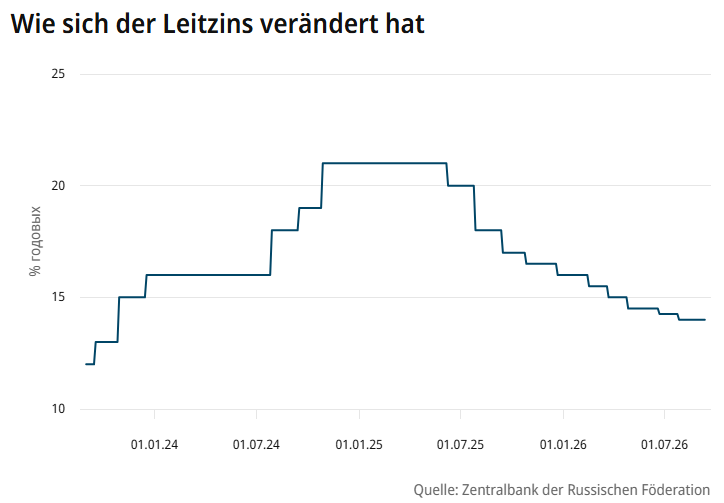
Kommersant: The Central Bank Left the Key Interest Rate at 14%; Sept. 11, 2026
In the press release regarding its latest key interest rate decision, the Central Bank argues that the Russian economy will grow “moderately” in the third quarter of 2026. However, price pressures have “increased significantly” in recent months.
Central Bank: “Core inflation” has accelerated, and inflation risks are growing
In this regard, the Central Bank points to the trend in so-called “core inflation.” This is calculated by excluding price changes caused by administrative measures or seasonal factors (Bank of Russia: Glossary “Core Inflation”). According to the central bank, this “core inflation” has recently accelerated to an annualized rate of 5 to 6 percent.
Elwira Nabiullina, the president of the Central Bank, emphasized in her statement on the key interest rate decision that “inflation risks” have intensified:
“We continue to assume that inflation risks prevail and have even intensified. After supply and demand reach equilibrium in the first half of 2026, the economy could once again fall out of balance. Demand growth is likely to remain high due to stronger fiscal policy stimulus and accelerated lending. At the same time, however, supply growth could be slowed if repairs to production facilities take longer than assumed in the baseline scenario. As a result, price pressures could intensify. High inflation expectations could further amplify these effects. Inflation risks also exist in connection with the tight labor market and external conditions.”
Ben Aris: The “supply shock” has reached consumers’ shopping baskets
According to the central bank’s press release, the main cause of the faster rise in prices is “a temporary disruption in production in some sectors.” By this, the central bank is presumably referring primarily to the decline in production resulting from damage to refineries caused by attacks on Ukraine.
In his analysis of the key interest rate decision in bne Intellinews, Ben Aris comments:
“The Ukrainian offensive has now carried a supply shock so far into consumers’ shopping baskets that the cycle of interest rate cuts has been halted.”
The central bank expects the decline in “core inflation” to resume once these effects subside and provided that growth in aggregate demand remains subdued.
The annual inflation rate rose to 6.3 percent in August
According to the statistics agency Rosstat, the year-over-year rise in consumer prices recently accelerated from 6.0% in July to 6.3% in August.
From January through August 2026, prices rose by 4.67%. During the same period last year, the increase was 3.94%.
Gasoline has seen the sharpest price increase since the beginning of 2026 (+24.64%), with a monthly increase of 0.76% (Kommersant).
In its July “medium-term forecast,” the Central Bank projects that the annual increase in consumer prices will range from 6.0% to 7.0% in December 2026. By the end of 2027, it is expected to reach the Central Bank’s inflation target of 4.0%.
Central Bank Governor Nabiullina on the Reasons for the “Pause in Key Rate Cuts”
Elvira Nabiullina commented on the acceleration of inflation in Russia right at the beginning of her statement on the key interest rate decision. She outlined the reasons why the Central Bank did not lower the key interest rate further as follows:
“The rate of price increases was high in July and August. … The accelerated rise in prices over the summer was mainly due to the situation on the fuel market. Although this is a one-time factor, it influences the prices of a broader range of goods and services. Inflation expectations also remain high. The Central Bank of Russia needs additional data to assess the extent and duration of these effects, as well as their impact on core inflation.
In addition, fiscal policy parameters are an important factor for monetary policy. They are expected to be updated by the end of September.
All of these factors contributed to the decision to postpone the key interest rate cut at today’s meeting.”
The “strongest passage” in the Central Bank’s press release
The significance of the update to the “fiscal policy parameters”—amid the current budget deliberations in the government and parliament—for the Central Bank’s monetary policy is also emphasized in the Central Bank’s press release:
“The Bank of Russia’s July baseline scenario assumes a gradual reduction of the structural primary budget deficit to zero by 2029. The fiscal policy parameters, including the path toward a balanced structural budget, will be outlined in greater detail in the October forecast after the government submits new medium-term budget projections to the State Duma. Should these forecasts assume a higher structural primary budget deficit, a more restrictive monetary policy than envisaged in the baseline scenario may be required.”
For Ben Aris, this reference to the possibility of a more restrictive monetary policy is “the sharpest passage” in the central bank’s statement. He comments on this in bne Intellinews:
“In other words: The Ministry of Finance is being told in advance that a looser budget will come at the cost of a higher policy rate. This is significant because, for the third consecutive year, Russia is running a war budget with high real interest rates, and GDP growth for 2026 is projected to be between 0% and 1%.“
Potential Conflicts Between Monetary and Fiscal Policy
russland.capital reports on how President Nabiullina commented on the interplay between monetary policy and government spending policy during the press conference (russland.ru video, starting at min. 31):
“The central bank governor directed her clearest economic policy message to the government. Under current conditions, every additional ruble of government-stimulated demand pushes an interest rate cut further into the future. Nabiullina attributed this to high capacity utilization in the economy, full employment, and persistently elevated inflation expectations. Government support, she said, therefore cannot be viewed in isolation from monetary policy.
She cited the pandemic year of 2020 as a counterexample. At that time, private demand had collapsed; government aid was able to prevent deflation and persistent unemployment. Today, she said, the situation is the reverse.
Russia.capital sees a conflict in economic policy:
“Additional government support can help individual companies or industries, but at the same time, it can keep overall borrowing costs high for longer due to increased demand.”
At the same time, russland.capital emphasizes:
“Nabiullina’s warning specifically concerns the stimulation of demand—it is not a blanket judgment on every government investment.”
Nabiullina: “Moderate growth” is in line with our forecast
In her statement, the Central Bank president summarizes the current economic trend in the Russian economy as follows:
The economy is expected to continue growing “moderately” in the third quarter of 2026. According to recent surveys, business sentiment and expectations regarding production and demand have improved slightly overall.
Consumer spending growth slowed somewhat in July but remained high.
Investment activity has gradually recovered following its weak performance in the first quarter of 2026. Major projects continue to be implemented in a number of sectors, particularly in the chemical industry, the energy sector, and the transportation vehicle manufacturing sector.
The tight labor market is gradually easing. The share of firms reporting labor shortages is declining. Wage growth has slowed slightly, but labor productivity growth remains significantly lower. For inflation to ease sustainably, the gap between labor productivity growth and wage growth must continue to narrow. Faster labor productivity growth would be desirable.
Overall, the data show that economic growth is in line with the Central Bank’s forecast (the Central Bank expects real gross domestic product to grow between 0 and 1 percent in 2026).
IEF RAS: In July, Russia’s GDP grew by 0.9% year-over-year
The “Institute for Economic Forecasting of the Russian Academy of Sciences” (IEF-RAS) expects, in its monthly “Short-Term Analysis of Gross Domestic Product Trends” published last week, that real gross domestic product will rise by 1.1% year-over-year in the third quarter.
For 2026 as a whole, the Russian economy is projected to grow by 0.8% compared to 2025.
This forecast from the monthly “Short-Term Analysis of Gross Domestic Product Trends” is slightly higher than the 0.7% growth forecast for 2026 that the IEF presented in early September in its “Quarterly Economic Forecast.”
In its “Short-Term Analysis,” the IEF estimates annual growth of the Russian economy in July 2026 at 0.9% in real terms (see the blue column on the right in the figure below). However, according to the institute, seasonally adjusted aggregate economic output in July fell by 0.4% compared to the previous month of June. This is reflected in the decline of the real gross domestic product index (black line).
Estimate of the monthly trend in real gross domestic product
Black line: Real gross domestic product index, Jan. 2019=100
blue bars: Estimate of year-over-year GDP change in percent
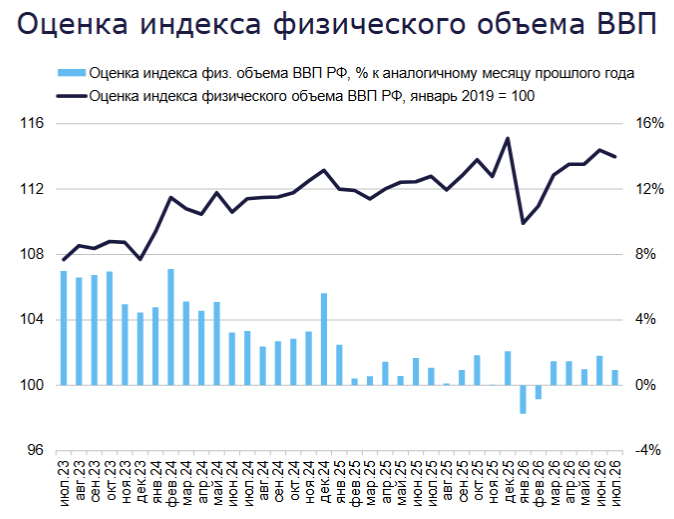
IEF RAS: Short-Term Analysis of GDP Trends; Sept. 11, 26
Timothy Ash: Russia’s Economy in the Summer of 2025 – Assessment and Outlook
In early September, British historian Timothy Ash analyzed on his blog the risks that the protracted war with Ukraine poses to the Russian economy.
Ash initially emphasizes that, for a long time after the war began, the Russian economy proved to be unexpectedly “resilient.” However, he notes that it fell into a deep crisis over the course of 2025. In summary, he points to the following deteriorations in economic growth, the national budget, and the current account balance:
Real GDP growth fell to just 1% in 2025. This was due not only to Russia’s lower revenues from fossil fuel exports, “but also to the Central Bank’s restrictive monetary policy aimed at combating high inflation.”
The budget deficit soared from 8 to 10 percent of GDP to 2.6% of GDP in 2025 due to military spending. In the course of 2026, the government began forecasting an annual deficit of nearly 5% of GDP.
The current account balance also deteriorated significantly in late 2025 and early 2026. In addition to sanctions and lower world market prices for fossil fuel exports, this was caused by Ukrainian drone attacks on Russian refineries.
The divided Russian economy is “in a deep crisis”
Ash emphasizes that a distinction must be made between the “military-industrial complex” and “the rest” of the Russian economy:
The sectors of the “war economy” are bolstered by enormous government spending and receive preferential access to resources.
“The rest of the economy,” on the other hand, has plunged into a recession amid high inflation, high interest rates, and a tight labor market. Loans are increasingly becoming nonperforming. There is a rising number of bankruptcies.
In the long term, Russia could face a “nightmare scenario”
According to Ash, the rise in oil prices resulting from the war in Iran is indeed “a godsend” for Russia. However, growth forecasts for Russia remain low. Ash cites the following reasons for the bleak outlook for the Russian economy:
Ukraine’s attacks on targets in Russia “are having an impact.”
Furthermore, Russia simply cannot finance the war in Ukraine in the long term while competing with Europe’s aid to Ukraine.
And in the long run, Ash also considers a reversal back to “significantly lower oil prices” to be possible. This would result in a “nightmare scenario” for Russia: oil prices and Russia’s oil production would be lower than before, while the national budget would simultaneously be heavily strained by military spending amounting to 8 to 10% of GDP.
Recommended Reading
German-Russian Chamber of Foreign Trade
- Eastern Economic Forum 2026: Quotes and Results, 09/08/26
- Consumption Instead of Investment: Potential Growth in Russia Higher Than in Germany, September 3, 2026
- New Russian Economic Model Aims to Bring About a Turnaround, August 28, 2026
- Alexander Schochin: “We will never return to business as usual,” August 25, 2026
Podcasts, Videos
- ZDF heute; Auslandsjournal, Felix Klauser: Shortages, Fear, and Explosions. Ahead of the September 20 elections, a persistent fuel crisis and attacks on logistics centers are taking a toll on the daily lives of many people in Russia, 8 min., September 9, 2026
- Janis Kluge, German Institute for International and Security Affairs (SWP), on the Deutsche Welle podcast with Thomas Kohlmann: “Russia’s leadership has a real problem with the costs of the war,” columns of smoke rising from refineries, burning warehouses, and long lines at gas stations in many parts of Russia. How severe are the economic consequences? Audio, 25 min., Aug. 28, 26
Monetary policy; key interest rate decision on September 11
- russland.capital: Expensive Gas, Expensive Loans: Russia’s Central Bank Pauses Interest Rate Cuts; featuring a russland.ru video of the Central Bank’s press conference, September 12, 26
- russland.news; Video: Central Bank President on monetary policy; press conference on the results of the Monetary Policy Committee meeting. Participants include Bank of Russia Governor Elvira Nabiullina and Bank of Russia Deputy Governor Alexei Zabotkin; September 12, 2026.
- bne intellinews, Ben Aris: Russia’s Central Bank Stops Cutting Rates and Blames the Refineries, September 11, 2026
- Finam.ru; Olga Belenkaya: Why did the Russian Central Bank leave the interest rate at 14%? What will shape decisions for the rest of the year? 09/11/26
- Finam.ru; Olga Belenkaya: The Russian Central Bank expects a pause in key rate cuts and a toughening of rhetoric. The regulator has once again failed to provide a clear signal regarding future measures. September 11, 2026
- Kommersant: Rosstat: The annual inflation rate rose to 6.33% in August; 09/11/26
- Kommersant; Erdny Kagaltynov: Nabiullina on the sharp rise in prices, the fuel crisis, and attacks by Ukrainian forces on logistics, September 11, 2026
- Moscow Times: Russian Central Bank Holds Key Rate at 14%, September 11, 2026
- Meduza.ru: Russia’s Central Bank Holds Key Rate at 14% for the First Time Since 2025, Sept. 11, 2026
- Fokus-Pocus: Central Bank Meeting: A Pause, Not the End of Easing, September 11, 2026
- Hard Numbers: Press Conference of the Central Bank of Russia: Summary, September 11, 2026
- Bank of Russia: Statement by Bank of Russia Governor Elvira Nabiullina following the Board of Directors meeting on September 11, 2026, September 11, 2026
- Bank of Russia; Press Release: Bank of Russia Keeps Key Rate at 14.00% p.a., September 11, 2026
Preliminary Reports on the Key Rate Decision
- The Bell; Denis Kasyanchuk: Putin publicly backs Nabiullina, September 9, 2026
- Nezavisimaya Gazeta; Vladimir Polkanov: The Russian Central Bank Fails to Meet Expectations. The High Key Rate Hinders the Resumption of Investment Growth, September 9, 2026
- German-Russian Chamber of Foreign Trade: The Central Bank is expected to pause, Vedomosti; September 8, 2026; Vedomosti+, Anastasia Boyko: Vedomosti consensus forecast: The Central Bank will leave the key interest rate at 14% in September. 09/07/26
- Finam.ru; Olga Belenkaya: Ahead of the Bank of Russia’s meeting on September 11. The choice is likely to be between a pause and a continued cautious cut in the key interest rate; September 4, 2026
Fiscal Policy; National Budget
- U24 Media; Katherina Popilnichenko: War in Ukraine. Russia Spends a Record $125 Billion on the Military in the First Half of 2026, Nearly 44% of the Federal Budget, 09/09/26
- Finam.ru; Olga Belenkaya: Thanks to dividend income, the Ministry of Finance was able to achieve a budget surplus in August. The main factor influencing the size of this year’s budget deficit is the trend in spending; September 9, 2026
- Kommersant.ru: Russia’s budget deficit totaled nearly 6 trillion rubles in the first eight months. Russia’s budget deficit reached 2.5% of GDP in the first eight months; September 9, 2026
- Meduza.io: Russia’s budget deficit has reached 2.5% of GDP since the start of the year; 09/09/26
- Frankfurter Rundschau; Mark Simon Wolf: The war in Ukraine is becoming increasingly costly for Russia: How long can Putin afford his war economy? September 9, 2026
- Janis Kluge, German Institute for International and Security Affairs (SWP): Russian military spending soars, upending the Kremlin’s budget plans; Point of View, September 4, 2026
Economic Forecasts
- Institute for Economic Forecasting of the Russian Academy of Sciences (IEF-RAS): Short-term analysis of GDP trends; September 11, 2026
- Vedomosti: How will Russia’s GDP growth trend until the end of the year? The Ministry of Economic Development has raised its economic growth forecast for 2026, said Maxim Reshetnikov. September 2, 2026; Tsargrad: The Ministry of Economic Development forecasts GDP growth of 0.6% for Russia in 2026. September 2, 2026
- Bank of Russia: Macroeconomic Survey of the Bank of Russia, analyst survey; September 2, 2026
- Institute for Economic Forecasting of the Russian Academy of Sciences (IEF-RAS): Quarterly Forecast of Macroeconomic Indicators of the Russian Federation, excerpt in English dated 09/03/26 from a forecast in Russian dated 09/01/26
- russland.capital: Russia’s Central Bank: The more realistic scenario is not the “base” scenario, September 7, 2026
- Raiffeisenbank, Fokus-Pocus: Central Bank: Pro-inflationary scenario is the most likely alternative to the baseline scenario, September 1, 2026
- Bank of Russia: The Main Guidelines of the Unified State Monetary Policy for 2027 and the Period 2028–2029; Press Release, English; PDF: Monetary Policy Guidelines for 2027–2029; August 31, 2026
- Moscow Times; Sergei Shelin: Russia’s Economic Doomsayers Were Wrong. So Were the Optimists. Aug. 31, 26
Overall Economy
- Kommersant: Rosstat: The annual inflation rate rose to 6.33% in August; September 11, 26
- BOFIT, Bank of Finland: BOFIT Weekly: Rapid emergence of e-commerce in Russia; September 11, 26
- russland.capital: Russia Is Recalculating: More Digital Assets, More Visible Raw Material Consumption. Rosstat Plans to Gradually Transition GDP Calculations to a New International Standard; September 10, 26
- russland.capital: Fewer Russians are considered poor—real income growth remains low; September 10, 2026
- Merkur.de; Mark Simon Wolf: The war in Ukraine is becoming increasingly costly for Russia: How long can Putin afford his war economy? September 10, 2026
- CBC News; Briar Stewart: Ukraine has been trying to bring the war to Russia. More Russians are beginning to feel the effects. The summer was marked by fuel shortages and drone attacks on warehouses; 09/09/26
- Nezavisimaya Gazeta; Vladimir Polkanov: The Russian Central Bank Is Falling Short of Expectations. The High Key Interest Rate Is Hindering the Resumption of Investment Growth. 09/09/26
- Nezavisimaya Gazeta; Mikhail Sergeev, Head of the Economics Desk: Consumer demand is already providing less support to the economy. 09/08/26
- Kommersant; Artem Chugunov: Investment spending has fallen for the fifth consecutive quarter. Declining profits and investments in equipment are worsening the investment outlook. 09/08/26
- Telepolis; Josephine Bollinger-Kanne: The Far East as an Economic Engine: Putin Bets on Investment and Energy, September 8, 2026
- elitetrader.ru; Sergey Blinov: Macro Review No. 36 (2026), 09/08/26
- CMASF: Trends in the Russian Economy, 09/08/26
- Timothy Ash; @tashecon blog: The Long War Poses Economic Risks for Putin, September 6, 2026
- Bond Guide; Denis Kasyanchuk, Economic Briefing “The Bell”: Russia: The Bad News Is Becoming Official, 09/05/26
- russland.capital: The “patient investor” is getting restless: Russia is seeking its citizens’ money, September 5, 2026
- russland.capital: Slowdown as Planned: Putin Defends Investment Slump and Budget Deficit, September 4, 2026
- russland.news: Far East Forum 2026: Grand Plans Meet an Overcooled Economy, 09/04/26
- Nezavisimaya Gazeta; Olga Solovieva: The Russian economy has either cooled down or overcome the crisis. The government expects to cut the key interest rate to kick off the next investment cycle, September 3, 2026
- Expert.ru: Vladimir Putin spoke at the plenary session of the Eastern Economic Forum. Key points, September 3, 2026
Economic Data for July 2026
- Raiffeisenbank; Focus-Pocus: Consumer Sector: It’s still too early to speak of a “soft landing”; September 4, 26
- Kommersant; Artem Chugunov: Less growth, more inflation. The state of the Russian economy in the second half of the year is becoming increasingly clear; 09/03/26
- Finam.ru; Olga Belenkaya: July Results: Industry Stagnates, Labor Market Cools. The key interest rate is not expected to change significantly by the end of the year; September 3, 2026
- Finam.ru: The Ministry of Economic Development estimated Russian GDP growth at 0.6% in July and at 0.6% for the first seven months; September 2, 2026
- Hard Numbers: The Ministry of Economic Development estimated GDP growth in July at 0.6% year-over-year; with table; September 2, 26
- Interfax: Rosstat reported that Russian GDP grew by 0.6% in the first half of the year, September 2, 2026
- Interfax.ru: Russian retail sales rose by 5.3% in July; September 2, 2026
- RESTAURANTOVED, a portal dedicated to the restaurant industry: Revenue growth without profit; 09/03/26
- Interfax.ru: Investment in fixed assets in Russia fell by 9.9% in the first half of the year, September 2, 2026
- Interfax.ru: Unemployment in Russia rose to 2.3% in July, up from 2.2% in June; September 2, 2026
- Interfax.ru: Net profit of Russian companies fell by 13.3% in the first half of the year; September 2, 2026
- Elitetrader.ru, Sergey Blinov: Macro Review No. 35 (226), September 1, 2026
- CMASF: Industrial Production in July 2026, Aug. 31, 26
Energy Sector, Fuel Supply
- Energy Future: European Court of Auditors: EU Is Moving Too Slowly to Wean Itself Off Fossil Fuel Imports from Russia, September 10, 26
- Telepolis; Josephine Bollinger-Kanne: The Far East as an Economic Engine: Putin Bets on Investment and Energy, September 8, 26
- iSANS: Russia’s Energy Sector in July 2026, August 24, 2026
Foreign Trade, Sanctions
- bne Intellinews; Ben Aris: Russia’s Oil Refining Down, but Shortages Drive Up Revenues Anyway, CREA Monthly Report on Fossil Fuel Exports, September 11, 2026
- Merkur.de; Richard Strobl: Putin’s Gas War Is Costing German Taxpayers Dearly: Ministry of Finance Names Euro Amount for the First Time, September 11, 2026
- André Seifert, MDR AKTUELL: Despite Sanctions: Why the EU Still Imports So Much Liquefied Natural Gas from Russia; September 9, 26
- by Riddle; Nikita Smagin: Turkey and Russia: Economic Rapprochement Amid Political Rivalry, September 9, 2026
Political Context
- Political Context; BR24: Russia-Ukraine War in the News Ticker
- Telepolis; Luca Schäfer: Russia’s Army Is Not on Its Last Legs, but Its Model Is Becoming More Expensive, September 12, 2026
- Prof. Gerhard Mangott, University of Innsbruck, and economist Vasily Astrov (WIIW) in conversation with Eduard Steiner on the “Die Presse” podcast “Gas, Sanctions, Oligarchs”: Is Putin Living in Fear of Death? And are he and his Western opponents still acting rationally? September 2, 26