Georgian Refinery Processes Russian Oil: EU Debates Sanctions
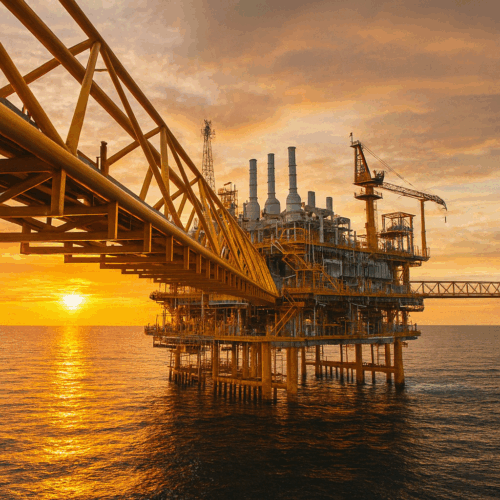
The member states of the European Union (EU) have been negotiating the 21st sanctions package against Russia for several weeks. Among the controversial issues is a refinery in the Georgian Black Sea port of Kulevi. The European Commission wants to add the facility to the sanctions list because, since it began operations in October 2025, it has been processing Russian crude oil and has shipped its products to the EU despite the import ban—according to shipping data from the Finnish research institute Center for Research on Energy and Clean Air (CREA). Italy and Bulgaria are opposing the sanctions against Georgia, reports the German business newspaper Handelsblatt.
Georgia’s Largest Private Investment
Georgia’s first and only refinery (pictured) processes 1.2 million metric tons of crude oil per year, or about 24,000 barrels per day. According to the British news agency Reuters, capacity is set to rise to 4 million metric tons by 2028. On October 6, 2025, the tanker Kayseri delivered the first shipment of crude oil from the Russian Black Sea port of Novorossiysk: 105,340 metric tons of Siberian Light, supplied by the Russian producer Russneft, Reuters reported, citing shipping data. A few weeks later, the EU added the tanker to its shadow fleet list.
The refinery in Kulevi was built and is operated by Black Sea Petroleum LLC, founded in 2022. Construction began in October 2024, and the first oil flowed a year later. The Georgian government hailed the project as the largest private investment in the history of Georgian independence. The operator estimates the total investment for the first phase of construction at up to $700 million. This sum was financed through loans from the state-owned Georgian Development Fund and commercial banks, including Cartu Bank—linked to Georgia’s wealthiest citizen and political power broker, Bidzina Ivanishvili—the base bank of the Chinese Hualing Group, and the Kazakh Halyk Bank. The U.S. corporation Honeywell supplied the technology, licenses, and control systems. The oil terminal in Kulevi has been owned by the Azerbaijani state-owned corporation SOCAR since 2008.
Precedents in India, China, and Indonesia
As of January 21, 2026, the EU has banned the import of fuels produced in third countries from Russian crude oil. The ban’s effectiveness remains limited: According to data from the Finnish research institute CREA, from January through May, 49 tanker shipments from third-country refineries processing Russian oil arrived at EU ports: 36 from Turkey, and 6 each from India and Georgia. The institute estimates the value of products made from Russian crude oil for these five months at 929 million euros. According to CREA, the Turkish refinery Tüpras Izmit most recently used 60% Russian crude oil, the Indian refinery Jamnagar 27%, and Kulewi 100%.
Kulewi would not be the first case of an EU-sanctioned refinery in a third country. In the 18th package, which was adopted in July 2025, the EU sanctioned the Indian refinery Nayara Energy in Vadinar, in which the Russian state-owned company Rosneft holds a 49.13% stake. After a brief drop to 240,000 barrels per day, throughput in November 2025 was back above nominal capacity at 420,000 barrels, according to the data service Kpler. Since then, the company has been exporting to Brazil, Turkey, and Sudan using sanctioned tankers. In June 2026, according to Reuters, Nayara even sold gasoline via intermediaries to Russia, where fuel is in short supply. The 19th sanctions package included, for the first time, two Chinese refineries and a Chinese oil trader; the 20th package included an Indonesian oil port.
Russian Trade Boom with Tbilisi
According to the Georgian Statistical Office (Geostat), trade in goods between Georgia and Russia rose by 6.3% in 2025 to $2.69 billion. Georgia imported 225,300 metric tons of crude oil from Russia—21.5 times the previous year’s volume. In January 2026, Georgian exports of crude oil and petroleum products jumped to $58.7 million, five times the amount for the same month the previous year. The “Georgian Dream” party government rejects all allegations: Neither the ship nor the sender nor the recipient of the Kayseri shipment is subject to sanctions, the Georgian Tax Service stated.
The Kulevi refinery has already escaped being placed on a sanctions list once before. The European Commission removed the facility from the 20th sanctions package in March 2026 after Tbilisi and the Azerbaijani oil company SOCAR made commitments—including the refusal to accept ships subject to EU sanctions. On July 1, the refinery’s operator, Black Sea Petroleum, announced that starting in September, it would process only non-Russian crude oil from Turkmenistan and Kazakhstan. For Rome and Sofia, this is an argument against immediate sanctions, not least to avoid further straining the already tense relations between the EU and the small Black Sea country.
Source: Handelsblatt; CREA, Bloomberg, Black Sea Petroleum (all EN); Kommersant, Interfax, Vedomosti (all RU)
Source: German-Russian Chamber of Foreign Trade, Georgian Refinery Processes Russian Oil: EU Debates Sanctions, July 23, 2026.
This article was prepared for the German-Russian Chamber of Foreign Trade.