Consumption Rather Than Investment: Potential Growth in Russia Is Higher Than in Germany

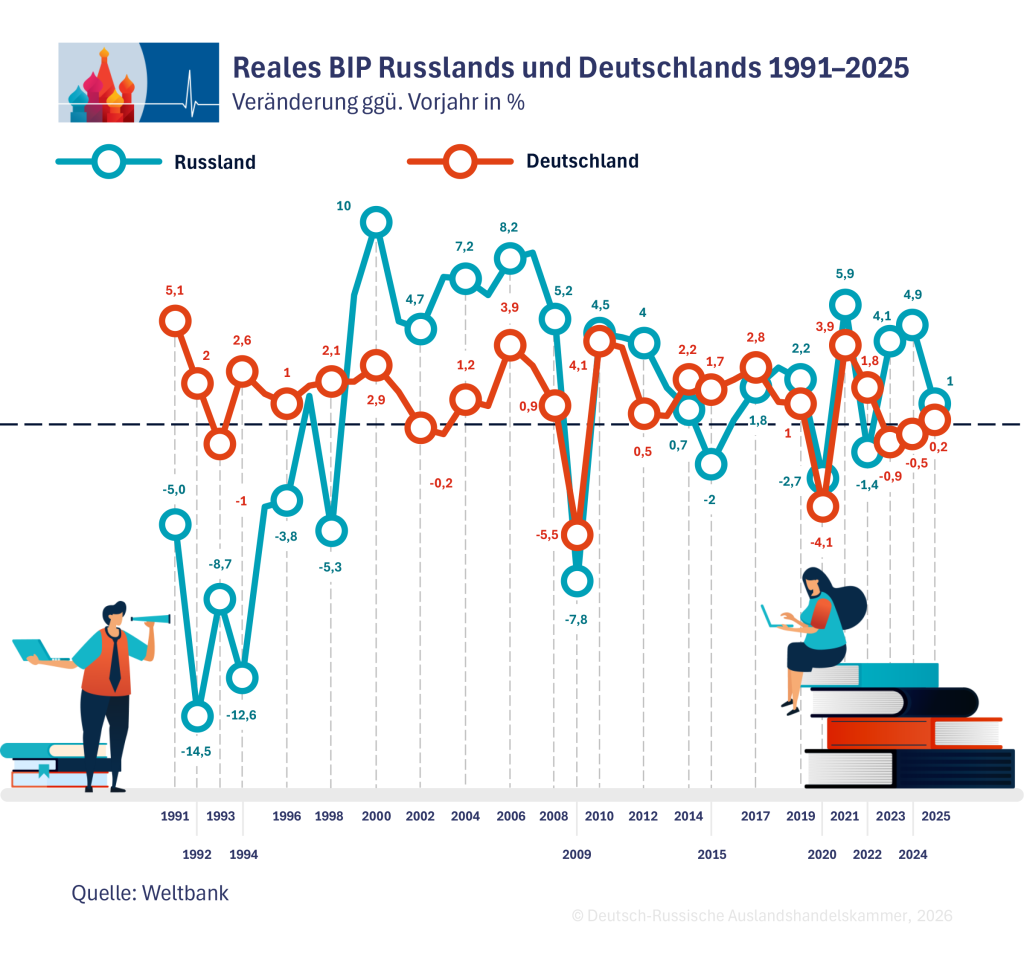
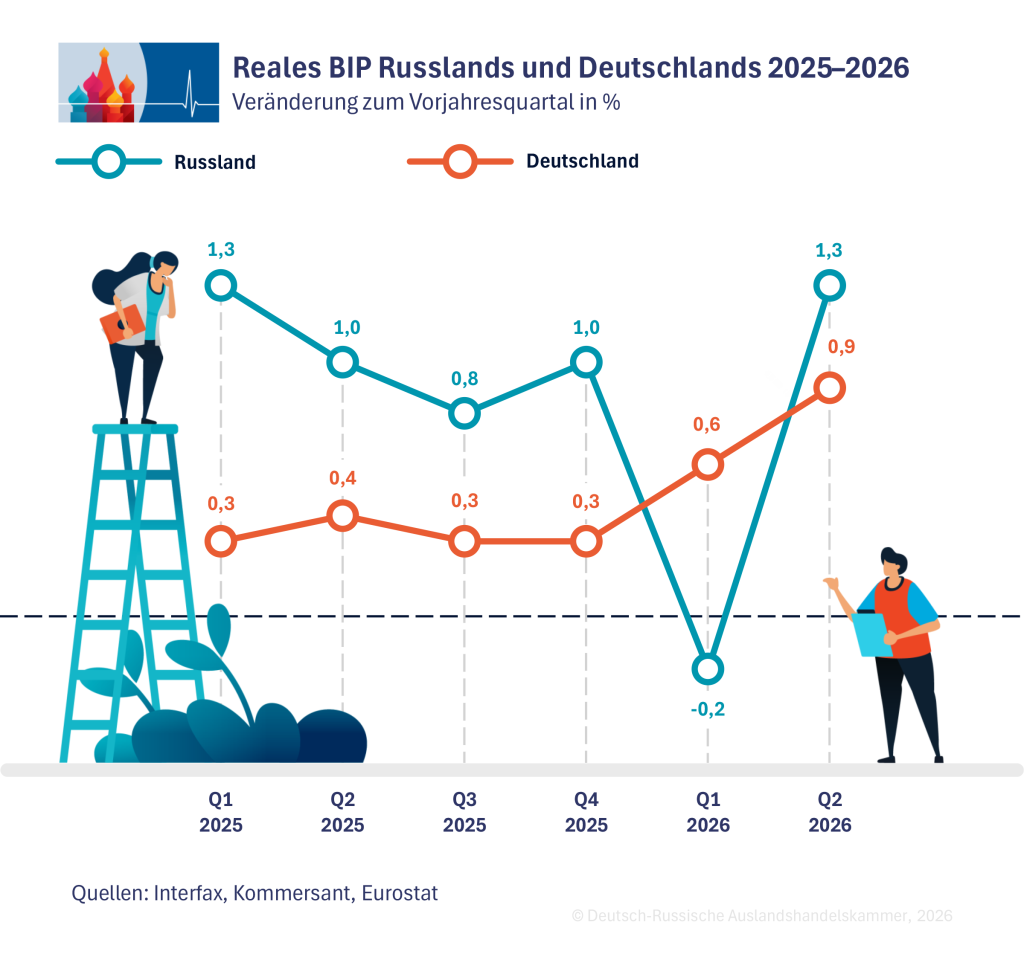
Russia's economy grew by 1.3% in the second quarter of 2026 compared with the same quarter a year earlier. Following a 0.2% decline in the first quarter, growth for the first half of the year stood at 0.6%. Consumer spending drove this growth: Retail sales were up 7.2% from a year earlier, and restaurant sales rose 6.2%. Mining, construction, and agriculture contracted.
The second quarter exceeded expectations
The Federal State Statistics Service (Rosstat) published its flash estimate on August 12. The 1.3% growth rate significantly exceeded the consensus: The Ministry of Economic Development had expected 0.9%, and the Central Bank had forecast 0.8%. The Russian economy had not grown this strongly since the first quarter of 2025.
The ministry subsequently raised its half-year estimate from 0.3% to 0.6%. Economy Minister Maxim Reshetnikov stated that the recovery that began in March was continuing, “despite ongoing external pressure and restrictions in certain sectors.”
Austria’s Raiffeisenbank calculated a seasonally adjusted increase of 0.5% quarter-over-quarter based on the annual rate. In the first quarter, economic output had remained at the level of the fourth quarter of 2025. The bank attributes part of the growth to the elimination of temporary special factors: The winter was unusually cold, and the first quarter had fewer working days.
Graphic: German-Russian Chamber of Foreign Trade
Consumer Spending Drives Quarterly Growth
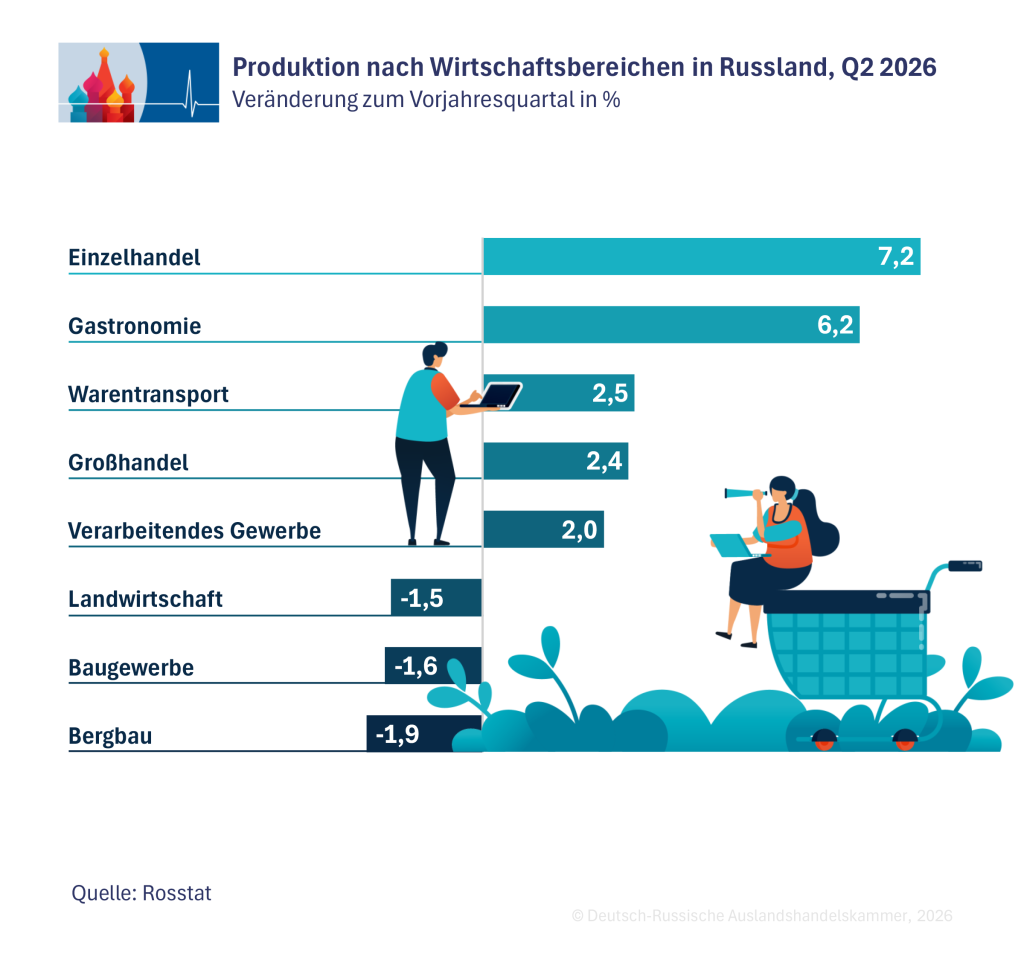
The sector-by-sector figures show two diverging trends. According to Rosstat estimates reported by the business newspaper Kommersant, retail sales grew by 7.2% and the food service industry by 6.2%. Freight transport increased by 2.5%, wholesale trade by 2.4%, and manufacturing by 2%. On the other hand, mining declined by 1.9%, construction by 1.6%, and agriculture by 1.5%.
Raiffeisenbank compared these figures to those of the first quarter. Retail growth doubled from 3.5% to 7.2%. In freight transport, a 3.6% decline turned into a 2.5% increase. In the construction industry, the decline narrowed from 10% to 1.6%.
The BOFIT Institute of the Bank of Finland summarizes the quarter as follows: Higher retail sales and increased service output accounted for the bulk of the growth, while mining and construction declined by nearly 2% compared with the previous year.
The Russian Central Bank’s economic survey shows the same disparity in fixed investment. Investment recovered slightly from the low point at the beginning of the year, with the best figures reported by retail, services, and the consumer goods industry. In the construction sector, investment continued to decline. In the raw materials industry, investment remained weak but improved slightly compared to the start of the year.
Vladimir Yeromkin, a researcher at the Laboratory for Structural Analysis at the RANEPA Presidential Academy in Moscow, attributes consumer spending to savings that the population has accumulated thanks to accelerated wage growth in previous years. In the first five months, real wages rose by 7.2%. His conclusion for the year as a whole: “Stable consumer demand, positive industrial development, a gradual recovery in investment activity, and controlled inflation could create the conditions for economic growth in the range of 0.7 to 1.2% in 2026.”
Alexei Vedev, head of financial research at the Gaidar Institute for Economic Policy in Moscow and deputy minister of the economy from 2014 to 2017, explains the mechanics: “The decline in investment is slowing economic growth, while rising consumption of goods and services is, on the contrary, boosting it. The government may have underestimated the sustainability of high consumer demand. Deposit interest rates, which have fallen compared to the previous year, have prompted the population to shift funds from their savings into consumer spending.”
Graphic: German-Russian Chamber of Foreign Trade
The leading indicators are negative
The Purchasing Managers’ Index (PMI) compiled by American analysts at S&P Global rose from 48.9 to 49.6 points in July, but remained below the 50-point growth threshold for the fifth consecutive month. The sub-index for the manufacturing sector stood at 50.7, while that for services was 49.0.
The Composite Leading Index from the Economic Research Center at Moscow’s Higher School of Economics fell by 6.1 points to 165.8 in July, a drop of nearly 10 points over two months. The SberIndex measures real household spending: In the week of August 3–9, it was only 1.9% higher than the previous year, down from a July average of 5.9%.
Denis Popov, a senior analyst at the Moscow-based PSB Bank’s analysis center, therefore warned early on against drawing false conclusions from the quarterly figures: In his view, the growth rates achieved did not appear sustainable. The bank lowered its annual forecast in July from 0.5% to 1% to 0% to 0.5%.
Raiffeisenbank has reached the same conclusion. The second-quarter recovery is clearly temporary and is likely to weaken in the second half of the year.
Industry Has Been Stagnant Since the Start of the Year
Rosstat published the July data on August 26. Industrial production grew by 0.4% compared with the same month a year earlier, following 0.7% growth in June. Over the first seven months, production was only 0.1% higher than in the same period a year earlier. On a twelve-month basis, the trend is weakening: Rosstat had previously reported 1.1% for the twelve months through December 2025, but the figure for the twelve months through July 2026 is 0.5%.
The manufacturing sector grew by 2.4% year-over-year in July, following a 2.8% increase in June. Mining contracted by 2.6%, as it had in June. Seasonally and calendar-adjusted, industrial production rose by 0.1% compared with the previous month, following a 0.2% increase in June. As a result, production volume remained virtually unchanged compared with previous months.
Over the past seven months, the manufacturing sector gained 0.5%, while mining declined by 0.9%. The manufacture of other transportation equipment, which includes aircraft and shipbuilding, grew by 22.9%. Pharmaceuticals and medical supplies rose by 13.9%, metal products (excluding machinery and equipment) by 10.9%, and computers, electronic, and optical products by 4.2%. At the negative end of the spectrum is the production of coke and petroleum products, which fell by 9.2% over seven months. In July, the decline amounted to 19.3%. This is due to Ukrainian drone attacks on Russian refineries.
The seasonally adjusted production volume of industries not related to military spending this summer was below the level seen at the beginning of 2022. In 2025, value added in defense-related sectors rose by 20%, while that of all other manufacturing sectors combined rose by 0.4%.
The PSB Bank Analysis Center derives its forecast for the third quarter from these figures: “Given the high importance of industry to the Russian economy, real GDP growth in July will be quite weak, although moderate economic growth is likely to continue given the high and stable level of consumer spending. We maintain our forecast of real GDP growth close to zero (in the range of 0% to 0.5%) through the end of 2026.”
Graphic: German-Russian Chamber of Foreign Trade
Forecasts for 2026 and 2027 are being revised downward
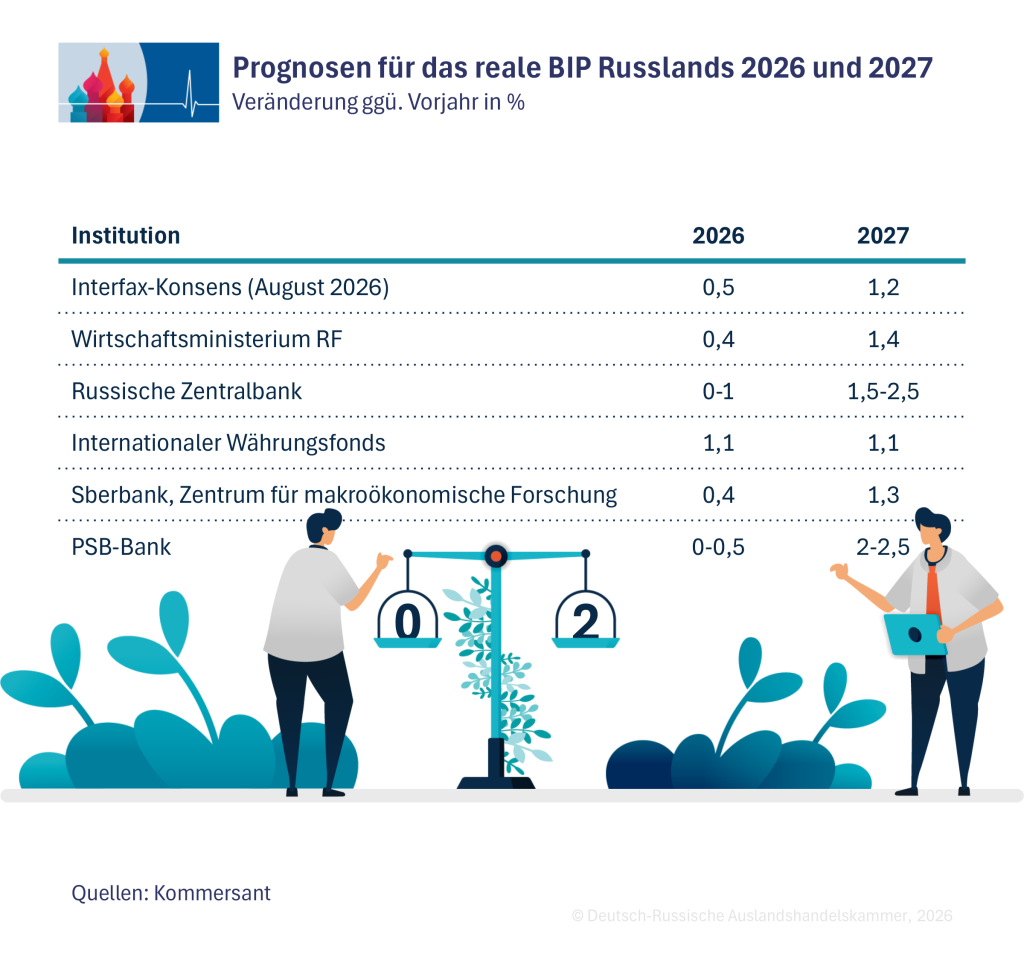
The Central Bank lowered its growth forecast in July to 0% to 1%, down from the previous range of 0.5% to 1.5%. It attributed this to temporary capacity shortfalls in certain sectors and revised both investment and exports downward. At the same time, it raised its inflation forecast to 5.9% to 6.2%, up from 5.1% to 5.6% in the spring. For 2027, it maintains its growth forecast at 1.5% to 2.5%, but expects inflation of 4.3% to 5.2%. The official target of 4% is thus projected to be exceeded over the forecast horizon. It lowered the key interest rate to 14% at the end of July.
The August survey by the London-based forecasting service Consensus Economics shows an average growth rate of 0.7% for 2026 and 1.2% for 2027, with inflation at 6.2% and 4.6%, respectively. In the monthly survey of Russian analysts conducted by the Interfax news agency, the median forecast for 2026 fell from 0.7% to 0.5% between July and August; individual forecasts ranged from zero to 1.2%. The International Monetary Fund expects 1.1% for both 2026 and 2027.
For 2027, expectations are more widely dispersed than for this year. The Central Bank maintains its forecast of 1.5% to 2.5%, the Ministry of Economic Development expects 1.4%, the Interfax consensus is 1.2%, and the International Monetary Fund forecasts 1.1%. Sberbank’s Center for Macroeconomic Research forecasts 0.4% this year, 1.3% next year, and 1.6% in 2028.
Potential growth limits the recovery
Two analyses by economists at the Central Bank of Russia, dated August 11, quantify just how much recovery is actually possible. Their conclusion: The inflation-neutral growth path for the Russian economy is 1.5 to 2% per year in the medium term.
The output gap—the difference between actual and potential economic output—stood at minus 0.5% of potential in the first quarter of 2026, down from plus 1.3% a year earlier. The economy is thus operating just below its potential but has virtually no spare capacity. Unemployment stands at 2.2% to 2.3%, and industrial capacity is fully utilized.
The analysts project nine scenarios for potential growth through 2035. In the inertia scenario, the economy grows by 1.3% per year; on the long-term equilibrium path, it grows by 1.56%. The range extends from 0.45%—assuming a widening technological gap—to 3.17%—assuming a significant easing of external trade restrictions. The authors consider the optimistic scenarios to be less likely.
The reason: Between 2015 and 2025, Russia’s total factor productivity grew by an annual average of about 0.1%, compared with 0.6% in the United States. Measured against the median of technologically leading countries, Russia reached 60.4% in 2018 and 59.8% in 2025; in 2012, the figure was 68%. The gap is widening rather than narrowing.
The labor market sets the second limit on potential growth. The Russian Ministry of Labor expects the working-age population to decline by just under 6 million people by 2030, primarily in the 30- to 39-year-old age group. According to the Central Bank economists’ model, the labor force participation rate will fall from 62.9% in 2025 to 60.5–60.7% in 2035, solely due to the changing age structure.
Migration does little to offset this trend. Between 2005 and 2023, net migration averaged 218,000 people per year; in 2021, it reached 430,000—the highest level since 1995—before falling to 62,000 in 2022. Since 2024, the figures are no longer comparable due to a change in methodology, and in 2025, Rosstat ceased publication.
Graphic: German-Russian Chamber of Foreign Trade
Germany Is Growing Above Its Potential
The Deutsche Bundesbank estimates Germany’s production potential at 0.4% for 2026 and at 0.3% each for 2027 and 2028.
On August 25, the Federal Statistical Office (Destatis) reported 1% year-over-year growth for the second quarter, following 0.8% in the first quarter. Compared to the previous quarter, the German economy expanded by 0.3%. Exports drove the quarter’s growth, rising 3.7% year-over-year. The manufacturing sector increased its value added by 1.1%, marking its first growth since the first quarter of 2023.
Construction investment fell by 1.5% year-over-year, while private consumption stagnated at 0.1%. The 1% increase in consumer spending is partly attributable to the government, primarily through higher spending by the federal government and social security. Thus, in Germany as well, the government is providing support while private demand is weakening.
KfW Research, the economic research department of the state-owned development bank, raised its forecast for 2026 by 0.4 percentage points to 1.1% on August 25 and its forecast for 2027 to 1.5%. The institute had originally expected a decline for the second quarter. The upward revision is attributed to full order books: Order intake in the manufacturing sector rose by 4.5% in the second quarter compared with the same quarter a year earlier, and the order backlog at the end of June was 9.3% higher than a year earlier.
The Bundesbank cites demographic change—including a shortage of skilled workers and rising non-wage labor costs—high energy costs, bureaucracy, and growing competition from China as reasons for the low potential growth in Germany.
Source: German-Russian Chamber of Foreign Trade, “Consumption Instead of Investment: Potential Growth in Russia Higher Than in Germany,” September 3, 2026.
This article was prepared for the German-Russian Chamber of Foreign Trade.
The day's most important Russian economic stories. Free, in your inbox three times a week.
Mon, Wed, Fri. Double opt-in, no tracking, unsubscribe anytime. By subscribing you consent to the processing of your email address as described in our Privacy Policy.