All that glitters is not gold: Mining is booming, but reserves are dwindling
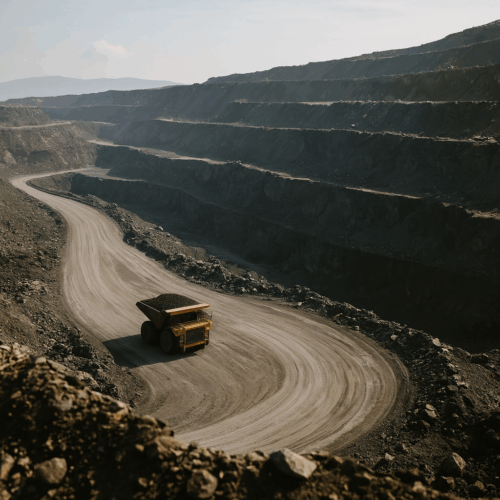
In May 2026, the world’s most powerful particle accelerator, the Large Hadron Collider (LHC) at the CERN nuclear research center near Geneva, made the dream of Albertus Magnus, Johann Friedrich Böttger, Hennig Brandt, and other alchemists a reality. Lead was transformed into gold through the collision of atomic nuclei at nearly the speed of light. However, only one trillionth of a gram was produced. And while physicists continue to harbor hopes, gold is still mined using traditional methods from ore, placer deposits, and complex deposits that contain more than just gold.
Graphic: German-Russian Chamber of Foreign Trade
Reserves and Mining in Russia
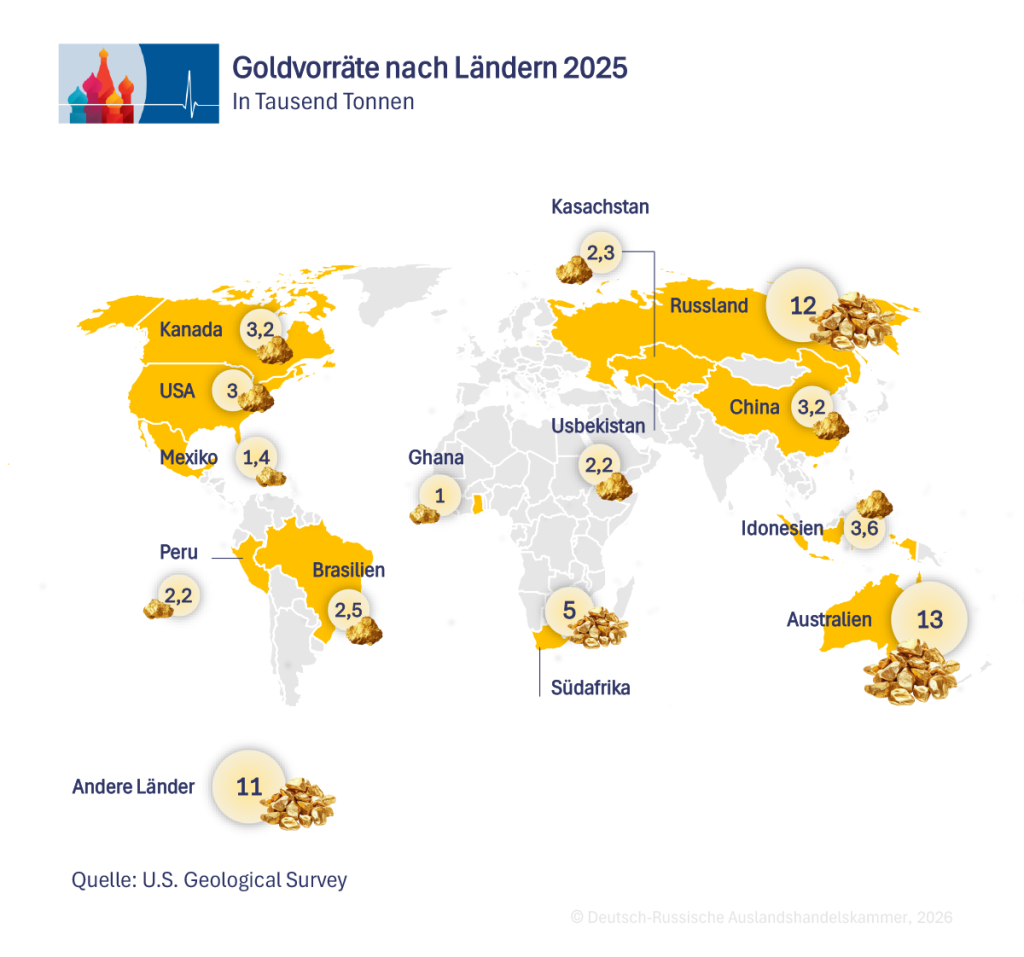
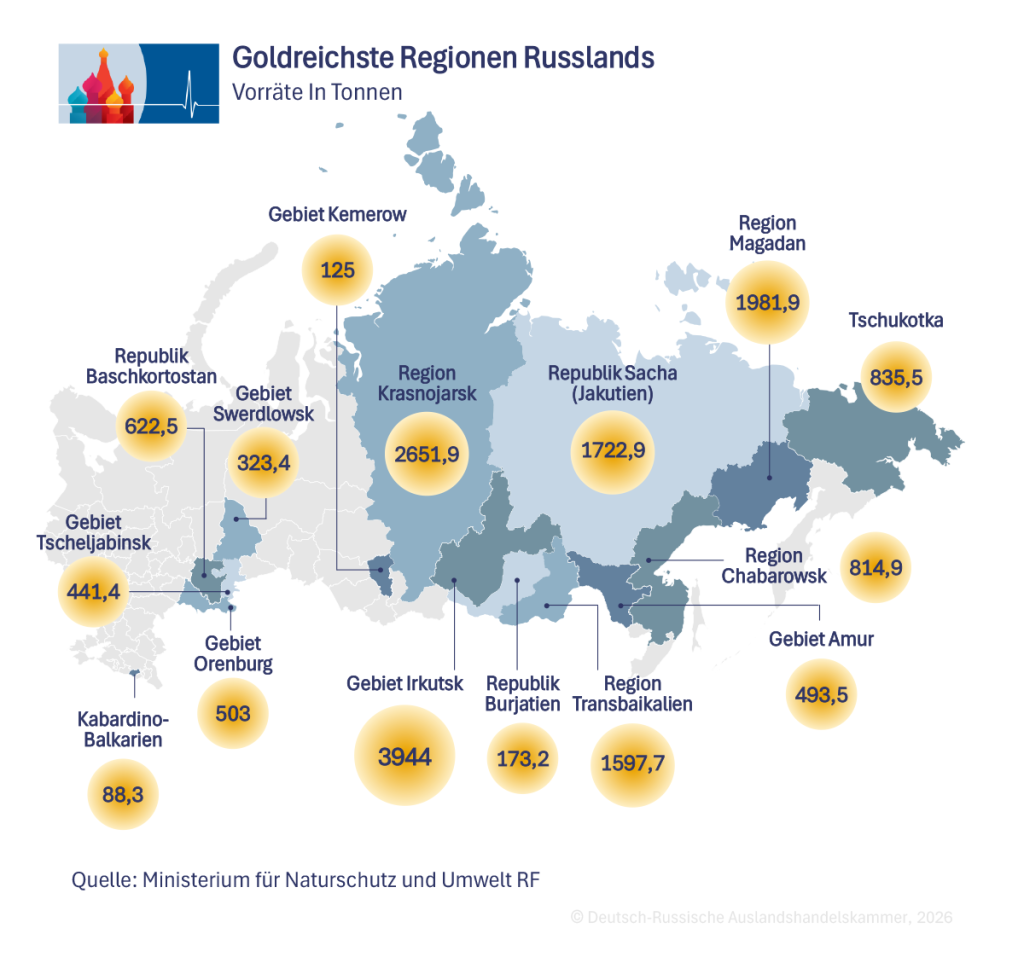
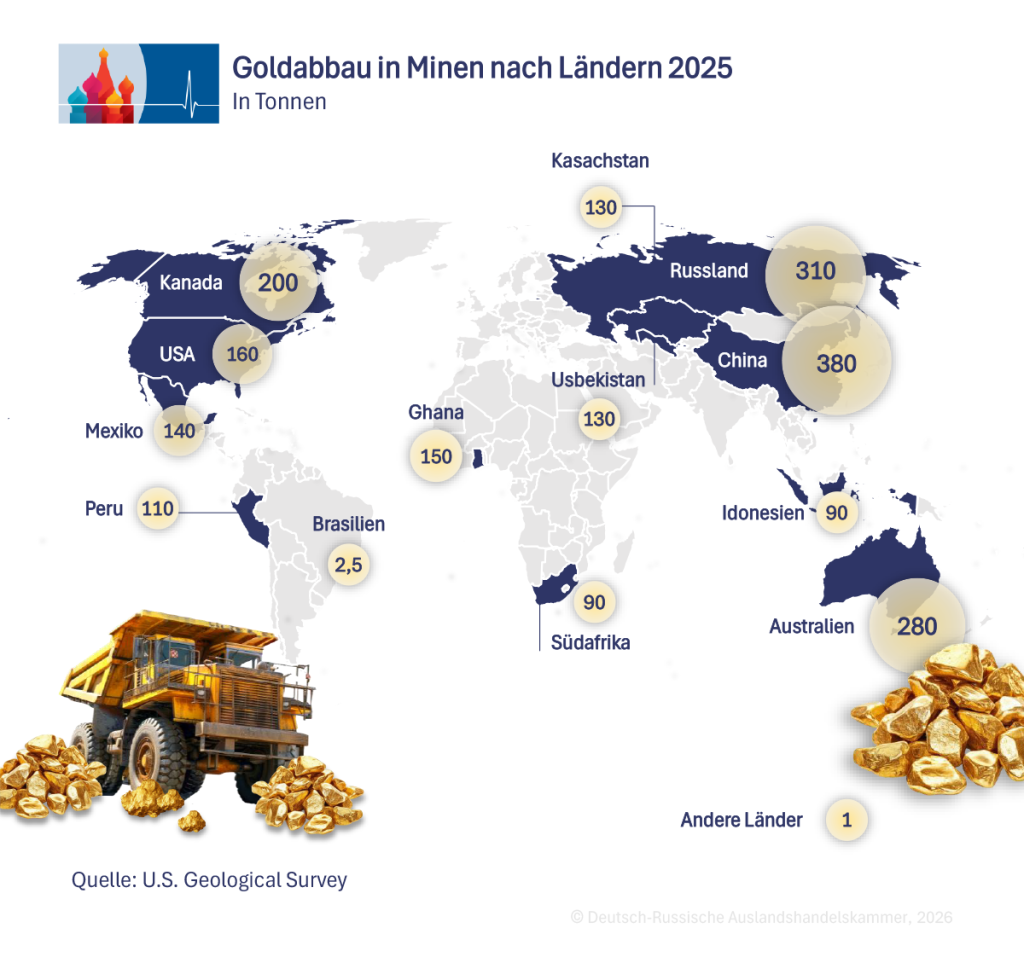
According to the U.S. Geological Survey, global proven gold reserves totaled 66,000 metric tons in 2025. The three largest producers worldwide are China, Russia, and Australia. Russia’s gold deposits in categories A+B+C1+C2 total approximately 17,000 metric tons. These categories include proven and probable deposits whose extraction is economically viable. Ninety percent of these deposits have already been allocated: By early 2026, 7,000 licenses had been granted for their development, including 6,000 for placer gold. Nearly half of these licenses are held by junior mining companies (small exploration companies, typically startups).
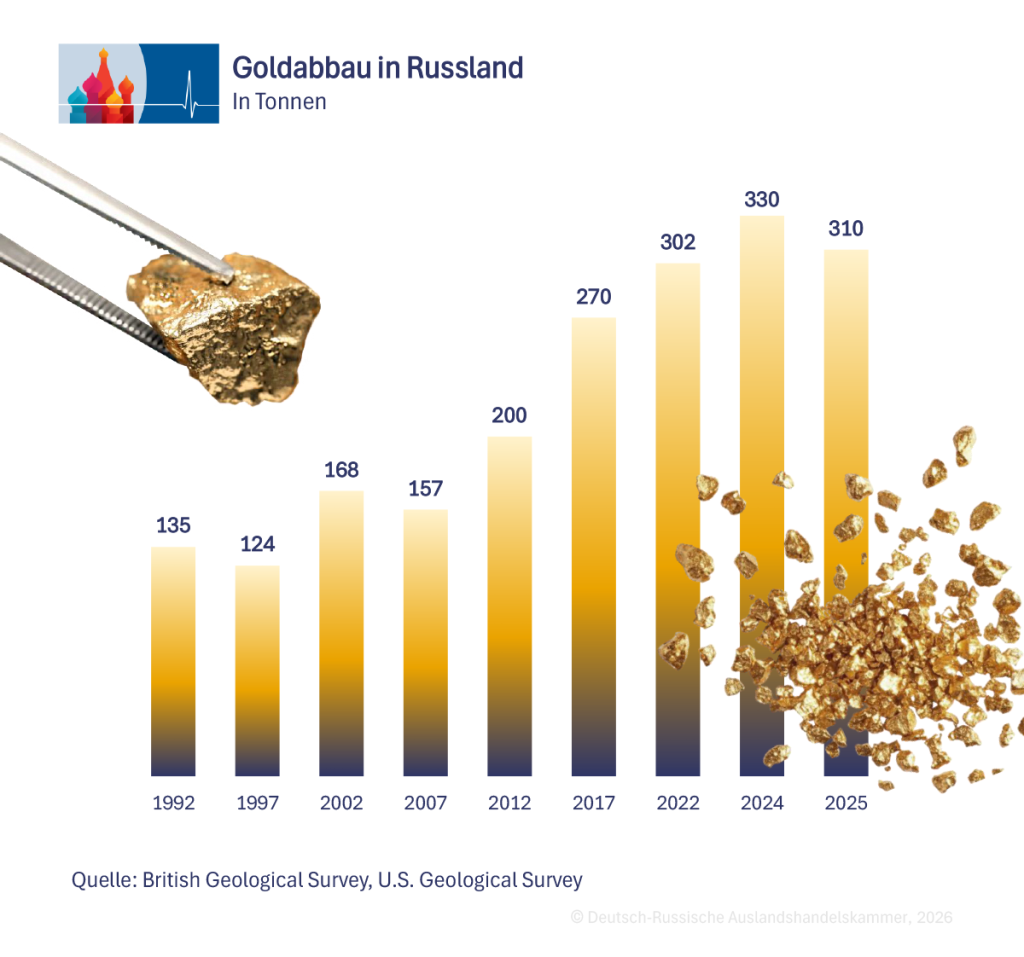
According to conservative estimates by the U.S. Geological Survey, a U.S. government agency, Russia produced a total of 310 metric tons of gold in 2025. Mikhail Leskov, editor-in-chief of the Russian magazine “Gold and Technology,” estimates 360 metric tons, while the Russian Ministry of Natural Resources cites higher figures of 480 to 485 metric tons. This corresponds to a value of approximately $42 billion, equivalent to about 3 trillion rubles, and is comparable to the profits of Russian banks or the revenue of the IT sector.
Graphic: German-Russian Chamber of Foreign Trade
Russian gold mining is highly fragmented, explains Sergey Kashuba, chairman of the Association of Russian Gold Producers. 197 companies produce less than 20 kilograms of gold per year, while another 210 produce between 20 and 100 kilograms. About 70% of Russia’s gold reserves are found in ore deposits, another 25% in complex deposits, and the remainder in placer deposits. Forty-two large and medium-sized holding companies are active in ore mining, while 536 are involved in placer gold mining.
In the 1990s, 70% of Russian gold production came from placer deposits. By 2011, this share had fallen to 40%; by 2021, to 27%; and by 2025, to 20%. By the end of 2026, the 80:20 ratio will remain in place due to accelerated growth in ore mining and environmental regulations governing placer gold mining. The easily accessible placer deposits are nearly depleted, and companies are competing even for small but still profitable deposits.
Industry associations estimate that gold production from placer deposits in Russia could decline by 5% this year. Reasons for this include a shortage of developed deposits, declining profitability, and increasing administrative burdens for companies. One of the restrictive measures is the requirement to set aside a portion of funds for land restoration.
In the coming years, several major projects will drive the growth of gold mining in the country: Sukhoi Log in the Urals, Nezhaninskoye and Kuchus in Yakutia, Chulbatkan and Malmyshskoye in the Khabarovsk Region, and Pechchanka in Chukotka. Leading companies such as Polyus, Areal (formerly Highland Gold), UMMC, Polymetal, Nordgold, Pavlik, Vysotchayishchiy, Seligdar, Norilsk Nickel, and BTS-Zoloto (formerly UGK) will continue to divest stakes in their smaller projects and focus on developing the most important and largest assets in their portfolios. All of these companies are still owned by private individuals or investment funds.
Graphic: German-Russian Chamber of Foreign Trade
Unlike rare metals, mined gold does not require complex processing. Therefore, according to the Ministry of Natural Resources, the industry generates enormous amounts of highly liquid funds and can secure investments and technologies independently without relying on foreign expertise. The ministry also notes that gold, to a certain extent, “diverts” investment away from geological exploration. The high demand for gold means that investments are directed toward deposits that have already been explored and are ready for mining, leaving no funds available for geological exploration of new raw materials. Investors seek quick profits from precious metals and ignore long-term and risky projects. However, since the government is strategically focusing on deposits of scarce raw materials, including rare metals and rare earths, public investment in gold exploration will gradually decline. Private investment, on the other hand, will increase over the next two to three years.
According to Fares Kilzie, head of the CREON Group—a commodities consulting and investment firm based in Moscow and Luxembourg—the biggest challenge lies not in the availability of gold deposits, but in the speed of industrial production and processing. However, even rich deposits will not yield immediate economic benefits as long as Russia does not change its development model, according to CREON. What is needed, it says, are long-term investments, major contractors, a well-developed transportation and energy infrastructure, an established service sector, and effective cooperation between the government, banks, contractors, and the companies themselves.
The Exodus of Western Gold Producers
There are virtually no foreign corporations left in the Russian gold sector. Kinros Gold (Canada), which owned the high-yield Kupol and Dvoynoye deposits in Chukotka, was sold in June 2022 at a 50% discount for $340 million to the Russian conglomerate Highland Gold, owned by Vladislav Sviblov, a Russian executive and major shareholder in a number of large exploration, mining, and industrial companies.
Graphic: German-Russian Chamber of Foreign Trade
The British company Petropalovsk PLC, one of Russia’s five largest gold producers and listed on the London and Moscow stock exchanges, lost its distribution channels due to sanctions against Gazprombank and was declared bankrupt in London in 2022. All production facilities in Russia were taken over by the Ural Mining and Metallurgical Company (UGMK).
Polymetal International (now Solidcore Resources), the largest foreign player, which was registered on the island of Jersey and in Cyprus, sold its Russian assets (Polymetal JSC) to the Russian group Mangazeya Plus in March 2024. The company was subsequently renamed Solidcore Resources, re-registered in Kazakhstan, and delisted from the Moscow Stock Exchange.
Highland Gold (formerly Highland Gold Mining, UK), a former owner of mines in the Far East, was taken over by entities controlled by Vladislav Sviblov. In June 2024, the Russian government added MKAO Highland Gold to the list of “economically significant organizations,” which made it possible to exclude the foreign offshore entities (Cyprus, Jersey) from the chain of ownership through legal proceedings.
Nordgold (formerly Nord Gold N.V., Netherlands/United Kingdom), an international holding company with major mines in Yakutia, Buryatia, the Amur Region, Kazakhstan, and Africa, was seized as part of the nationalization process. Foreign holding companies were liquidated or isolated as a result of sanctions. Management was transferred to Nordgold Management (Moscow), an entity effectively controlled by Russian billionaire Alexei Mordashov (Severgroup) and operating as a purely Russian company. Nordgold recently acquired a 20% stake in a company holding a gold exploration license in Kamchatka. The construction of a mine and processing plant there is expected to cost over 20 billion rubles (212.6 million euros). Another Nordgold entity (“Uryakh” OOO) plans to begin developing the Uryakh gold deposit in the Bodaibo District of the Irkutsk Region by 2031. Investments in this project are expected to exceed 30 billion rubles, or just under 320 million euros.
Korou Goldfields (Sweden)—a holding company that, through PAO AG Mining, controlled mining companies in the Khabarovsk, Khakassia, and Irkutsk—was able to sell its Russian assets to the Russian mining company Aljans in 2025 following a necessary decree by Russian President Vladimir Putin.
While the direct presence of Western capital has been reduced to zero, some foreign companies continue to operate in Russia through affiliated companies based in Russia or friendly nations, using complex structures. Partnerships with investors from Asia and the Middle East remain in place.
Refining Plants Operating Below Capacity
No foreign capital has flowed into the Russian gold refining industry—that is, the processing and purification of gold—since the Soviet era. According to the Federal Law “On Precious Metals and Gemstones,” refining is permitted exclusively for companies listed on a government-approved list. This list includes eleven facilities, among them the Moscow Special Alloy Plant and the Prioksky Non-Ferrous Metals Plant.
The first three facilities alone account for 90% of processing, resulting in chronic excess capacity, as the industry’s average capacity utilization rate stands at 30–35%. The plants compete for primary and secondary raw materials, particularly gold-bearing electronic scrap, of which they collect only very small quantities. As a result, only 20% of the waste is processed further.
Administrative hurdles in raw material imports, sluggish geological exploration, undifferentiated taxation, non-transparent channels for collecting secondary raw materials, and the export of domestic scrap pose further obstacles. According to Sergey Kashuba, chairman of the Russian Association of Gold Producers, even with stable gold mining trends and annual growth of 1–2% over the next ten years, these quantities will not be sufficient to ensure full capacity utilization at the refineries.
Gold for Hard Times
Commercial gold exports, which are exempt from export duties and value-added tax, generate foreign exchange revenue for Russia, especially as trade flows shift toward markets in the Asia-Pacific region, the Persian Gulf, and India. In addition, the government regularly sells gold bars from the gold and foreign exchange reserves of the National Wealth Fund and the Russian Central Bank to cover the rapidly growing budget deficit.
Graphic: German-Russian Chamber of Foreign Trade
Russia ranks fifth worldwide in terms of gold reserves (2,304.75 metric tons), behind the United States (8,133.5 metric tons), Germany (3,350.3 metric tons), Italy (2,451.9 metric tons), and France (2,437 metric tons). Unlike Germany, which stores its gold not only in Frankfurt am Main but also with the U.S. Federal Reserve and the Bank of England, Russia keeps its gold reserves exclusively on Russian territory, including in the Russian Central Bank’s high-security vault in Moscow and at other locations throughout the country, including the facilities of the currency printing company Gosnak.
For decades leading up to 2022, Russia had been actively purchasing gold to reduce its dependence on the dollar and to secure its own monetary sovereignty and increase the independence of its currency. As a result, gold reserves grew from 340 in 2000 to 2,300 metric tons in 2021. However, after the West froze the Russian Central Bank’s reserves—amounting to 210 billion euros in the European Union and 1 billion dollars in the United States—in 2022 immediately following the start of the military conflict between Russia and Ukraine, and imposed sanctions on dollarand euro transactions, gold and the Chinese yuan increasingly became key liquidity instruments.
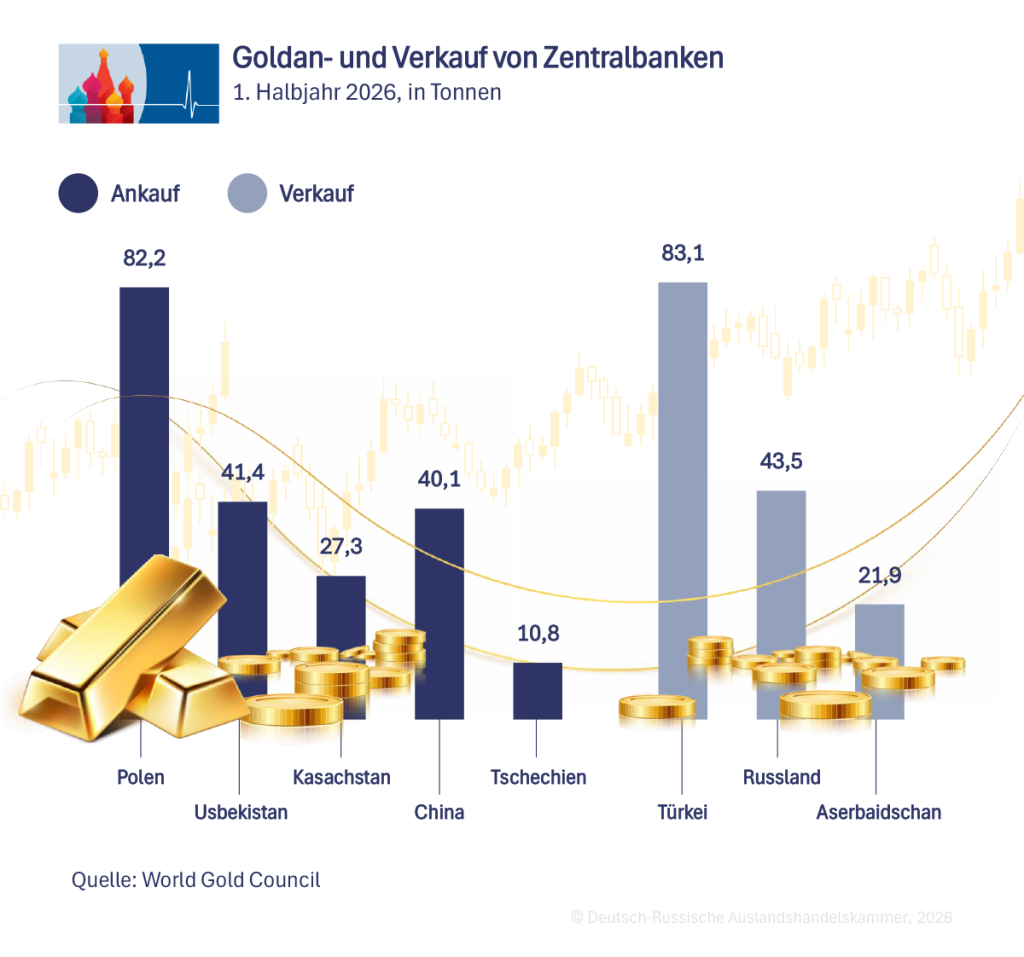
Unlike the Russian Central Bank, which is forced to sell gold, numerous other central banks are purchasing gold and thereby replenishing their strategic reserves. According to the World Gold Council, central banks worldwide purchased 244 metric tons of gold in the first quarter of 2026, 17.4% more than in the previous quarter and 3% more than in the same period of 2025. Demand from private individuals for gold bars and coins rose by 42% to 474 metric tons, the highest level in 13 years. According to a report by the European Central Bank, the share of gold in the reserves of various central banks rose to 27% by the end of 2025, while the share of U.S. Treasury bonds fell from 25% in 2024 to 22%. For private investors, gold serves to safeguard savings and hedge against risks. Even in times of crisis, its price remains stable and sometimes even rises.
Still the Safest Asset?
According to the World Gold Council, the breakdown of global gold consumption is as follows: jewelry (40%), physical gold bars (24%), central banks and other institutions (21%), commemorative coins, medals, and replica coins (7%), electrical engineering and electronics (7%), and other uses such as medicine and aerospace (1%).
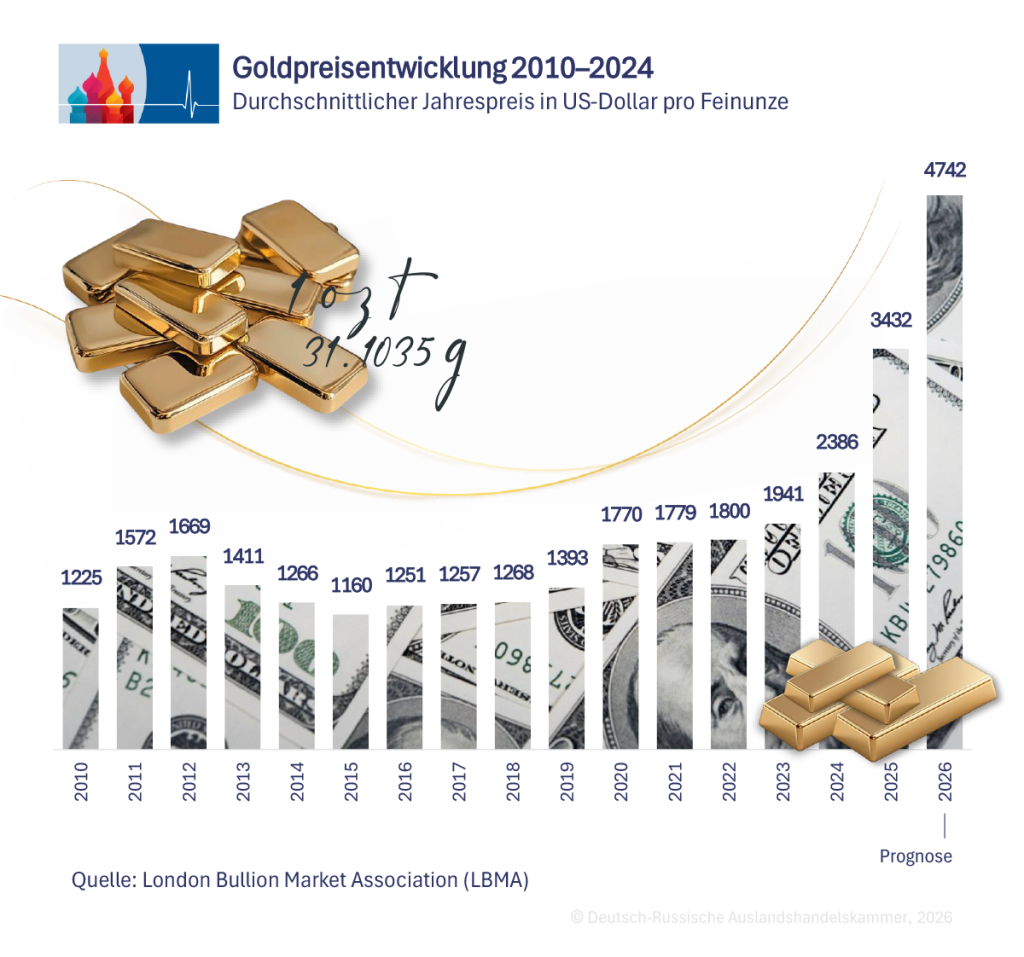
Over the past three years, gold prices have nearly tripled, rising from $1,830 to $4,500 per troy ounce. However, gold purchases by central banks—primarily from China, Poland, Turkey, and India—slowed to 825 metric tons in 2025, compared to 1,000 metric tons from 2022 to 2024, and gold prices began to fall in 2026, contrary to expectations. At the end of June, the price of gold futures for August 2026 delivery on the Comex exchange fell below $4,030 per troy ounce.
Graphic: German-Russian Chamber of Foreign Trade
The conflict in the Middle East has shaken the traditional view of gold as a safe haven. Normally, the price of gold rises during times of geopolitical crises and economic instability. But in the spring of 2026, the opposite occurred. The market reacted to the inflationary consequences of the blockade of the Strait of Hormuz, a key global transport route for energy and metals. As a result, some analysts began to question whether gold is still a store of value for hedging against macroeconomic and geopolitical risks.
Other observers believe that the physical growth in demand for gold is preventing a bear market for the metal. They anticipate the following baseline scenario for 2026–2027: prices will remain high, accompanied by high volatility. High global debt, the declining importance of reserve currencies, and heavy central bank buying will keep the average annual price at around $4,500 per troy ounce or higher.
Analysts at the major U.S. bank JP Morgan view the current market situation more as a temporary pause than as a trend reversal. Long-term “bullish” factors (currency devaluation, declining purchasing power, financial risks in the U.S., and geopolitical tensions) remain relevant for investments in precious metals, according to the U.S. experts. Once the Strait of Hormuz is fully reopened and the global oil shortage eases, interest in gold among central banks and private investors will rise again. According to the American bank’s scenario, gold prices could rise to $6,000 per ounce by the end of the year and reach $6,200 in the first quarter of 2027 (a 36.6% increase). However, this will only happen if yields on U.S. Treasury bonds fall, oil-driven inflation eases, and investment demand from large funds picks up again.
Gold Price Factors: U.S. Benchmark Interest Rate and the Dollar
Global investors are reducing their gold holdings in anticipation of an interest rate hike by the U.S. Federal Reserve (Fed) in light of rising commodity inflation. An interest rate hike lowers the price of gold, while a rate cut raises it. Since gold yields neither interest nor dividends, its appeal as an investment depends directly on how much investors can earn from risk-free investments.
If the interest rate rises, the yield on stablecoins (UST) increases, making them more attractive to investors. Capital outflows cause the price of gold to fall: an inverse correlation between gold and the U.S. dollar. If the Fed’s benchmark interest rate rises, the dollar appreciates, making gold more expensive for investors holding other currencies. This reduces demand and puts downward pressure on the price. If the interest rate falls, the dollar weakens, making gold cheaper for foreign buyers, which boosts demand and the price.
The Russian market, in turn, has been influenced by various factors in recent years. Private investors’ steady interest in gold shows no signs of abating. Since September 2025, there has been a steady inflow into gold investment funds, with total investments of 28.1 billion rubles (295.2 million euros) during this period and fund assets totaling 78.47 billion rubles (824.4 million euros). Investors are seeking to minimize risks, including the weakness of the ruble resulting from the Russian Central Bank’s interest rate cut, the Ministry of Finance’s foreign exchange purchases, and seasonal foreign exchange demand from importers and private households.
On the Moscow Stock Exchange, the volume of gold transactions from January through May 2026 totaled 173.6 metric tons, more than twice as much as in the same period the previous year.
Source: German-Russian Chamber of Foreign Trade, “All That Glitters Is Not Gold: Mining Is Booming, Reserves Are Shrinking,” August 12, 2026.
This article was prepared for the German-Russian Chamber of Foreign Trade.
The day's most important Russian economic stories. Free, in your inbox three times a week.
Mon, Wed, Fri. Double opt-in, no tracking, unsubscribe anytime. By subscribing you consent to the processing of your email address as described in our Privacy Policy.