Russia
Analyst survey: growth will continue to fall in 2026, but the rouble is still strong
Author: Klaus Dormann
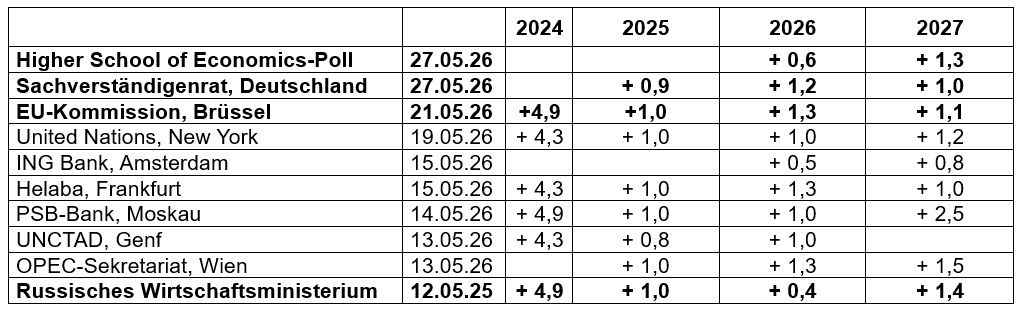
On May 12, the Russian government lowered its forecast for this year's growth in the Russian economy from 1.3% to 0.4%. A few days later, however, the EU Commission (+1.3%) and the German "German Council of Economic Experts" (+1.2%) published significantly higher forecasts for 2026.
The "analysts" at banks and institutes apparently consider the government's low forecast to be more realistic. In any case, the Russian and international experts surveyed by the Economic Research Institute of the Moscow Higher School of Economics from May 18 to 27 now expect economic growth this year to be as weak as the government. On average, they lowered their forecast for this year's growth in real gross domestic product to 0.6 percent. In February, they had still expected an increase of 0.9 percent.
The analysts' average forecast for growth next year is also largely in line with the government's assessment. Analysts expect GDP growth to accelerate to 1.3% in 2027. The government then expects economic growth to pick up to 1.4%. By contrast, the EU Commission and the German Council of Economic Experts are not forecasting an acceleration next year, but rather a slight decline in the growth rate.
GDP forecasts for Russia 2024 to 2027Change in real gross domestic product compared to the previous year in percent
HSE survey: The economic "downturn" will hardly lead to less inflation in 2026
The results of the latest analyst survey listed by the Higher School of Economics in the table below show that, despite the further slowdown in economic growth, the experts surveyed expect the inflation rate at the end of 2026 to be barely lower on average (5.4%) than it was in December 2025 (5.6%). By way of comparison, the central bank forecast puts the inflation rate at the end of 2026 in a range of 4.5% to 5.5%.
According to the HSE consensus forecast, the key interest rate, which was last cut to 14.5% on April 24, will be reduced by a further two percentage points by the end of the year. Analysts then expect an average key interest rate of around 12.4%.
HSE consensus forecast for 2026-2032(expert survey, May 18-27, 2026)
Higher School of Economics, S.V. Smirnov: Consensus Forecast of the Development Center Institute, 27.05.26
The sharp rise in the rouble will depreciate noticeably by the end of the year
The Russian rouble has appreciated significantly against the US dollar since the beginning of 2025. Most recently, only around 71 roubles had to be paid for one dollar. This is the strongest it has been since the beginning of 2023.
However, the HSE survey revealed that experts now expect the rouble to depreciate significantly by the end of 2026. They assume that around 83 roubles per US dollar will have to be paid by the end of the year.
"Downturn" in the economy, but "upturn" in the currency
In recent weeks, headlines have been piling up about the appreciation of the Russian rouble. No wonder: the annual growth of the Russian economy already weakened last year from 4.9 percent to just 1.0 percent. The majority of experts now expect even less growth in the current year. At the same time, however, the Russian rouble has gained considerably in value against the US dollar and the Chinese yuan. Less and less roubles have to be paid for a foreign currency unit. This makes Russian imports, which have to be paid for in foreign currency, "cheaper".
How does this fit together? Normally" the equation applies: weak economy = weak currency. Why is the rouble so strong when there is less demand for it than before? After all, many countries have drastically reduced their trade with Russia because it has been subject to sanctions due to the war in Ukraine. Numerous Western companies have left the country. Foreign investment has collapsed. In addition, a large proportion of Russian foreign trade is no longer conducted in roubles. China has been Russia's largest trading partner for 16 years and the Chinese yuan is the most important currency in Russian foreign trade (see also IFW Kiel).
The English channel "Joe Blogs" analyzed these and other questions about the development of the rouble in a video on 20 May. "Joe Blogs" is run by a former financial analyst and management consultant. Below is a summary of his analysis.
How the rouble developed against the US dollar
Over the past 10 years, the ruble exchange rate has remained relatively stable for a long time in a range of around 60 to 70 rubles per US dollar. In 2020 – during the COVID pandemic and when oil prices collapsed – the rouble weakened: the exchange rate rose from around 62 roubles per dollar before the COVID crisis to around 80 roubles at the height of the pandemic. A sign of how vulnerable the Russian economy is to shocks on the global energy markets.
The weakening of the rouble was even more pronounced four years ago in 2022, after the invasion of Ukraine. At that time, the first sanctions were imposed and Russia's foreign currency reserves were frozen. Within Russia, many feared a severe financial crisis with the collapse of banks. At its peak, around 120 roubles had to be paid for one US dollar.
Ruble per US dollar in the last 5 years
Trading Economics: Russian Ruble, 29.05.26
After this initial slump, however, the ruble recovered quickly. In mid-2022, it even reached a rate of around 50 roubles per US dollar - its strongest level in around ten years. In the further course of the year, however, it weakened again significantly until around the end of 2024. Since then, the rouble has appreciated significantly. It is now stronger than it has been since the beginning of 2023, which was not to be expected: currencies "normally" appreciate when an economy is booming. Foreign capital then flows into the country. This increases global demand for the currency in question. In Russia, however, economic growth already slowed considerably last year.
What interest does the Russian government have in a strong rouble?
Historical experience shows that countries under sanctions often benefit from a devaluation of the currency. In Russia, however, the rouble is appreciating despite the sanctions. What are the explanations for this? Is the Russian government interested in a strong rouble? The first explanation is the government's interest in more stable prices. Russia has been battling a very high inflation rate for some time now. One of the quickest ways to curb imported inflation is to strengthen its own currency. After all, a strong rouble makes imports cheaper. Politically, this is of great importance. If the rouble collapses, domestic prices shoot up. The Russian population then feels the effects of inflation in very sensitive areas such as food, electronics, cars, medicines and other consumer goods. From the government's point of view, it is therefore probably very important to maintain a strong currency.a second aspect from a political perspective is that a strong currency has a psychological effect. Headlines celebrating the rouble as the "strongest currency" then appear - as has been the case in recent weeks. This can be presented by the government as proof that Russia is resilient and that the sanctions have come to nothing. A revaluation has enormous propaganda value for the government both domestically and internationally. Currencies have a symbolic character: a strong currency is equated with national strength, and the third possibility could be that the government is concerned with the stability of the financial system. The Russian banking system has been under enormous pressure since the start of the sanctions. A weak rouble carries the risk of triggering a flight of capital, which could lead to panic reactions and instability in the banking sector. If the authorities keep the exchange rate relatively strong, they can expect to maintain confidence in the financial system.
What are the disadvantages of a strong rouble?
However, an appreciation of the rouble also has serious disadvantages: The stronger the currency becomes, the more difficult it will be for exporters. And the Russian economy is still essentially an export-oriented commodity economy. It is based on oil, gas, metals and other raw materials. If the revenues of these exporters come under pressure due to the appreciation of the rouble, while at the same time their costs continue to rise as a result of inflation and war-related burdens, the profitability of the companies will ultimately suffer massively. However, if the profitability of companies falls, the government's tax revenues also fall. And if tax revenues fall while military spending remains at an extremely high level, the Russian state's finances come under increasing pressure.
The conclusion of "Joe Blogs": The rouble exchange rate is a "managed exchange rate"
"Joe Blogs" draws the following conclusions from these considerations, among others:
What we are seeing in Russia "is not a truly strong currency supported by a strong economy, but a managed exchange rate used as a political and financial tool. ... The reality is that, according to many analysts, in a free and fully open market, the rouble would probably be significantly weaker than it is at present."
"Joe Blogs" emphasizes that the rouble exchange rate does not form in a "normal economic environment". Russia is an economy characterized by sanctions, capital controls, restrictions on capital movements, massive government intervention and a growing dependence on China.
Reading tips:
Forecasts:
1Prime.ru. Svetlana Medvedeva: "Better than us." How Russia surprised the EU. Spring forecast of the EU Commission for the EU, Russia and Germany; 28.05.26
Higher School of Economics, S.V. Smirnov : Consensus forecast of the Development Center Institute, 27.05.26; Archive of issues
Kommersant on UNCTAD forecasts: Trade will slow down along with GDP. Forecast of the United Nations Conference on Trade and Development (UNCTAD), 25.05.26
Foreign trade: Ruble exchange rate, sanctions and trade with China:
Alfa Bank; Vasily Karpunin, head of the information and analytical content department at Alfa Investments; Economy and trends: what to expect from the ruble in June? 29.05.26
Tagesschau.de; Angela Göpfert: Ruble rally Why the strong ruble is hurting Putin, 28.05.26
The Riddle; Vladislav Inozemtsev: The Pivot to the East Has Succeeded. But There Are Nuances. How partnership with China has turned Russia into its technological vassal; 27.05.26
Kommersant: Shokhin spoke about the impact of the ruble's appreciation on federal budget revenues, 27.05.26
Alfa Bank; Anastasia Stepantsova, Economy and Trends: The ruble has stopped appreciating. Has the trend reversed? 26.05.26
Kommersant: Trade will slow down along with GDP. Forecast by the United Nations Conference on Trade and Development (UNCTAD), 25.05.26
Alexander Kolyandr; Senior Fellow at the Center for European Policy Analysis (CEPA): The British and US Sanctions That Quietly Aren't. US and UK sanctions relief aimed at easing domestic consumer pressures also transfer billions into Putin's war chest, at Ukraine's expense, 22.05.26
Joe Blogs, Video: Russian Ruble Crisis. In this video, we examine the mysterious rise of the ruble and ask whether it is now being actively managed behind the scenes, 20.05.26
russia.capital: Russia and China: Many words about partnership, but Beijing calculates coolly; 24.05.
Alfa Bank; Arseniy Anatolyev: The ruble exchange rate has peaked, 22.05.26
wallstreetONLINE; Ingo Kolf: Revenues are gushing. Russia profits massively: The secret winner of the Middle East war, 21.05.26
Frankfurter Rundschau; Marcel Reich: Putin's oil via detours: Why London is giving in on the Russia sanctions, 21.05.26
BANKNN:RU: The dollar exchange rate fell below 70 rubles for the first time since 2023, 21.05.26.
Sergei Guriev; CNBC interview: Guriev: Russia is in need of a pipeline to China; Sergei Guriev, dean of London Business School, discusses the impact of increased oil prices Russia's economy, and the country's relationship with China, 19.05.26
CNBC; Holly Ellyatt: Putin in Beijing: 3 things Russia needs from China, 19.05.26
Vedomosti+; Ksenia Kotchenko, Anastasia Boyko: Russian currency reaches its strongest level this year, 19.05.26
Inosmi.ru: The rouble has appreciated against the dollar more than ever before: What's behind it? BZ: Reliable mechanisms of the Central Bank of Russia contributed to the strengthening of the ruble. 20.05.26; Original article: Berliner Zeitung, Liudmila Kotlyarova: Ruble gains most against dollar worldwide: what's behind it? The rouble lost much of its value after the start of the Iran war. Now, according to Bloomberg, it is the world's biggest gainer against the US dollar. How is this possible? 19.05.26
Inosmi.ru: The rouble is outperforming all other currencies: Russia benefits from Iran oil boom: Bloomberg original article;05/19/2016
Alfa Bank, Arseniy Anatolyev: The Ministry of Finance's currency purchases failed to stop the appreciation of the exchange rate, 15.05.26
Economic and business data: Industrial production in April:
Finam.ru; Pavel Paevsky, Head of the Macroeconomic Credit Analysis Department at RSHB Asset Management: the economic statistics of recent weeks have not changed the overall picture. Neither here nor there; 28.05.26
FocusEconomics: Russia Industrial production April 2026, 27.05.26
Kommersant; Artem Chugunov: The industry is moving on an uncertain path, 28.05.26
Politics and economy in Russia; overall economic development:
Petersburg business city, Anton Taranukha: GDP forecast, Shokhin's promotion and preferential mortgages: the main economic events in May, 29.05.26
russia.capital: Russia's business association warns government: don't "squeeze the economy too hard", May 26, 2026
bne Intellinews; Ben Aris: CBR governor Nabiullina's terms expires next year and replacement list is short - The Bell, 25.05.26
Fortune; Jason Ma, Weekend Editor: Russia's economy is much worse than it seems, and 'elites are increasingly alarmed' as alternate GDP gauge shows huge contraction. In a New York Times op-ed on Wednesday, Foreign Minister Maria Malmer Stenergard cautioned the West against overestimating Russia and said the economy is more fragile than it appears, 24.05.26; Gazetaexpress.com: Maria Malmer Stenergard: Russia's economy is more fragile than it seems. 25.05.26
en.ara.cat; Leandre Ibar Penaba: Russia abandons economic optimism. Sanctions, Ukrainian bombings, labor shortages, and inflation push to the limit an economy geared towards the war effort, 25.05.26; Alexander Kolyandr, CEPA: Europe’s Edge: Russia Settles for Stagnation. The Kremlin’s own forecasters now admit what they long denied: the war economy has run out of steam, 20.04.26
russia.capital. Natalia Zubarevich: Russia's economy is slipping - but not into a crash; 25.05.26; see also:Republicmag.io; Egor Senchin: "We have to survive this madhouse somehow." Natalia Zubarevich and her colleagues on how the Russian economy can survive in 2026; 22.05.26;66.ru: "They overreacted to small businesses." - Economist Natalia Zubarevich on who will be hit the hardest. 12.05.26;prufy.ru; Rustam Nabiullin: "They have Tatneft." Natalia Zubarevich on the industrial decline of Bashkortostan and the reasons for its "eternal" lag behind Kazan; 20.05.26
Gazeta.ru: Growth under restrictions: How the private sector became a pillar of the Russian economy in the era of sanctions. Russia's GDP grew by 1.8% in March; 25.05.26
Maeil Business: Trade surplus jumps 175% in March. Market outlook optimistic despite Russia’s reverse growth, 23.05.26
Alexander Kolyandr, CEPA: Europe’s Edge: Russia Settles for Stagnation. The Kremlin’s own forecasters now admit what they long denied: the war economy has run out of steam, 20.05.26
russia.capital: Reshetnikov calls for leeway for lower interest rates and more efficiency in the economy, 20.05.26
Inosmi.ru: No, the Russian economy is not in danger of collapse. FP: There is no reason to talk about a possible collapse of the Russian economy.23.05.26; original article in Foreign Policy: No, Russia's Economy Is Not About to Collapse. The war with Ukraine has slowed growth, but Moscow remains stable. By Cameron Abadi, a deputy editor at Foreign Policy, and Adam Tooze, a columnist at Foreign Policy and director of the European Institute at Columbia University; 21.05.26; Podcast Foreign Policy "Ones and Tooze": Adam Tooze on Russia's economic slowdown, 05/15/2016
The post Analyst survey: Growth will continue to fall in 2026, but the rouble is still strong appeared first on ostwirtschaft.de.
Original article (German):
Read on ostwirtschaft.de →