Russia
Controversial economic analyses on the economic forum in St. Petersburg
At 0.4%, the Russian government expects economic growth in Russia this year to be even lower than almost all analysts. Next year, however, it expects growth to pick up again to 1.4 percent. At the International Economic Forum in St. Petersburg, President Putin assured the audience that the economic slowdown was intentional. Russia is now on the upswing.
Many analysts are less confident. The renowned Moscow-based "Center for Macroecomic Analysis and Short-term Forecasting" (CMASF) has lowered its growth forecast for 2027 from 1.2 to 1.5 percent to 0.8 to 1.0 percent. The CMASF currently sees the Russian economy "on the verge of stagflation."
Ministry: Russia's GDP only grew by 0.2 percent in the first four months
The development of production to date suggests that the growth rate, which had already fallen to just 1 percent last year, cannot be maintained. The Rosstat statistics office published the economic data for April at the beginning of June. The Ministry of Economy estimates that real gross domestic product in the first four months was only 0.2 percent higher than in the previous year. Around three weeks ago, it had already lowered its forecast for this year's growth in the Russian economy from 1.3% to 0.4%, which came as a surprise to many observers.
BOFIT: Annual GDP growth in the first four months was "practically zero"
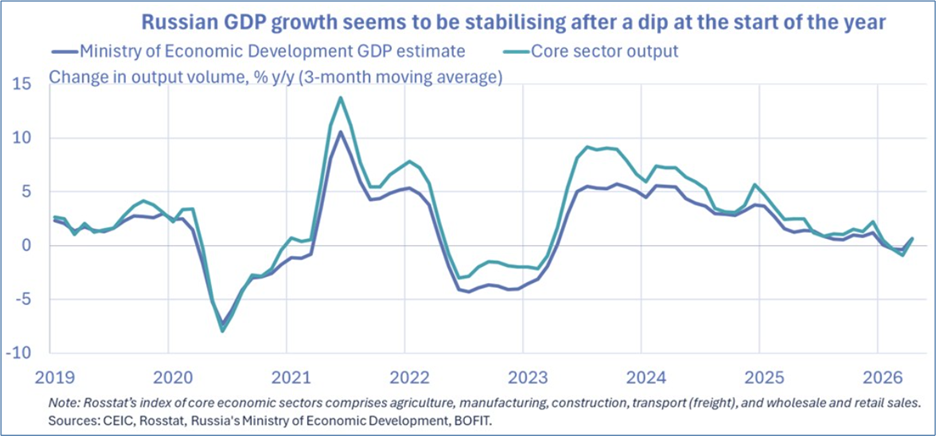
In its weekly report, BOFIT, the research institute of the Bank of Finland, compares in the following chart how production in the five "core sectors" of the Russian economy recorded by the Rosstat statistics office and the production of the economy as a whole have developed according to the estimates of the Ministry of Economy. BOFIT has calculated the averages of the rates of change compared to the previous year for each month in the last three months (so-called "3-month moving average").
Russia's GDP growth appears to be stabilizing –after a decline at the beginning of the year
BOFIT Weekly: Russian economy stabilizing after weak start of the year, 05.06.26
According to the chart, production in the "core sectors" (agriculture, manufacturing, construction, freight transport, wholesale and retail) fell slightly in March on a 3-month moving average compared to the previous year following an increase at the end of 2025. However, it grew slightly again in April (green line).
According to BOFIT, growth in real gross domestic product was "practically zero" (blue line) in the period from January to April compared to the previous year due to the weak development in the first two months of 2026.
VEB Institute: The sharp GDP slump in January has almost been made up for
Every month, the research institute of the state development company VEB.RF estimates how Russia's overall economic production will develop from month to month, adjusted for seasonal and calendar effects. In January 2026, the VEB Institute recorded a sharp slump in real gross domestic product after it had reached a new high at the end of 2025. However, overall economic production has now largely recovered from this slump.
Index of real gross domestic product (Jan. 2014=100)seasonally and calendar-adjusted; estimate by the VEB Institute
VEB Institute: World Economy and Markets, 05.06.26t.
According to the VEB Institute, GDP growth continued in April for the third month in a row. The growth rate reached a seasonally and calendar-adjusted +0.4% compared to the previous month (first line of the following table). Compared to April 2025, overall economic production rose by 1.1% according to the VEB Institute.
Real GDP growth compared to the previous month (seasonally and calendar-adjusted) and compared to the same month of the previous year in percent
Almost all sectors of the economy made positive contributions to economic growth in April compared to March. The VEB Institute only calculated declines in production for wholesale and mining. Production in agriculture stagnated.
EBRD and OECD maintain their low growth forecasts for Russia
The London-based European Bank for Reconstruction and Development had already forecast at the end of February that the real increase in Russia's gross domestic product is likely to slow from 1.0% to 0.8% in 2026. It is also unlikely to be higher in 2027 (+1.0%). The EBRD stood by these forecasts on June 3 (PM).
The Paris-based OECD continues to expect even less growth in Russia. In its "Economic Outlook", it has now lowered its Russia forecast for 2026 slightly to 0.5%. This means that the OECD forecast is now almost as low as the Russian government's growth forecast (+0.4%). According to the OECD, Russia's economic growth will also remain below one percent next year (+0.8%). By contrast, the government expects economic growth to pick up to 1.4% in 2027.
In its quarterly forecast, the Institute for Economic Forecasting of the Russian Academy of Sciences (IEF-RAS) now estimates the growth trend in Russia to be almost the same as the EBRD. The Institute for Economic Forecasting lowered its growth forecast for 2026 published in mid-March from +1.1% to +0.7% and its forecast for 2027 from +1.4% to +1.1%.
GDP forecasts for Russia 2024 to 2027Change in real gross domestic product compared to the previous year in per cent
The CMASF currently sees Russia's economy "on the brink of stagflation"
At the end of May, the Moscow-based Center for Macroeconomic Analysis and Short-term Forecasting (CMASF) slightly raised its forecast range for GDP growth in 2026 to +0.5 to +0.8 percent in its monthly update of its forecast for the Russian economy. However, it lowered its growth forecast for 2027 from +1.2 to +1.5 percent to just +0.8 to +1.0 percent. In an accompanying commentary, the CMASF currently sees the Russian economy "on the verge of stagflation":
"In terms of the relationship between the development of inflation and overall economic output, the Russian economy has effectively entered stagflation - GDP fell in the first quarter despite a significant rise in prices. Although a slight economic recovery is expected in the second quarter, it is unlikely to change the position on the edge of stagflation."
The CMASF believes that the measures taken by the government and central bank have continued to have a dampening effect on the economy. Negative stimuli from government fiscal policy (withdrawal of funds from the economy) have been combined with high interest rates by the central bank.
Symptoms of the "Dutch disease" in the Russian economy
Against the backdrop of expectations that the rise in energy prices will stimulate growth in the Russian economy, the CMASF has published its opinion on the expected economic development in 2026:
"Despite the very favorable external economic situation, the macroeconomic forecast parameters have changed only slightly. In the baseline scenario, the external economic situation will lead to growth through increased exports and growth along the consumption chain due to the high rouble exchange rate and high interest rates (with an increase in wages and incomes, private consumption will ultimately rise by 1.7 to 2.0% in 2026).
At the same time, there are no signs of increased investment activity (a decline in investment is expected) and growth in private consumption will be increasingly offset by rapidly rising imports.
As a result,… GDP growth in 2026 is expected to be a meagre 0.5 to 0.8% against the backdrop of inflation of 4.6 to 5.0%."
In view of these forecasts, the CMASF is reminiscent of the "Dutch disease".
Comparison of the CMASF forecasts with the government forecasts
In the following table, the CMASF compares its forecasts for the development of real gross domestic product in the "basic variant" and in the "optimistic variant" with the basic forecasts of the Russian Ministry of Economy.
The table is followed by comparisons of the forecasts for:
Investments in property, plant and equipment,
Consumption by private households (sum of retail sales and paid services for the population),
Inflation: increase in consumer prices (December compared to December),
Unemployment rate (in % of the working population),
Urals crude oil price, dollars per barrel
CMASF and government forecasts 2026 to 2029
When comparing the base variants of the CMASF and government forecasts, the CMASF expects 2026:
a sharper decline in investments in property, plant and equipment(CMASF: -2.6 to -2.2%; government: – 1.5%),
a significantly stronger increase in private consumption(CMASF: +1.7 to +2.0%; government: +1.0%),
a lower annual increase in consumer prices in December(CMASF: +4.6 to +5.0%; government: +5.2%),
a similarly low unemployment rate (CMASF: 2.2 to 2.5%; government: 2.4%)
The oil price trend is assessed very differently: While the government anticipates a Urals oil price of USD 59/barrel in its base scenario for 2026, the CMASF expects a price of USD 80 to 82/barrel this year.
However, Russian Finance Minister Anton Siluanov noted at the SPIEF that his ministry had assumed an oil price of around USD 59 to 60 per barrel in its calculations for 2026. In the meantime, however, market conditions have improved significantly. Siluanov explained that the Russian budget could generate additional revenue of around one trillion roubles due to the situation in the Strait of Hormuz. This could contribute to achieving the budget targets (Financial One; 05.06.26).
President Putin: After the intended "cooling down", we are on the upswing
The current development of the Russian economy was also one of the central topics of President Putin's speech in the plenary session at the economic forum in St. Petersburg (speech text in English: en.kremlin.ru; video by DRM News). He acknowledged the slowdown in economic growth, but emphasized that it had been intended by the government.
Putin compared the decline in growth in Russia with the economic development in the Eurozone:
"Of course we hear criticism from all sides that growth has lost steam. Yes, but we have only fallen to the same level that the eurozone countries have experienced in recent years. And now we are on the upswing. The most important thing is that we have preserved the principles of our macroeconomic policy."
In his speech, the President recalled that the government is pursuing the goal of returning to "sustainable" economic growth rates next year. This could only be achieved on one condition: through higher investment with the start of a new investment cycle. From 2021 to 2024, investment in Russia increased by almost 38 percent in real terms. However, there was a decline in investment last year (capital investment fell by 2.5% in 2025 according to Rosstat, according to the Moscow Times).
According to the president, it is important to achieve balanced growth, supported by domestic demand and associated with a further decline in inflation. In 2026, the price increase is expected to fall to 5.2% (according to the government forecast at the end of the year).
According to fontanka.ru, the president thus supported the government's financial policy and the policy of the Central Bank of Russia, which aims to combat inflation, even at the expense of economic growth. As a "key message from the Kremlin", fontanka.ru emphasizes that the current economic slowdown is a temporary phase that is considered necessary for long-term economic stability.
In his speech, Putin also hinted that the budget deficit could continue to grow in the current year. However, he emphasized that it is currently only 2.6 percent, which is below the deficit ratios of European countries. DPA notes: Due to the high interest rates on loans associated with inflation, the Russian government has to spend comparatively more money than EU countries to service its national debt.
BOFIT: Fixed asset investments continued to fall in the first quarter of 2026
The BOFIT research institute of the Bank of Finland published the following summarized information on the decline in investments mentioned by President Putin in its latest weekly report:
According to preliminary figures from Rosstat, investments in property, plant and equipment fell by around 14% in the first quarter of 2026 compared to the previous year. The last time such a sharp decline in investment activity was recorded was in 2009 during the global financial crisis.
Fixed asset investments slump by around 14% in the first quarterAnnual change in fixed asset investments in percent
BOFIT Weekly: Russian economy stabilizing after weak start of the year, 05.06.26
Investments have fallen significantly in almost all sectors of the economy this year. The few exceptions include public administration and national defense services, finance and insurance, the aerospace industry and tourism.
Financing investments has become much more difficult. In recent years, companies have increasingly financed their investments from their own funds. From January to March, however, total corporate profits fell by 26% compared to the previous year, with 37% of companies recording losses in the first quarter. The proportion of loss-making companies is slightly higher this year than in the pandemic year 2020, when the last peak was reached.
The government has also increased corporate taxes. Corporation tax was already raised last year. Further tax increases are being prepared.
The cost of credit for companies has also remained high, as the central bank has only been able to gradually reduce the prime rate. The share of bank loans in investment financing fell last year.
Surveys show that companies are also less optimistic about their future investment plans. They believe that the outlook for demand has deteriorated and capacity utilization has fallen significantly in many sectors.
On the production side, the weakness in investment was particularly evident in the construction industry. Construction output fell by a further 5% in April compared to the previous year. In the period from January to April, construction output was 8% lower.
In her detailed economic analysis for April, Olga Belenkaya, chief economist at the financial institution FINAM, points out that the Ministry of Economic Development's new economic forecast for 2026 assumes a 1.5% decline in fixed asset investments. According to Economy Minister Reshetnikov, the 14.3 % decline in investments in the first quarter is not in line with the simultaneous slight decline in GDP (-0.2 %). The minister expects the development of investments and GDP to converge more strongly in the next two quarters (see also: United24 Media).
Further current economic data for April
Olga Belenkaya highlights the following current trends in her analysis:
According to the Ministry of Economic Development, real gross domestic product showed a slight upward trend in the first four months of 2026 (+0.2% year-on-year), after falling by 0.2% year-on-year in the first quarter of 2026.
The ministry estimated GDP growth in April at 1.3% year-on-year, after 1.9% in March. Seasonally adjusted, GDP fell by 0.5% in April compared to the previous month. The growth in overall economic production in April was supported by developments in industry, consumer demand and freight transport, while in industry the increase in production in April (+1.9%) continued to be driven by only a few sectors, primarily the defense industry. Among the numerous sectors with declining production, metallurgy in particular is suffering from the consequences of falling construction activity and the strong rouble. The refinery sector recorded the largest decline in production in April (damage to facilities due to attacks by Ukraine).
According to the "Center for Macroeconomic Analysis and Short-Term Forecasting (CMASF)", industrial production in the "civilian" industrial sectors was 2.9 percent lower in April than a year ago. Excluding the refinery sector, the decline is estimated at 2.2 percent.
According to Rosstat, the seasonally adjusted growth in industrial production compared to the previous month accelerated slightly to 0.3% in April (March: +0.2%).
Growth in the wholesale sector slowed to +2.3% year-on-year in April, after +8% in March;
Freight throughput recorded annual growth for the first time this year in April (+3.7%), driven primarily by rail transport (+4.1%). The above-average growth in freight throughput indicates an increase in transport distances (shift in transport towards the east).
Although the annual decline in production in the construction industry slowed somewhat in April (-5%), the cumulative decline in the first four months amounted to -8.4% compared to the previous year.
According to the Ministry of Economic Development, the indicator for consumption development, the real total turnover of retail trade, services for the population and gastronomy, rose by 5.8% in real terms in April 2026 compared to the previous year, after +5.9% in the previous month. In the first four months of 2026, growth in consumer activity amounted to 4.2% compared to the previous year.
In the retail sector, real sales growth of 6.5% in April exceeded market expectations, as in March. The Ministry of Economic Development sees the main reason for this in the increase in car sales (+40.6% year-on-year).
In the hospitality industry, turnover rose by 6.2% in April compared to the previous year. From January to April, turnover increased by 6.5%, according to the Rosstat report on the socio-economic situation in the Russian Federation (Financial One.ru).
Economic indicators April 2026 compared to April 2025Changes compared to previous year in %
Unemployment rate remains low and wages are rising sharply
The labor market situation hardly changed in April compared to the previous month. The unemployment rate remained close to a historic low (2.2%). However, there are signs that the shortage of labor is easing, e.g. reduced hiring plans on the part of companies.
However, according to the data available so far, wages rose even more strongly in the first quarter of 2026 than in the first quarter of 2025 (15.1% nominal, 8.7% real). However, Olga Belenkaya notes that a breakdown by sector shows that the development is very uneven. Wage growth rates are well below the national average in many sectors. Apparently, the salary statistics show distortions due to shifts in the timing of annual bonus payments. She expects a clearer picture of salary trends when the data for the second quarter of 2026 is available.
Central bank: "Inefficient distribution of the workforce" and "underemployment"
In the "Summary of the key rate discussion" published by the Central Bank of Russia, the participants stated the following about the development of the labor market: "Although labor shortages are decreasing, many companies continue to suffer from staff shortages. At the same time, others are reluctant to lay off employees - partly because they have already experienced staff shortages in previous years - and are therefore trying to retain their workforce even if demand for their products falls. They fear that they will find it difficult to restore their workforce in the future.
As a result, there is an inefficient distribution of labor. … Under these conditions, the labor market adjusts primarily through slower wage and bonus growth and an increase in underemployment."
The "leading indicators" signal an economic slowdown in May
At 49.2 index points, the composite purchasing managers' index (PMI) determined by S&P Global in surveys of Russian companies remained slightly below the "growth threshold" of 50 points in May. As S&P Global notes, despite a recovery in manufacturing output growth, a stronger decline in service production had a negative impact on the development of the combined index. A decline in incoming orders led to further job cuts. The order backlog fell more sharply than at any time in the last four years.
Russia: Combined Purchasing Managers' Index
Tradinig Economics: Russia Composite PMI, 03.06.26
The Central Bank of Russia's business survey also indicated a slowdown in business activity growth in May due to lower price expectations.
PSB Bank advises more expansive monetary policy
Denis Popov, chief analyst at the state-owned PSB Bank, draws the following conclusion from the economic data:
Despite the generally good signals regarding the current economic situation (increased economic activity in March and April), the indicators for medium and long-term economic development continue to deteriorate. Rosstat recorded a slump in fixed asset investments in the first quarter (-14.3% compared to the previous year; the sharpest decline since the third quarter of 2009). This indicates a significant decline in production potential. As companies are generally withdrawing from investments, the volume of completed construction projects is also falling rapidly. Negative investment trends have been observed for a year now. The downward trend is even accelerating. Under these circumstances, we believe that a more expansive monetary policy is advisable (t.me; see also: Finam.ru).
Reading tips:
German-Russian Chamber of Commerce Abroad: Analyses, German; also Russian; (selection):
SPIEF 2026: Lots of Asia, but Germany No. 1 among Western countries, 04.06.26
Ruble exchange rate: Why there is weakness in strength, 29.05.26
Hormuz consequences for Russia and Germany between model and reality, 28.05.26
Russia and China: More tourists, less business, 26.05.26
"Die Presse" podcast on the Russian economy: Russia - gas, sanctions, oligarchs: HostEduard Steiner (Die Presse) and economist Vasily Astrov (wiiw) in conversation with guests:
Is peace in Ukraine in sight? And how dangerous will Russia's military then be for Europe? Guest: Military expert Wolfang Richter, former German colonel, 03.06.26;from min. 16:30 to 28: Vasily Astrov on the participation of Western companies in SPIEF, the development of the Russian economy and the priorities of economic policy
Fear in the Kremlin: Are the Russians ready to chase Putin out of office? guest: Prof. Gerhard Mangott (University of Innsbruck), 30.04.26
SPIEF 2026:
The Moscow Times:Putin Talks Multipolarity and Shrugs Off Economic Pain at 'Russian Davos', 06.06.26
Russia's Pivot to Asia: Putin's Speech At SPIEF 2026: Full Content & Detailed Analysis, 06.06.26
Finanzmarktwelt; Josephine Bollinger-Kanne: The four apocalyptic horsemen for economic growth in Russia. In Russia, the key interest rate, taxes, the strong rouble and administrative hurdles are seen as a major burden; 06.06.26
fontanka.ru: Putin at SPIEF 2026: No isolation, Russia's "cooling off", war in Iran and "Work, brothers!" Russia focuses on a new global economy, technological independence and long-term sustainability; 05.06.26
Der Stern, DPA: Putin admits economic problems in Russia, 05.06.26
rte.ie; AFP: The Russian economy has not collapsed, says Putin at an important forum, 05.06.26
en.kremlin.ru: Plenary session of the St Petersburg International Economic Forum. Vladimir Putin took part in the plenary session; speech text, English; 05.06.26.
Business-magazine; Sergei Lysenkov: The share of oil and gas in Russia's GDP has almost halved, Putin said; 05.06.26
russia.capital: Putin promotes Nord Stream: "One push of a button" - but Berlin would have to decide, 05.06.26
Prime.ru: Novak gave a forecast for Russia's GDP growth. Deputy Prime Minister Novak said he expects Russia's GDP growth to be 0.4% by the end of 2026, 05.06.26
vesti.ru; Alexey Karpenko: Novak expressed confidence that investments in the Russian economy will increase by the end of 2026, 05.06.26
vesti.ru: Gref explained why it is necessary to switch to a policy of economic recovery, 05.06.26
Financial One: High oil prices could reduce the budget deficit by 1 trillion rubles. This was stated by Finance Minister Anton Siluanov at SPIEF, 05.06.26
vesti.ru: The Russian Union of Industrialists and Entrepreneurs (RSPP) has announced which key interest rate would be favorable for companies in Russia, 05.06.26
German-Russian Chamber of Commerce Abroad: SPIEF 2026: A lot of Asia, but Germany No. 1 among Western countries, 04.06.26
Moskauer Zeitung; Sasha Paraponov: In adaptation mode: German companies in Russia. Just in time for the economic forum in St. Petersburg, the German-Russian Chamber of Commerce Abroad has presented the results of its survey of German companies in Russia, 04.06.26
Inosmi.ru; Die Welt; Andreas Macho, Daniel Zwick, Carsten Dierig: International Economic Forum St. Petersburg. Business with Russia for "ethical reasons" - the myth of a mass exodus of German companies, 05.06.26; original article in "Die Welt", 04.06.26
Inosmi.ru: Putin answered questions from leading international media representatives at SPIEF 2026, 04.06.26
russia.capital: Manturov sees Russia's industry on track despite sanctions, 04.06.26
NDR Info; "Das Thema"; Peter Mücke: Four years of war – Russia's economy on the ground? Audio, 11 min., including interview with Janis Kluge, Stiftung Wissenschaft und Politik, 04.06.26
NDR Info; Podcast: „Zehn Minuten Wirtschaft“, Astrid Kühn and Nicolas Lieven:German companies at the Putin Forum: Business despite the war? 04.06.26.
Tagesschau.de: Economic forum in St. Petersburg: How Putin uses the event; Interview with ARD correspondent Silke Diettrich about the background; 04.06.26
World news channel; Interview with Michael Roth, SPD, on the SPIEF and the participation of AFD politicians: Fierce attack against the AfD! „Embarrassing! That's a kind of betrayal of the fatherland “, 04.06.26
DW.com; Sabine Klose: Who from the Alternative for Germany took part in Putin's forum? 04.06.26
t-online.de, Jakob Hartung: Bruch, Dürr, Friedrich: These German entrepreneurs are traveling to Putin's economic forum, 03.06.26
Tagesschau; Kerstin Dausend: AfD politicians and German companies in St. Petersburg: Marc Henrichmann, CDU: "Naive and stupid", Video, 2 Min., 03.06.26
ntv.de; Frauke Niemeyer: Forum in St. Petersburg. A German stands on Putin's stage; Thomas Bruch, Globus-Holding, which is involved in hypermarkets for food in Russia; with quotes from Prof. Michael Rochlitz on the effectiveness of sanctions; 03.06.26
Berliner Morgenpost, Funke Mediengruppe; Jo Angerer, Freelance Correspondent: Wirtschaftsforum St. Petersburg. New desire to do business with Putin: German companies in Russia satisfied, 02.06.26
Der Standard; Jo Angerer from Moscow: Business meeting. Some companies are holding on to their business with Russia - and want gas from Russia again. This year's economic forum in St. Petersburg also invites to a German-Russian economic dialog, 03.06.26
Russia's Pivot to Asia: SPIEF 2026 International Investment Forum Opens in St. Petersburg: US Attends For First Time In Years, 03.06.26
Kronenzeitung; Matthias Fuchs: The economy is groaning. Russian managers urge Putin to end the war, 02.06.26
FOCUS online; Anne-Kathrin Oestmann: Risky criticism of the war. Russian business bosses rebel against Putin, 03.06.26
Manager-Magazin: Meeting in St. Petersburg. Germans take part in Putin's economic forum again. The head of the German-Russian Chamber of Commerce Abroad does not want to "leave the market to Asia in the long term"; 31.05.26
Forecasts:
EBRD; Ksenia Yakustidi: Growth in EBRD regions slows as Middle East conflict sparks energy shock and disrupts supply chains, 03.06.26
OECD: OECD Economic Outlook, Volume 2026 Issue 1: Under Pressure, 03.06.26
Reuters, Press Reader: Analysts cut Russia’s GDP forecast, rouble to weaken less, 29.05.26
Institute of Economic Forecasting of the Russian Academy of Sciences; IEF-RAS: Quarterly GDP Forecast. Issue No. 70, 02.06.26
1Prime.ru. Svetlana Medvedeva: "Better than us." How Russia surprised the EU. Spring forecast of the EU Commission for the EU, Russia and Germany; 28.05.26
Higher School of Economics, S.V. Smirnov : Consensus forecast of the Development Center Institute, 27.05.26; Archive of issues
Kommersant on UNCTAD forecasts: Trade will slow down along with GDP. Forecast of the United Nations Conference on Trade and Development (UNCTAD), 25.05.26
Current economic development:
VEB Institute: World Economy and Markets, 05.06.26.
BOFIT Weekly: Russian economy stabilizing after weak start of the year, 05.06.26
Olga Belenkaya; Finam.ru: Results April 2026 - The economy is showing signs of recovery in spring. Macroeconomic data give reason to believe that the central bank will continue its 50 basis point rate cut in June; 04.06.26
The Moscow Times: Rosstat reported an unprecedented slump in investment in Russia since 2009, 04.06.26
United24 Media, Katherina Popilnichenko: Russian Investment Sees Record Decline in 16 Years as Economy Faces Pressure, 04.06.26
Manager Magazin; Nele Geiger: Economic forum in Petersburg. How Putin wants to talk away the Russian economic crisis. It is increasingly affecting citizens and companies, 04.06.26
Tagesschau; Silke Diettrich, ARD Moscow: Mood in Russia. Why many Russians are increasingly unsettled, 04.06.26
Tagesschau.de; Jürgen Buch, ARD Moscow: Poor economic situation. Russia's debts are rising, the economy is sluggish; 03.06.26
RBC.ru; Ivan Tkachev, head of the economic department: The Ministry of Economic Development reported a slowdown in Russian economic growth, 03.06.26
Politics and economy in Russia; overall economic development:
t-online.de;Patrick Diekmann: Putin's problems are growing. The closer you look, the clearer it becomes, 06.06.26
Prime.ru: Novak gave a forecast for Russia's GDP growth. Deputy Prime Minister Novak said he expects Russia's GDP growth to be 0.4% by the end of 2026, 05.06.26
vesti.ru; Alexey Karpenko: Novak expressed confidence that investments in the Russian economy will increase by the end of 2026, 05.06.26
vesti.ru: Gref explained why it is necessary to switch to a policy of economic recovery, 05.06.26
russia.capital: Manturov sees Russia's industry on course despite sanctions, 04.06.26
Alexander Shokhin, President of the Russian Union of Entrepreneurs and Economic Ombudsman in an interview with RBC-ru: Shokhin proposed "mirror image" conditions for businesses in Russia and the West, 03.06.26
ORF III Aktuell interview; WIIW economist Vasily Astrov: „Russian economy is stagnating “ Russia imposed an export ban on kerosene, Video, 11 min., 02.06.26
FR.de; Nils Thomas Hinsberger: Putin's economy under pressure: Companies in Russia struggle to survive, 02.06.26
Business City Petersburg, Anton Taranukha: GDP forecast, Shokhin's promotion and preferential mortgages: The most important economic events in May, 29.05.26
russia.capital: Russia's business association warns government: don't "squeeze the economy too hard", May 26, 2026
The post Controversial economic analyses at the economic forum in St. Petersburg appeared first on ostwirtschaft.de.
Original article (German):
Read on ostwirtschaft.de →