Unexpectedly weak start for the Russian economy

Author: Klaus Dormann
Last week, the Rosstat statistics office published further economic data for the month of January. A year-on-year comparison with January 2025 shows an unexpectedly sharp decline in production in the Russian economy. The Ministry of Economic Development estimated that Russia's real gross domestic product in January was 2.1% lower than in January 2025.
A certain slowdown in economic activity at the beginning of 2026 had been expected. The Russian central bank expected that the upcoming increase in VAT in 2026 and the announced increase in the recycling fee for car purchases would only temporarily boost demand until the end of 2025. At the beginning of 2026, in return for this "growth spurt" at the end of the year, a decline in consumer growth is to be expected, the central bank assumed.
However, some of the economic data for January was even worse than expected. In an Interfax analyst survey, for example, industrial production was still expected to rise by 0.9 percent in January. However, industrial production actually fell by 0.8% year-on-year in January. And real retail sales rose by only 0.7% in January, far less than analysts had expected (+1.9%). This was reported by Olga Belenkaya, Chief Economist of the stock exchange company FINAM, in a detailed analysis of the Russian economy's "weak start" to 2026.
The initial situation of the Russian economy at the turn of the year 2025/2026
In the Moscow business magazine Profile.ru, senior correspondent Vladislav Grinkevich summarized the current "problem situation" of the Russian economy at the beginning of March as follows:
"In fact, the Russian economy is facing numerous problems: Growth is slowing, inflation remains high, the industrial sector is in a downturn, and the labor market is tight. Nevertheless, most experts agree that there can be no talk of a crisis, let alone a collapse of the Russian economy. However, it must be recognized that this year will be the most difficult since 2022."
Grinkevich points in particular to the rising deficit in the federal budget and the decline in production in many industrial sectors outside the defence sector.
Russia's federal budget deficit has increased significantly in 2025
According to Grinkevich, the budget deficit has already risen to 2.6 percent of GDP in 2025, although a reduction to 0.5 percent of GDP was originally planned.
According to "intelligence findings" by the German Federal Intelligence Service (BND), the deficit even rose to 3.7 percent of GDP at 8.0 trillion roubles (Die Welt, ZDF). According to the BND, the deficit was around 42 percent higher than stated by the government.
Picture of the BND:
Increase in the deficit in the Russian federal budget
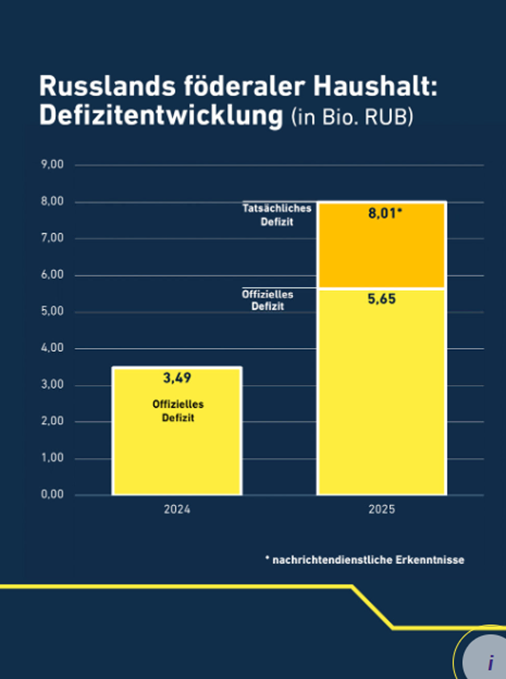
Federal Intelligence Service, BND: Russian economy in the red: Sanktionen wirken, Defizit steigt deutlich, Investitionsstandort wird zum unwägbaren Risiko, 04.03.26
Grinkevich: The decline in oil and gas revenues is financeable
According to Grinkevich, the main reason for the increase in the deficit in 2025 was the 24 percent decline in state revenues from the oil and gas sector due to low world market prices. Forecasts by the independent "Centre for Research on Energy and Clean Air" (CREA), which is registered in Finland, indicate that oil and gas revenues are expected to fall by a further 27% in 2026.
Grinkevich emphasizes, however, that this decline is "no reason to panic". According to Sergei Khestanov (Associate Professor at the Russian Presidential Academy of the National Economy and Public Administration, RANEPA), the Russian state has reserves to cover the budget deficit. The liquid portion of the National Welfare Fund still amounts to around 4 trillion roubles. The potential for borrowing government bonds comprises a further 3 to 3.5 trillion roubles.
According to Die Welt, analysts from the German government also do not expect Russia to have to end the war in Ukraine in the short term for financial reasons. Recently, the head of Finnish military intelligence, Pekka Turunen, told WELT that Russia could continue the war from a financial perspective "at least this year and perhaps next."
Since 2018, the share of revenues from the oil and gas sector in the total revenues of the federal budget has already halved. According to Tatiana Mitrova (Global Fellow at the Center on Global Energy Policy Columbia University), it fell from 46 percent in 2018 to 23 percent in 2025.
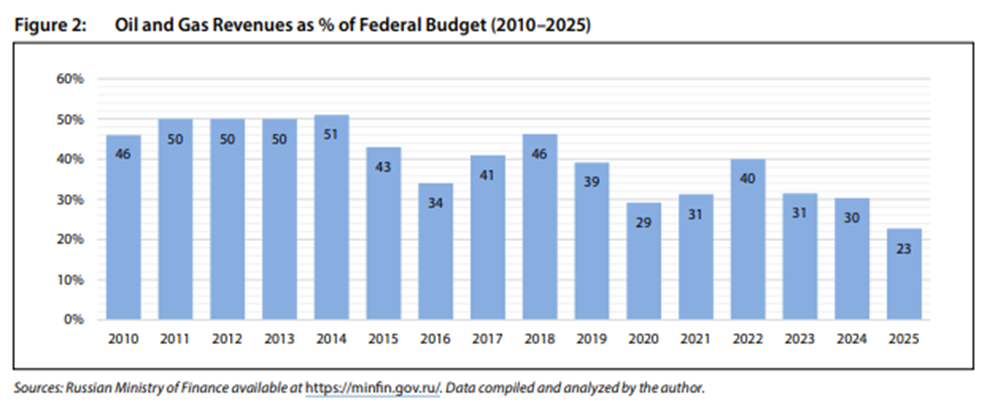
Tatiana Mitrova (Columbia University): Russian Oil under Pressure: Adaptation, Fiscal Reconfiguration, and Domestic Constraints; in: RUSSIAN ANALYTICAL DIGEST No. 335, 18.02.26
Can the rise in oil prices help Russia with budget financing?
As a result of the war in the Middle East, oil prices have risen sharply. The following figure from the weekly report published on Friday by the Institute of the Russian State Development Corporation VEB.RF shows: The price of Brent oil rose to around 85 dollars/barrel on March 05. Russian Urals oil was quoted at around 72 dollars/barrel. The "discount" of Urals oil compared to Brent was therefore around 16% (gray area, left scale in the following figure).
Oil prices: Urals and Brent in US-$/barrel; Urals discount in %
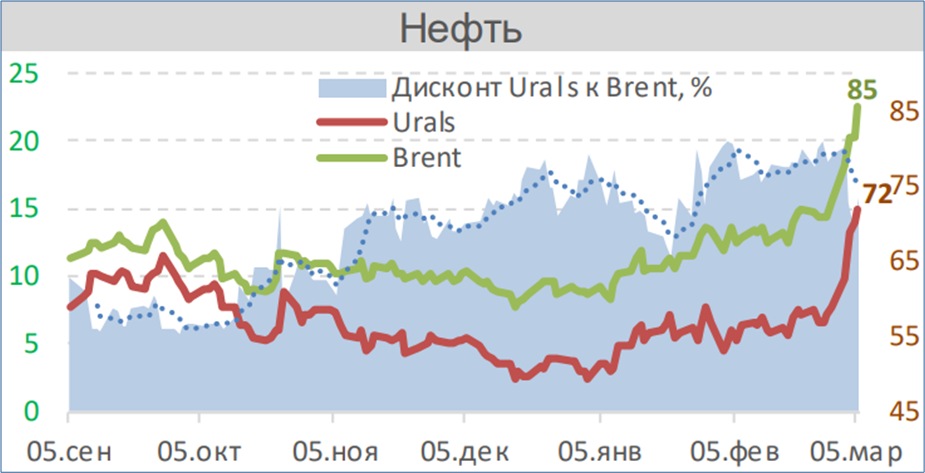
VEB Institute: World Economic and Market Outlook, 06.03.26
Alexander Kolyandr, Senior Fellow at the "Democratic Resilience Program" at the "Center for European Policy Analysis (CEPA)", believes, however, according to the title of his CEPA article, that the Iran war will not save Russia's "ailing economy". Russia is in serious difficulties due to the growing budget deficit.
The conclusion of his article: The impact of the war on oil prices could indeed help Russia. However, unless oil prices remain at a high level in the long term and the rouble depreciates significantly, the budget problems are likely to persist for a long time to come.
According to Kolyandr, the Russian government now seems ready to acknowledge its budget problems. Apparently, the experts have succeeded in persuading President Putin to restrict spending. This will slow down the most important driver of economic growth in the last three years. As cuts in military spending are practically impossible, the already stagnating civilian sectors of the economy would be disproportionately burdened by the reduction in spending.
The production of the "civilian" sectors of industry is stagnating or declining
Vladislav Grinkevich also sees the development of Russian industry split into two blocks: The first block, the defense industry, is prioritized by the state and is growing. Production in the second "civilian" block of industry, on the other hand, is stagnating or even declining.
According to Grinkevich, the focus of public spending will continue to be on financing the "security forces" "in the near future". According to the 2026 budget plan, spending on "national defense" and "national security" will amount to 12.1 trillion rubles and 3.8 trillion rubles respectively, i.e. a total of almost 16 trillion rubles. By comparison, spending on the civilian "national economy" sector will amount to 4.8 trillion roubles.
How the government explains the GDP decline in January 2026
To explain the 2.1 percent decline in overall economic output in January 2026 compared to January 2025, the Ministry of Economy pointed to the high comparative basis of January of the previous year. In January 2025, real GDP had risen by a strong 2.9% compared to the same month last year.
In January 2026, there were only 15 working days - two days fewer than in January 2025 with 17 working days.
Another reason was this year's significantly colder weather compared to January 2025. Construction output in January 2026 was 16% lower than a year ago due to the weather.
CSR Institute estimates calendar-adjusted GDP decline at 0.8 percent
According to initial calculations by Daniil Nametkin, Director of the Center for Investment Analysis and Macroeconomic Research CSR, if one takes into account that there were two more working days in January a year ago, GDP in January 2026 "calendar-adjusted" fell by only 0.8 percent compared to the same month last year (press release; Public News Service OSN). Nametkin emphasized that the current decline in GDP in January is not a long-term trend. The future development will largely depend on the monetary policy of the Russian central bank. If the key interest rate is lowered further, a recovery in business activity and investment growth in a number of industries can be expected.
This is how the production of the "core industries" developed in January
The index of goods and services production in the so-called "core industries" of the Russian economy fell by 3.2% in January compared to the previous year.
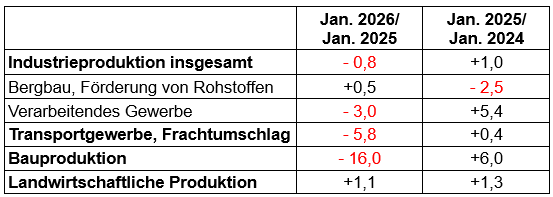
The following sectors recorded declines in production compared to January 2025: industry (-0.8%), construction (-16%), wholesale trade (-11.3%) and goods transportation (-5.8%).
On the 0.8 percent decline in industrial production, Kommersant editor Artem Chugunov drew the following conclusion:
"Although the decline is due to calendar effects, according to the ministry, analyst estimates and data from business surveys indicate a continuing trend: Civilian industry is stagnating and production growth has returned to zero or even negative after a sharp rise in December."
Growth in real retail sales slowed to 0.7% year-on-year in January. At the same time, sales of services for the population continued to grow by 2.7%. Turnover growth in the hospitality industry even accelerated to 15.1% (despite press reports of restaurant closures).
Economic indicators at the beginning of 2026
Changes compared to the previous year in %

Finam.ru; Olga Belenkaya: Results January 2026 - A weak start to the year, 05.03.26
Wages grew much more slowly in December
Wage growth slowed significantly in December, both in nominal and real terms (Rosstat has not yet published data for January). Olga Belenkaya sees this as a further sign of easing on the labor market in light of the ongoing economic slowdown. Wage growth is thus approaching the growth rate of labor productivity. According to the central bank, this is an important prerequisite for reducing the ongoing inflationary pressure.
In nominal terms, the rise in wages slowed to +8.1% in December compared to the previous year (after +12.8% in November). In real terms, wage growth fell to +2.4% (after +5.8% in November). With this sharp slowdown in wage growth in December, however, it must be taken into account that wages rose very sharply a year earlier in December 2024 because the payment of annual bonuses was brought forward to December 2024 before a sharper income tax progression came into force. In December 2024, wages rose by 21.9% in nominal terms and 11.3% in real terms compared to the previous year.
Industry produced 0.8% less in January than a year ago
For the first time since February 2025, industrial production fell in January 2026 compared to the previous year. After strong growth in December (+3.7% year-on-year), it was 0.8% lower in January than a year ago (Finmarket.ru). Industry contributed to the annual growth of Russia's gross domestic product by 1.0% in real terms last year with a 1.3% increase in production in 2025.
In January 2026, industrial production stagnated at the level reached in December 2025, adjusted for seasonal and calendar effects, according to an initial estimate by the Rosstat statistics office. Evgeny Kogan's Bitcoin Hotline published the following copy of a Rosstat illustration. The stagnation of the index of seasonally and calendar-adjusted industrial production is shown by the gray line, which is partially overlaid by the light blue trend line calculated by Rosstat.
Indices of industrial production according to Rosstat

dark blue line: unadjusted; grey line: seasonally and calendar adjusted; light blue line: trend
Source: Evgeny Kogan: Russian industry stagnates after a turbulent December; 27.02.26
Manufacturing production was 3 percent lower in January
The 0.8 percent year-on-year decline in total industrial production in January 2026 was mainly due to the 3.0 percent decrease in production in the "manufacturing sector".
In contrast, production in mining and extraction of raw materials was 0.5 percent higher in January than a year ago. According to Interfax estimates, natural gas production rose by 6.5% in January compared to the previous year (the highest increase in the last four years), which is due to the cold weather. Coal production, on the other hand, fell by 6.6%.
Among the few "growth drivers" in the manufacturing industry in January were two sectors from the defense industry: the production of "other transport vehicles and equipment (including aircraft construction, shipbuilding, etc.) rose by almost a quarter (+24.5%). The production of computers, electronics and optical products grew by almost a tenth (+9.8%). The manufacture of metal products - on the other hand - recorded a year-on-year decline of 6%.
After falling by 20.2% in December, production in the automotive industry continued to fall sharply in January (-21.3% compared to the previous year). Car production fell by 13% in January compared to the previous year, while truck production fell by almost 36%.
Finam.ru; Olga Belenkaya: Results January 2026 - A weak start to the year, 05.03.26
Cargo throughput in the transportation sector fell by 5.8% year-on-year in January (the sharpest decline since October 2022), following a fall of 1.3% in December. Construction output was 16% lower - due to weather conditions - while agricultural production rose (+ 1.1%).
Very contrasting estimates of seasonally and calendar-adjusted development
While the first Rosstat estimates show that industrial production in January 2026 stagnated at the level of December 2025 after seasonal and calendar adjustments, other estimates came to significantly different conclusions. The Moscow Center for Macroeconomic Analysis and Short-Term Forecasting (CMASF) has compared its own estimates with the Rosstat estimates and estimates from the Moscow Higher School of Economics (HSE) in the following figure.
The upper red line shows that industrial production stagnated at the index level of 112.7 in January, adjusted according to Rosstat.
The CMASF estimates shown with the light blue line had previously deviated only slightly from the Rosstat estimates. However, according to CMASF, industrial production fell by 1.7% in January compared to the previous month.
In contrast, according to the HSE's Economic Research Center (green line), production rose by 0.8% compared to December.
Industrial production according to Rosstat, CMASF and HSE estimates
(seasonally adjusted, monthly average 2021 = 100)

* Manufacture of fabricated metal products not classified in any other group; Computer, electronic and optical products; Aerospace industry; Other transportation vehicles not classified in any other group
The dark blue line shows CMASF estimates of how "manufacturing" production, excluding defense industry and petroleum refinery production, develops. It fell sharply in the course of 2025 and reached a new low in January 2026.
The lower brown line shows CMASF estimates of how total industrial production excluding industries dominated by the defense complex developed.
Academic Director of the HSE: "We have to wait for the quarterly results"
Georgy Ostapkovich, Academic Director of the Center for Market Research at the Higher School of Economics, remarked to the Moscow business portal globalmsk.ru on the economic data published so far for January that the manufacturing sector, the main driver of GDP growth with a share of over 30 % of GDP, has seen a significant decline. However, he said it was still too early to draw conclusions:
"You have to bear in mind that this data comes from the Ministry of Economic Development and Trade. This agency performs all calculations according to its own methods. …
January has always been an unsuitable month for accurate economic analysis, so we will have to wait for the April data when Rosstat summarizes the quarterly results."
Reading tips:
- German-Russian Chamber of Commerce:
Focus analyses, German; also Russian; (selection):
Economic consequences of the Iran war: oil price, Russia, tourism; 02.03.26Weak growth, declining available reserves and high military spending, 18.02.26 - Podcast "Tsars, Data, Facts" of the German-Russian Chamber of Commerce by Thomas Baier:
Low gas storage levels: Europe's challenge in the energy market; Guest: Dr. Heiko Lohmann, „energate Gasmarkt“; 34 min, 01.03.26
From boom to stagnation: Russia's economy in 2026; Guest: Vasily Astrov, 36 min, 17.02.26; - globalmsk.ru: Russia's GDP slipped into negative territory in January, 06.03.26
- SberCIB Investment Research: Oil market: The impact of the Middle East conflict and the blockade of the Strait of Hormuz on global oil prices and Russia, 06.03.26
- Joe Blogs video: Russia crippled. Russia's oil industry is facing a growing list of problems - and rising global oil prices may not be enough to solve them, 10 Min., 05.03.26
- CEPA; Alexander Kolyandr: Iran War Won't Save Putin's Crumbling Economy. Russia is in serious trouble from a ballooning budget deficit. Rising oil prices are unlikely to change the math, 04.03.26
- nv.ua: Pro-Kremlin economists warn Russia's economy shows signs of stagflation, 04.03.26
- Politcom.ru; Marina Voitenko: February 2026: Leading indicators and forecasts, 03.06.26
- VEB Institute: GDP Index December 2025. 03.03.26
- GIS Report; Carole Nakhle: Shadow fleet keeps Russia's oil exports beyond Western reach, 02.03.26
- FinanceRambler: Oil and gas prices rise due to the Middle East war: What does this mean for Russia and the rouble? 02.03.26
- Profile.ru; Vladislav Grinkevich: You have to hold your breath: The Russian economy will have to survive the next year with old reserves, 01.03.26
- MaresMedia.se; Alexander Dionisius: Russia's economy is eating itself - Putin's war is destroying the future, 25.02.26
Economic data and forecasts:
- Public News Service - OSN, Tatyana Ponomareva: Economist Nametki, Director of the Center for Investment Analysis and Macroeconomic Research (CSR), cites the reasons for the 2.1% decline in GDP, 05.03.26
- Elitetrader.ru; Promsvyazbank The Russian Ministry of Economic Development estimated the year-on-year decline in real GDP in January at 2.1%. 05.03.26
- Finam.ru; Olga Belenkaya: Results January 2026 - A weak start to the year, 05.03.26
- Kommersant, Artem Chugunov: Private demand continues to exist. The economic slowdown is only now reaching the labor market, 05.03.26
- Hard figures: Table: Development of key economic indicators May 25 to Jan. 26; 04.03.26
Purchasing Managers' Indices February 2026:
- bne IntelliNews: Russia's service sector PMI loses momentum in February, dropping to 51.3; 04.03.26
- bne IntelliNews: Russia's manufacturing PMI downturn eases to 49.5 but confidence remains fragile, 03.03.26
Gross domestic product in January 2026:
- Finmarket.ru: Russia's GDP fell by 2.1% year-on-year in January, 04.03.26
- Vedomosti: The ministry estimated a 2.1% decline in GDP for January, 04.03.26
More economic data for January 2026:
- Finmarket.ru: Production from core activities in Russia fell by 3.2% in January, 04.03.26
- Finmarket.ru: Retail sales growth slowed to 0.7% in January, 04.03.26
- Finmarket.ru: Real wages in Russia to rise 4.4% by 2025, 04.03.26
- Finmarket.ru: Unemployment rate in Russia remained at 2.2% in January, 04.03.26
- Bitcoin Hotline: Russian labor market remains overheated, 04.03.26
- Monocle.ru: GDP growth in the fourth quarter is most likely a statistical artifact, 02.03.26
- Reuters; Gleb Stolyarov: Russian rail freight drop deepens in February as economy slows, 02.03.26
- Handelsblatt; Jan Wöller: Ranking. Die zehn größten Volkswirtschaften der Welt, 02.03.26
Industrial production in January 2026:
- CMASF: Development of industrial production in January 2025, 05.03.26
- Kommersant; Artem Chugunov: The industrial sector started the year with a decline. The sector's performance fell short of analysts' expectations; 02.03.26
- Finmarket.ru: Industrial production in Russia fell by 0.8% in January; 27.02.26
- Russia.capital.de: Russian industrial production in January 2026 fell for the first time since February 2025, 03.03.26
- Raiffeisenbank; Focus-Pocus: Industry in January: Stagnation after strong December upswing, 02.03.26
- RBC.ru: Rosstat recorded a decline in industrial production in January, 27.02.26
- Evgeny Kogan: Russian industry stagnates after a turbulent December; Rosstat; 27.02.26
- Hard figures: Industrial production: not everything is so simple, 27.02.26
- Kyiv School of Economics: Russia Chart Book February 2026, 27.02.26
- CMASF, Moscow: Basic version of the macroeconomic forecast for 2026-2029, 27.02.26
- CMASF, Moscow: "Analysis of macroeconomic trends", 27.02.26
- SberCIB Investment Research: Inflation in Russia in 2026: Price trends since the beginning of the year and forecasts by analysts, the Central Bank and the Ministry of Economy, 27.02.26 2026Interfax.ru: Inflation in Russia was 0.19% from February 17 to 24, slowing to 5.8% year-on-year; 27.02.26
- Interfax-Russia.ru: 15.5% key rate with noticeable slowdown in inflation still represents restrictive monetary policy that limits lending - Central Bank says. 27.02.26
- Reuters; Elena Fabrichnaya and Gleb Bryanski: Russian rouble seen falling sharply this year as oil sales fall and deficit rises, 26.02.26
Original article (German):
Read on ostwirtschaft.de →