Russia
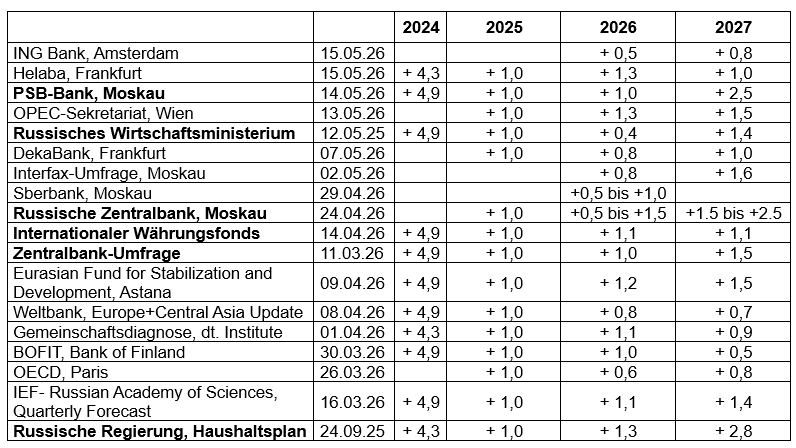
Russia's government expects only 0.4 percent growth in 2026
Author: Klaus Dormann
On May 12, Russia's Ministry of Economy unexpectedly lowered its forecast for this year's growth in the Russian economy. It now only expects real gross domestic product to increase by 0.4% in 2026. Since last September, the government had still expected economic growth of 1.3% in its budget planning.
The main reason for the sharp reduction in the forecast is likely to have been the weak production trend in the first quarter of 2026. The Ministry of Economy itself estimated that overall economic production in the first quarter was 0.3% lower than a year ago. The Rosstat statistics office has since put the decline at 0.2% in an initial estimate.
According to Interfax, the ministry's forecast points to the fact that "monetary policy conditions" are now more restrictive as one reason for the deterioration in growth prospects since fall 2025. The central bank's key interest rate forecast for 2026 is now 14.0 to 14.5 %. In September 2025, the central bank was still forecasting lower key interest rates of 12.0 to 13.0 % for 2026.
Few expect growth to be as weak as the government in 2026
By lowering its growth forecast for 2026 from 1.3% to 0.4%, the government's forecast slips just below the Russian central bank's forecast range of 0.5% to 1.5%. The government's forecast is therefore now also lower than the growth expectations of the major international economic organizations. In mid-April, the IMF raised its forecast for growth in the Russian economy to 1.1%.
Participants in a survey conducted by the Russian central bank in mid-April also expected an average increase in overall economic production of 1.0% for this year. In the monthly analyst survey conducted by the Interfax news agency, participants also lowered their growth forecasts, but only from 1.0% to 0.8% on average for 2026 and from 1.7% to 1.6% for 2027. At 0.3%, the lowest growth forecast for 2026 in the Interfax survey was barely lower than the government's new forecast of 0.4%.
In contrast, the Vienna OPEC Secretariat maintained its estimate in the "Monthly Oil Market Report" on May 13 that the Russian economy should grow by 1.3 % in 2026 and 1.5 % in 2027. The Russian state-owned PSB Bank even expects growth in the Russian economy to accelerate from 1.0% in 2026 to 2.5% in 2027. This would put Russia's growth next year at the upper end of the Russian central bank's forecast range for 2027 (1.5% to 2.5%).
GDP forecasts for Russia 2024 to 2027Change in real gross domestic product compared to the previous year in percent
The government also significantly lowered its growth forecasts for 2027 to 2029
According to the new government forecast, Russia's GDP growth of 1.4% in 2027 will remain just below the central bank's growth expectations (1.5 to 2.5%). Previously, the Ministry of Economy had forecast twice as strong growth of 2.8% for next year (see last line of the table above).
However, according to the Ministry of Economic Affairs' new forecast, the economy will not achieve this growth rate even at the end of the planning period. In 2028, annual GDP growth will increase to 1.9% and in 2029 to 2.4%. This is shown by the light red line in the following excerpt from an illustration by the German-Russian Chamber of Commerce Abroad.
Infographic by the German-Russian Chamber of Commerce Abroad:The Ministry of Economic Development has revised its GDP forecast downwards,14.05.26
However, the economy will grow throughout the forecast period
According to Interfax, a representative of the Ministry of Economy commented on the new growth forecasts:
"First of all, we continue to assume positive economic growth throughout the forecast period. We also do not believe that GDP will slip into negative territory in 2026. A decline in a single month or quarter - as may have occurred in the first quarter - is certainly to be expected, and the central bank has warned against this. Overall, however, we expect growth of around 0.4% for the year... ."
Government: Positive effects of the Iran crisis are "practically non-existent"
Although Russia is often described by many observers as a "profiteer" of the Iran crisis", according to the spokesperson of the Ministry of Economy, "positive effects of the crisis in the Strait of Hormuz on the Russian economy" are "practically non-existent". In the short and medium term, there may be price increases. However, it can now be seen that they remain below the forecasts of some analysts at the beginning of the crisis. And as far as the increase in Russian export volumes is concerned, the impact is "not that great".
Comparison of some of the government's new forecasts with its previous forecasts
Denis Popov, chief analyst at the state-owned Promsvyazbank (Wikipedia), provides information in the following table on how the government's expectations for economic growth, inflation, oil prices and exchange rates have changed.
Growth: The white figures in the first line of the tables show the reduction in the government's forecasts for annual GDP growth rates compared with its previous forecasts (red figures). Popov himself maintains his estimate that the Russian economy will grow by 1.0% again in 2026 (see blue figures in the table). He points to the potential for accelerated growth in exports and consumption and expects economic growth to accelerate to 2.5% next year.
Inflation: The ministry no longer expects Russia's inflation rate to fall to just 4.0% as early as December 2026. It now expects the rise in consumer prices to reach 5.2 % by the end of the year.Finam.ru; Denis Popov, chief analyst at PSB:The risks of continued economic stagnation into 2027 are high, 14.05.26 The central bank will not reach its inflation target of 4.0 % until the end of 2027.
Forecasts for GDP growth, inflation, oil price and rouble exchange rate in comparisonwhite figures: May 26 government forecastsred figures: September 25 government forecastsblue figures: current PSB forecasts
Finam.ru; Denis Popov, Chief Analyst at PSB:The risks of prolonged economic stagnation into 2027 are high, 14.05.26
Oil price: The ministry has confirmed its September forecast for the average price of Urals crude oil in 2026 in its new forecast at USD 59 per barrel. However, it lowered its forecast for 2027 from 61 to 50 US dollars.
Ruble exchange rate: According to the ministry, the ruble exchange rate will appreciate slightly on average in 2026 and amount to 81.5 rubles per US dollar (after 83.4 rubles per US dollar in 2025). For 2027, however, the ministry expects the rouble exchange rate to weaken to an average of 87.4 roubles per US dollar. In September 2025, the ministry had anticipated a stronger depreciation of the rouble.
What the optimistic PSB analyst Popov expects from the economy
Denis Popov explained to Vedomosti why he - unlike the government - is sticking to his forecast that the Russian economy is likely to grow by 1.0% again in 2026. In the next two years, growth could accelerate to between 2 and 2.5 %, Popov said. He expects economic activity to recover from the second half of the year onwards, as monetary easing will then become more effective.
He also believes that "external factors" will significantly limit the "risk of recession" for Russia this year. Popov expects a significant increase in oil and gas revenues. The development of the state budget will improve.
The chief analyst points to early indicators that signal increased demand in sectors with a high proportion of foreign customers and in the production of intermediate goods. For example, the transportation of goods by the Russian railroads has increased again.
Popov notes that the Ministry of Economy is "rather cautious" in its assessment of the positive effects of the global energy crisis for Russia. The ministry's forecast for goods exports in 2026 is significantly lower than the estimates of the Russian Central Bank and the PSB. The ministry expects exports of only 442 billion US dollars. The forecasts of the Central Bank (485 billion US dollars) and the PSB (490 billion US dollars) are around a tenth higher.
Taken together, these developments would enable a limited decline in fixed asset investments and further growth in household incomes.
Popov believes that the government's forecast for real wage growth (+2.2% in 2026) is too low. In January and February, real wages rose by 8.9% year-on-year, significantly exceeding most forecasts.
Alfa Bank: The government expects a further slowdown in growth in 2026
According to an analysis by Moscow-based Alfa Bank, the government expects the economy to weaken further in 2026, as the following indicators show:
Production: GDP growth will only reach 0.4% in 2026. Industrial production will grow by 0.6%, much more moderately than previously expected (autumn forecast: + 2.3%).
Labor market: Despite the expected economic slowdown, the unemployment rate forecast has been lowered from 2.6% to 2.4%. This shows that the shortage of labor is structural.
Investments: Corporate earnings have fallen for the second year in a row in 2025, making investment in the real sector unattractive. Investments in property, plant and equipment will fall by 1.5% in 2026 (fall forecast: – 0.5%). This is the second decline in a row.
Consumption: Consumer demand will also weaken in 2026.real disposable income will rise by 0.8% (autumn forecast: 2.1%).real wages will increase by 2.2% (autumn forecast: 2.4%).retail sales will rise by 0.8% (autumn forecast: 1.1%).savings behavior will support consumption:the savings rate will fall from a record 16.6% to 14.3%.
Foreign trade: The trade surplus will increase by USD 16.5 billion to USD 133.6 billion in 2026. The main reason for this is the growth in oil and gas exports.
The government expects growth to accelerate between 2027 and 2029
GDP growth will accelerate from 1.4% in 2027 to 2.4% in 2029 The inflation rate will reach the central bank's target of 4.0% by the end of 2027 The unemployment rate will stabilize at 2.3 %.
Investments will pick up again in 2027 (+2.0%). However, the decline in investment in 2025 and 2026 will not be fully recovered until 2028.
Consumption growth will also accelerate, although the forecast here is also much more moderate than in September: the increase in real disposable household income will accelerate from 2.1% in 2027 to 2.7% in 2029, while the increase in real wages will rise from 2.5% to 3.0%. Growth in retail sales will increase to 3.1% by 2029.
Infographic by the German-Russian Chamber of Commerce Abroad:The Ministry of Economic Development has revised its GDP forecast downwards,14.05.26
Detailed tables comparing the new forecasts of the Ministry of Economic Development with the forecasts of the Central Bank and the previous forecasts of the Ministry of Economic Development from September 2025 can be found in an analysis by the Moscow "Intersectoral Expert Center". The Center's report also compares the forecasts in the Ministry of Economy's "baseline scenario" with the forecasts in its "risk scenario".
Reading tips:
New forecasts:
Vedomosti.ru; Anna Milkina: Is the Russian economy facing a recession? Rising wages and increased government spending on the military-industrial complex and defense are no longer the drivers of GDP growth. Analysts examine these issues.15.05.26
German-Russian Chamber of Commerce Abroad: Infographics: The Ministry of Economic Development has revised its GDP forecast downwards, 14.05.26
Intersectoral Expert Center; Igor Safonov: The forecast for the socio-economic development of the Russian Federation for the period 2027-2029 has been published; 14.05.26
Finam.ru; Denis Popov, Chief Analyst at PSB: The risks of prolonged economic stagnation until 2027 are high, 14.05.26
Raiffeisenbank; Focus-Pocus: Forecast of the Ministry of Economic Development for 2026: Economy does not benefit from high oil prices. 14.05.26
Hard numbers: What is the Ministry of Economic Development's updated forecast?, 05/14/2016; How does the Ministry of Economic Development's updated forecast compare to the Central Bank's current forecast? 14.05.26
Alfa Bank; Arseniy Anatolyev: Ministry of Economic Development: Economy has slowed down more than expected. Forecast is for weak GDP growth in 2026; 13.05.26
bne Intellinews; Ben Aris: Russia trims growth outlook as economy skirts stagnation. Russia’s economy is slowing, but the windfall boost to revenues from the Iran war means it will probably narrowly avoid a recession, 13.05.26
Finam.ru; Elena Aleshina: Russia's economy: From optimism to realism, 13.05.26
Finam.ru; Olga Belenkaya: The Ministry of Economic Development's forecasts on oil prices and GDP raise questions. 13.05.26
Finam.ru; PAO Bank St. Petersburg: The new forecast of the Ministry of Economic Development indicates that state revenues outside the oil and gas sector may fall short of the planned target,13.05.26
Monocle.ru; Irina Sidorina: From boom to stagnation? What awaits the economy in the next four years? 13.05.26
russland.capital: Russia's government significantly lowers growth forecast: Economy only just above zero in 2026, 13.05.26; Ntv.de: Nach schwachem ersten Quartal. Russia expects significantly less economic growth, 12.05.26
Expert.ru; Yakov Timakov, Sergei Bolotov: The Russian economy is experiencing a cyclical downturn. Analysts discuss whether the country is facing a new upswing or a long phase of stagnation, 12.05.26
Expert.ru; Anton Tabakh, Associate Professor Moscow State University, Chief Economist of Expert RA rating agency: Where to look for growth points, 12.05.26
The Bell: The growth forecast for the Russian economy in 2026 is lowered to 0.4%, 12.05.26
Yahoo Finance; Reuters; Dmitry Antonov, Darya Korsunskaya: Kremlin plays down Russian economic forecast downgrades, 12.05.26; AOL; Reuters; Darya Korsunskaya: Russia downgrades 2026 economic growth forecast to 0.4% from 1.3%, deputy PM says, 12.05.26
Moscow Times: Russia Cuts 2026 Growth Forecast as Oil Revenues and Wartime Pressures Weigh on Economy, 12.05.26
Kommersant.ru; Artem Chugunov, Evgenia Kryuchkova: Delay with simultaneous acceleration. The Ministry of Economy has updated its medium-term macroeconomic forecast, 12.05.26
Vedomosti; Daria Mosolkina: Why the Ministry of Economic Development has significantly lowered its GDP growth forecast for 2026 to 0.4 %, 12.05.26
Alfa Bank; Arseniy Anatolyev: Alexander Novak named the main challenges for the economy. The Deputy Prime Minister discusses why GDP has fallen into negative territory, when growth will return and what oil price is planned; 12.05.26
Vedomosti interview by Valentin Sergeev: Alexander Novak: "We have a large margin of safety, and the economy is adapting to new challenges." The Deputy Prime Minister talks about the main structural challenges facing the Russian economy and the opportunities for growth; 12.05.26
Finmarket.ru: The Ministry of Economic Development: Industrial production growth in Russia will be 0.6% in 2026, not 2.3%, 12.05.26
Finmarket.ru: The forecast for oil production in Russia in 2026 has been reduced to 511 million tons, gas production is estimated at 688.4 billion cubic meters, 12.05.26
Finmarket.ru: The Ministry of Economic Development has lowered its forecast for Russian GDP growth this year to 0.4 % and raised its inflation forecast from 4 % to 5.2 %, 12.05.26
Interfax.ru: Macroeconomic forecast 2026-2029 - "soft landing" extended. Summary, 12.05.26
Interfax.com: Russian Econ Ministry lowers Russian GDP growth forecasts to 0.4% in 2026, 1.4% in 2027 and 1.9% in 2028, 12.05.26
Politics and economy in Russia:
FAZ Machtprobe - Der Auslandspodcast: Russia's economy is stuttering: "Is there still a ‚strongman‘ in the Kremlin?" Felix Hoffmann in conversation with Christoph Hein, head of FAZ-Newsletter Weltwirtschaft; with comments from FAZ Russia correspondent Friedrich Schmidt and Vasily Astrov, Russia expert at the "Vienna Institute for International Economic Studies, wiiw", Youtube-Audio, 36 min, 09.05.26
bne IntelliNews; Ben Aris: MOSCOW BLOG: Russia’s social contract has broken down The implicit deal Putin offered Russians at the start of the war - ignore the conflict and we’ll leave you alone - has been violated. Now, for the first time, even loyalists are angry, 12.05.26
ZDF today: Russia expert: No loss of power for Putin yet, but „path is mapped out“, Alexey Yusupov, Head of the Russia Program at the Friedrich-Ebert-Stiftung, in an interview, 09.05.2026
ZDFheute journal – the podcast: Fear in the Kremlin: Is the mood in Russia tipping? Host Helene Reiner and heute journal presenter Christian Sievers with Russia correspondent Felix Klauser and the head of the Friedrich Ebert Foundation's Russia program, Alexey Yusupov, 07.05.26
t-online.de: Fear of Putin's revenge. „Absolutely paranoid, Stalinist proportions“; 07.05.26
The post Russia's government expects only 0.4 percent growth in 2026 appeared first on ostwirtschaft.de.
Original article (German):
Read on ostwirtschaft.de →