Russia
How much and for how long will Russia benefit from the energy price boom?
Author: Klaus Dormann
Following the start of the Iran war around a month ago, oil and gas prices have risen sharply worldwide. Analysts are developing scenarios as to how higher energy prices could affect economic growth and inflation in Russia. Russia is often seen as the real "profiteer" of the Iran war, as its sharply reduced export earnings and state revenues are likely to rise sharply.
However, the BOFIT research institute of the Finnish central bank emphasizes in its weekly report that a short-lived rise in energy prices could only improve the situation of the Russian economy to a limited extent. BOFIT will publish its new Russia forecast for the period 2026-2028 on March 30.
Last Wednesday, the Paris-based "Organization for Economic Cooperation and Development (OECD)" presented new forecasts for the global development of growth and inflation in its "Economic Outlook Interim Report". The OECD assumes that prices for oil, gas and fertilizers "will gradually fall again from mid-2026".
British analyst Timothy Ash points out that an excessively long and excessively sharp rise in energy prices also poses risks for Russia. Demand could then collapse worldwide and also lead to an economic catastrophe in Russia, Ash writes in the Kyiv Post.
In the eurozone, more expensive energy is slowing down growth and driving up inflation
In view of the global rise in energy prices to date, the OECD now expects more inflation and less growth in the eurozone countries, because:
"The sharp rise in energy prices and the unpredictable course of the conflict in the Middle East will increase costs and dampen demand."
The OECD lowered its growth forecast for the eurozone countries significantly by 0.4 percentage points to 0.8%. It now also expects growth of just 0.8% for the two largest EU economies, Germany and France. At the same time, the OECD has tightened its inflation forecast for the eurozone by 0.7 percentage points to 2.6% in 2026.
According to the OECD, the energy price surge will hardly bring Russia any more growth
Despite the strong global rise in energy prices, the OECD has only slightly raised its forecast for growth in the energy-rich Russian economy. It now expects Russia's real gross domestic product to increase by 0.6% in 2026 as a whole. This is only 0.1 percentage points more than three months ago in December. The OECD raised its forecast for Russia's GDP growth next year by 0.2 percentage points to 0.8%.
According to this, Russia will apparently only receive relatively weak growth impetus from the sharp rise in energy prices, although the country is one of the world's leading energy exporters (bpb; Statistical Review of World Energy). However, this should be taken into account: Without the Russian energy sector, which is strong in exports, economic growth in Russia would probably be impaired as much as growth in the energy-poor countries of the eurozone, for example, due to the current rise in energy prices.
According to the OECD, Russia will also feel the effects of the rise in energy prices due to the war in Iran with an accelerated increase in consumer prices. Russia's inflation rate will remain noticeably higher than previously expected by the OECD. According to the new OECD forecast, it will only fall from 8.7 percent in 2025 to 6.4 percent in 2026. In December, the OECD had forecast that the inflation rate would fall to 5.4% in 2026.
BOFIT: Growth in the Russian economy has come to a standstill
According to the BOFIT research institute of the Finnish central bank, the situation of the Russian economy deteriorated significantly in 2026. A short-term rise in the oil price would not be enough to correct this development. The government's fiscal room for maneuver has also not yet increased significantly.
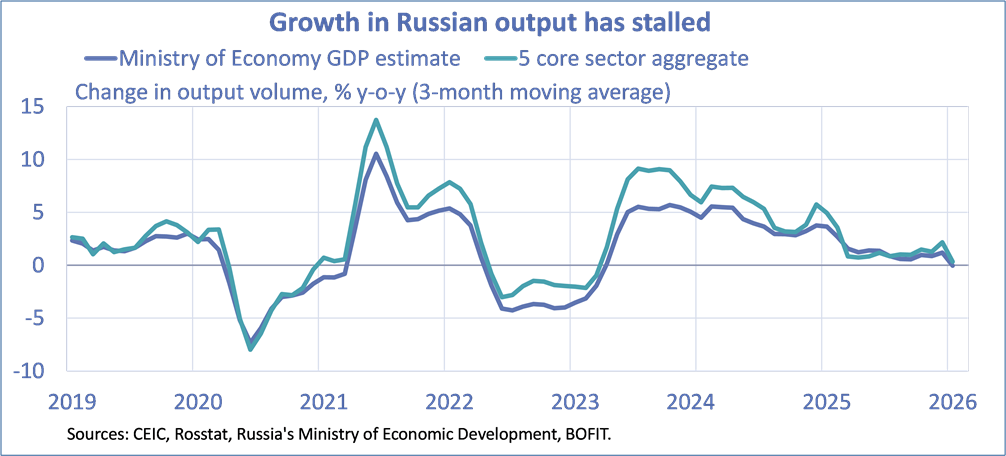
BOFIT published the following chart on the development of production in the five "core sectors" of the Russian economy and the estimates of the Russian Ministry of Economy on the development of production in the overall economy based on this. It shows that both the annual growth of real gross domestic product (blue line) and the annual growth of production in the core sectors of the economy (green line) fell to around zero percent on a 3-month moving average in January 2026.
Growth in Russian production has come to a standstill
BOFIT, BOFIT Weekly: Higher oil prices bring at least temporary relief for the Russian economy, 27.03.26
The government wants to lower its growth forecast of 1.3 percent for 2026
In terms of economic development in February, the Rosstat statistics office reported that industrial production fell by 0.8% in the period from January to February 2026 compared to the first two months of the previous year. Adjusted for seasonal and calendar-related factors, Russian industry grew by 0.3% in February 2026 compared to the previous month, according to Rosstat, after stagnating in January (Finmarket.ru).
Economy Minister Maxim Reshetnikov announced on the sidelines of an economic conference last week that the government will lower its previous forecast for this year's growth in the Russian economy of 1.3% in April. Reshetnikov explained: "We had expected a difficult first half of the year. And that's exactly how it turned out." The minister also emphasized that the central bank's monetary easing would have no immediate impact on the economy. "It is clear that the interest rate cut will have a delayed effect and will hardly affect the situation in 2026," he explained (vz-nn.ru).
Business surveys show the deterioration of the economy
BOFIT points out that the deteriorating situation of the Russian economy is also reflected in surveys of Russian companies:
In the Russian central bank's monthly survey, companies' assessment of the economic situation has deteriorated significantly this year. In March, companies assessed the current situation as almost as weak as in spring 2022, immediately after Russia's invasion of Ukraine (see also Politkom.ru weekly report).
In other company surveys, the majority of participants also stated that their company's situation had deteriorated in the first half of the year or would deteriorate in the coming months.
The problems cited by companies include rising costs and payment arrears. For example, in a survey conducted by the industry association RSPP at the end of 2025, payment arrears were the most frequently cited problem. More than 40% of companies, more than during the coronavirus pandemic, stated that arrears were affecting their business.
Rising oil prices bring higher revenues and stimulate growth
Nevertheless, BOFIT believes that the situation of the Russian economy has "at least temporarily eased" at the beginning of 2026 in view of the sharp rise in global oil prices. The rise in global market prices has benefited the development of Russian oil exports. In addition, the US sanctions against Russian oil exports have also been eased.
BOFIT points out that higher oil prices generally boost Russian economic growth and increase export earnings and government revenues. According to BOFIT, oil and gas still accounted for more than half of Russian goods exports and almost a quarter of federal budget revenues in 2025.
The Urals oil price rose by around two thirds in March compared to February
BOFIT cites the following data on oil price developments:The average price of a barrel of Brent oil rose to around USD 96 in March 2026.The price of a barrel of Russian Urals oil has also risen significantly in recent weeks to around USD 60, according to Bloomberg estimates.
The following chart from the weekly report of the research institute of the Russian state development company VEB.RF compares the sharp rise in the price of Urals and Brent oil. According to the Cbonds data, the price of Russian Urals oil, at USD 111 per barrel on March 19, even just exceeded the price of Brent oil of USD 109 per barrel (the research institute notes, however, that the Cbonds data differs from the prices quoted by other sources).
Development of oil prices from September 19, 2025 to March 19, 2026blue columns: Discount of Urals compared to Brent in %
VEB.RF Weekly Report: World Economy and Markets, 20.03.26
See also: Trading Economics: Urals Oil . According to Trading Economics, the Urals price rose by 66.5 percent last month compared to the previous month (as of 25.03.26).
Oil and gas revenues in the federal budget have halved so far in 2026
BOFIT reports on the development of the Russian federal budget at the beginning of 2026:
Russia's budget plan for 2026 is based on the assumption of an average export price of USD 59 per barrel. According to estimates by the International Energy Agency (IEA), the average export price for Russian oil in January and February of this year was only USD 46 per barrel, compared to USD 65 per barrel in the previous year. The average discount for Russian oil compared to reference grades reached USD 23 per barrel in January and February, compared to just USD 13 per barrel in 2025. The IEA also estimates that oil export volumes fell, particularly in February (more information: IEA Oil Market Report).
According to preliminary data from the Russian Ministry of Finance, revenues in the Russian federal budget fell by around 10% overall in January and February compared to the previous year.
The development of total revenue was particularly affected by a drastic decline in revenue from the oil and gas sector, which was almost 50% lower than in the previous year. The main reason for this was the significant fall in the export price of Russian oil.
Federal budget revenue excluding oil and gas revenue rose by 4% in January and February compared to the previous year. This increase is due to the VAT increase of two percentage points that came into force at the beginning of the year. As a result of the increase, VAT revenue rose by 11% year-on-year, while other revenue fell by 5%.
The Economic Expert Group, a research institute that works closely with the Russian Ministry of Finance, published the following table (excerpt) on the development of revenue, expenditure and the deficit of the Russian federal budget in the first two months of 2026.
Development of the federal budget in January-February 2026
Economic Expert Group: Economic Analysis March 2026 (excerpt), 25.03.26
Federal budget expenditure rose by 6% in January and February compared to the previous year. It grew slightly faster than planned for the year as a whole, while revenue fell short of expectations.
The deficit in the federal budget in January and February almost reached the level budgeted for the whole of 2026. It amounted to around 3,400 billion roubles (1.5% of GDP).
According to BOFIT, this year's budget deficit is to be financed mainly by borrowing with government bonds. However, a total of around 400 billion roubles was withdrawn from the "National Welfare Fund" in January and February to cover the deficit. At the end of February, the fund still had liquid assets worth around 4 trillion roubles.
Vasily Astrov: "The Iran war came at just the right time for Russia"
With this headline, the Austrian newspaper "Die Presse" draws attention to the latest edition of its podcast on the Russian economy. On March 25, long-time Russia correspondent Eduard Steiner discussed with Vasily Astrov, Russia expert at the "Vienna Institute for International Economic Studies", how the Russian state budget has developed and what the prospects are for the Russian economy in view of the rise in energy prices (minutes 19 to 31).
Astrov summarizes the budget development as follows:
Russia is of course now earning much more from its oil exports than it was a month ago. For one thing, global oil prices have risen sharply. In addition, the price discount for Russian oil compared to Brent has narrowed considerably.
However, Russia's first priority is to use the higher revenues to plug holes in its budget. Before the start of the Iran war, the budget situation was "really worrying" from a Russian perspective. A budget deficit of 1.6 percent of gross domestic product was planned for 2026 as a whole. However, the deficit was already so high after the first two months of 2026 that the target deficit ratio for 2026 as a whole was reached. In this respect, the Iran war and the sudden rise in global oil prices and, in some cases, gas prices came at the right time from a Russian perspective.
However, it is not the case that Russia is suddenly "swimming in money". The Russian government will use the additional revenue to plug the holes in the state budget. It will then have to take on less debt.
With regard to further developments, a great deal will of course depend on how long the high energy prices remain in place.
Across-the-board spending cuts of 10 percent are "off the table" for the time being
Astrov also reported on announced spending cuts:
Three days before the start of the Iran war, the Russian finance minister announced a ten percent cut in all government spending. Only military spending, social spending and the salaries of public sector employees were to be exempt from this.
However, these austerity plans have now been "put on hold" for the time being. The spending cuts have been postponed, probably until 2027 (see also Moscow Times).
The high energy prices are "of little help" to economic growth
Vasily Astrov is of the opinion that rising state revenues due to energy prices can definitely contribute to lower budget deficits. However, he considers the impact of higher energy prices on "the economy as a whole" to be "rather small". He means, among other things:
At the moment, the Russian economy is stuck in stagnation, and there are even signs of a recession. According to an estimate by the Ministry of Economy, GDP fell by around two percent year-on-year in January.
According to a business survey by the Russian central bank, the business climate in March fell to its lowest level since October 2022. The business climate is therefore as bad as it was when the Russian economy was suffering from the shock of the imposition of sanctions.
The general economic situation is therefore "not rosy" from a Russian perspective. The main reason for this is the continuing high interest rates. The rise in energy prices and Russia's additional income are "not necessarily" helping to solve these problems.
Timothy Ash: Russia urgently needs the rise in energy prices. In the long term, however, the Iran war poses risks for Russia
British economist Timothy Ash, Associate Fellow in the Russia and Eurasia programme at Chatham House and Senior Sovereign Strategist at RBC Bluebay Asset Management in London, analyzed the possible consequences of the Iran war for Russia in an opinion piece published by the Kyiv Post.
He concludes that "the third Gulf War" would bring Russia financial benefits in the short term. In the long term, however, it also harbors risks. Below is a summary of what Ash writes about the decline in Russian revenues from oil exports and the decline in state revenues from the oil and gas sector to date:
The "third Gulf War" has driven up energy and commodity prices.
In conjunction with the US decision to ease sanctions against Russia, Russia's export revenues will therefore rise. The Russian state coffers will fill up. The war against Ukraine and Europe can thus be continued for longer than would otherwise have been the case.
Russia's oil export revenues fell to a four-year low in February
Sanctions against Russia were tightened further in the course of 2025. In the first months of 2026, Russia's revenues from energy exports and energy-related revenues in the Russian state budget fell significantly.
According to IEA figures, revenue from the export of oil and petroleum products fell by USD 1.5 billion to just USD 9.5 billion in February 2026. This is the lowest level since the start of the war in Ukraine in 2022.
The decline in revenue reflected an increase in the price discount on Russian oil to over 30 %. In addition, Russian oil export volumes fell to 6.6 million barrels per day in February, a decrease of 850,000 barrels per day compared to the previous month and also the lowest level since 2022. Export volumes appear to have fallen due to both Western sanctions and successful Ukrainian drone and missile attacks on Russian energy infrastructure.
Russia's trade surplus fell by over 10% year-on-year in January 2026 to just USD 6.5 billion.
State revenues from the oil and gas sector fell drastically
In the federal budget, oil and gas revenues fell by 44% year-on-year in the first two months of the year. The budget deficit rose to 1.5 % of GDP, although the government had raised VAT from 20 % to 22 % at the beginning of the year. The media reported that spending cuts of 10 % were planned.
Russia's government was therefore faced with an increasingly tense budget situation. Falling revenues were offset by rising expenditure on the military. As the reserves in the "National Welfare Fund" were exhausted, the government had to cover a larger budget deficit with higher domestic debt.
This measure meant higher interest rates, further crowding out of the civilian sector and likely rising inflation, which in turn would keep interest rates high and dampen growth.
The Russian economy was already on the brink of recession
Real gross domestic product shrank in the first months of 2026, and forecasts for economic growth for the year as a whole were close to zero.
The economy increasingly presented itself as a two-tier society: the military-industrial sector continued to benefit from increased defence spending and its prioritization, while the rest suffered from high inflation, labour shortages, high wage costs, high debt and high interest rates.
Ash: The US war on Iran initially gave Putin a "great victory"
Ash assesses the US government's decision to attack Iran as follows:
"Just when the economic downturn seemed to be forcing Putin to make difficult decisions - such as making concessions in the Ukraine peace talks - Trump has handed Putin a major victory with his bizarre decision to attack Iran without any discernible, well thought-out strategy. In the short term, this will serve as a free pass for Putin. Higher oil and energy prices and the US decision to ease sanctions on Russian oil will strengthen Russia's budget and balance of payments."
Ultimately, however, there could be a collapse in oil and commodity prices
Ash estimates that Russia's oil and energy revenues could initially increase by up to USD 10 billion per month. At the same time, however, he points out that the long-term consequences of a sustained high oil price are still unclear. A sustained high oil price would probably lead to a slump in demand and lower global growth, similar to the period around COVID-19 or during the global financial crisis in 2008. Russia would then be the one to suffer. Higher oil prices in the long term could trigger "a catastrophe" for the Russian economy.
Reading tips:
German-Russian Chamber of Commerce Abroad:Analyses, German; also Russian; (selection):Growth, key interest rate, ruble exchange rate: Forecasts in view of the Iran war, 23.03.26Hormus shock: Europe facing a new gas crisis, 18.03.26Hormus shock: How big will Russia's unexpected oil windfall be? 11.03.26Economic consequences of the Iran war: oil price, Russia, tourism; 02.03.26Weak growth, declining available reserves and high military spending, 18.02.26
Podcast "Tsars, Data, Facts" of the German-Russian Chamber of Commerce Abroad by Thomas Baier:Russia’s Economy: Sanctions and Growth Prospects; Guest: Prof. Jacques Sapir, 44 min., 09.03.26Low gas storage levels: Europe's challenge in the energy market; Guest: Dr. Heiko Lohmann, „energate Gasmarkt“; 34 min., 01.03.26
"Die Presse" podcast on the Russian economy: Russia - gas, sanctions, oligarchs:Expert Vasily Astrov points out: "The Iran war came at exactly the right time for Russia"; Recording on 25.03.26; Podcast guest is military expert Wolfang Richter, former German colonel. He explains how the Iran war will also change the Ukraine war; 48 min., 27.03.26Is Russia the big profiteer of the Iran war and China the loser? Recorded on 10.03.26;The Ukraine war has made Russia the economic loser and China the profiteer. The Iran war, however, has a completely different impact. Vladimir Putin is already laughing up his sleeve. And China? Sinology professor Dr. Susanne Weigelin-Schwiedrzik and Russia economist Vasily Astrov (WIIW) in conversation with Eduard Steiner; 11.03.26
Iran war, energy supply and Russia
Inosmi.ru; Bloomberg: The Trump administration analyzes the consequences of a possible rise in oil prices to 200 dollars per barrel, 26.03.26
Inosmi.ru; Bloomberg: Russia sold 60 million barrels of oil to India, delivery in April, 25.03.26
Kyiv Post; Timothy Ash: OPINION: For Russia – Gulf War 3 Creates Economic Wins but Also Risks, 24.03.26
Fortune; Marco Quiroz-Gutierrez: Putin is the real winner in Trump's Iran war as it puts Russian oil back on the map, 23.03.26
Focus.de; Analysis by Ulrich Reitz: Putin deal? Hidden by the Iran war, an explosive idea is circulating, 22.03.26
FR.de; Marcus Giebel: Hundreds of billions of dollars: How Putin could profit from the Middle East war - three scenarios. Study by the "Kyiv School of Economics" (KSE); 21.03.26
Kyiv School of Economics: Iran war helps Russia; long conflict would fundamentally undermine economic pressure campaign; sanctions easing does not resolve energy market challenges - KSE Institute, Study: Assessment of the Impact of the Iran War on Russia, 20.03.26
Foreign Policy Podcast "Ones and Tooze", Ep. 234: Adam Tooze on the Economic Fallout of War in Iran (plus: Jürgen Habermas), 20.03.26
Jacques Sapir, Director of CEMI (Center for Industrialization Studies, Paris), foreign member of the Russian Academy of Sciences; Kommersant: Global economic bifurcation. Three scenarios for the Middle East conflict;19.03.26
BBC; Dharshini David, Deputy economics editor: Russia, China and the US - the global winners and losers of the Iran war, 19.03.26
Fiscal policy: State budget and oil prices
Moscow Times: Russia Drops Budget Cut Plans as Oil Price Surge Boosts Revenues - Bloomberg, 27.03.26
Yahoo Finance; Reuters: Russia delays change to fiscal fund after Iran war energy price surge, 23.03.26
Inosmi.ru; Stratfor USA: Ironically, Russia benefits from Iran-related oil price shocks. Stratfor: US war on Iran will lead to Russian budget surplus, 03/23/2016
Politkom.ru; Marina Voitenko: Extremely high volatility of oil prices and extremely uncertain consequences,19.03.26
Deutsche Welle.com/ru; Oleg Loginov: SIPRI: Russia has passed the peak of military spending growth, 19.03.26
Overall economic development:
ura.news: Russia faces a year without economic growth. The expert Nikolayev named five reasons for the economic crisis in Russia, 24.03.26
ura.news: Nothing catastrophic will happen, but the situation on the labor market will worsen, noted Igor Nikolayev. Russia's economic statistics are increasingly pointing to a recession, according to Igor Nikolaev, senior researcher at the Institute of Economics of the Russian Academy of Sciences, 24.03.26
Anadolu Agency; Kanyshai Butun: Russia says EU energy restrictions could cost bloc over $3.48 trillion by 2026. Moscow envoy says EU losses already top $1.74 trillion as gas price surge hits economy, 23.03.26
Le Monde; Stéphane Lauer: ‚The oil shock in the Middle East is a godsend for Russia‚, 23.03.26
ntv.de: Decisive measures demanded. Putin admits collapse of the Russian economy, 23.03.26; Der Spiegel: Russia's economy is sliding into the red, even Putin can see that now, 23.03.26
RBC.ru, Ekaterina Kuzmina: Putin thought the drop in GDP in January was to be expected, government meeting on economic issues, 23.03.26
Kremlin.ru: Vladimir Putin held a meeting on economic issues, 23.03.26
TVP World, Tymon Miller: Rising oil prices bolster Russia's war funding. New report from the Stockholm International Peace Research Institute (SIPRI); 23.03.26.
European Leadership Network; Sinikka Parviainen; Senior Economist, Bank of Finland Institute for Emerging Economies: Understanding Russia's wartime economy and why it matters for Euro-Atlantic security, 20.03.26
Peace Research Institute Oslo, PRIO; Pavel K. Baev: Moscow calculates benefits of Gulf conflict, coming short, 17.03.26
Forecasts:
German Institutes: Joint Economic Forecast: 01.04.26
BOFIT: BOFIT Forecast for Russia, 30.03.26
vz-nn.ru: The Ministry of Economic Development will lower its forecast for Russian GDP growth in 2026; 28.03.26
OECD: OECD Economic Outlook, Interim Report March 2026 – Testing Resilience, 26.03.26
en.euronews.com; Doloresz Katanich with AFP: OECD lowers eurozone growth forecast due to rising energy prices, 26.03.26
IEF RAS: Quarterly GDP forecast. Issue No. 69, 16.03.26; Nezavisimaya Gazeta; Mikhail Sergeev: Russians do not believe in a peace agreement for Ukraine. According to the survey participants, the most difficult times are still ahead for the economy, 17.03.26
Monthly and weekly economic reports:
Politkom.ru; Marina Voitenko: Weekly economic report: compromise under the pressure of uncertainty, 28.03.; Extremely high volatility of oil prices and extreme uncertainty of consequences,19.03.26
Economic Expert Group: Economic analysis March 2026, 25.03.26
CMASF monthly report: "Analysis of macroeconomic trends", 24.03.26
Sergei Blinov: Macro Overview No. 12 (2026), 24.03.26
VEB Institute: World Economy and Markets, weekly report
Industrial production in February 2026:
Finmarket.ru: Industrial production in Russia fell by 0.9% in February, 25.03.26
Kommersant; Artem Chugunov: Industrialists do not expect the best. Industrial production in February and results of recent business surveys, 26.03.26
Hard figures: Industrial production in February: below trend, 25.03.26
The post How much and how long will Russia benefit from the energy price boom? appeared first on ostwirtschaft.de.
Original article (German):
Read on ostwirtschaft.de →