Russia
Japan buys Russian oil, Russians buy Japanese cars
It all started with a denial. The planned visit by a Japanese government delegation to Moscow on May 26 and 27 does not mean that Japan intends to expand its economic relations with Russia or even return them to the level they were at before February 24, 2022, according to the official Tokyo Ministry of Economy, Trade and Industry, which instead emphasized that the main aim of the government trip was to protect the assets of Japanese companies in Russia. However, the fact that Japan and Russia are on the verge of a cautious revival of their economic relations is indicated by both the high-caliber composition of a business delegation accompanying the government representatives from Tokyo to Moscow and the development of trade between the two countries in recent months.The talks in the Russian capital are to be attended by representatives of major Japanese corporations operating in Russia, including Mitsubishi Corporation, one of Japan's largest companies with 72,000 employees worldwide, Mitsui & Co, which is active in the energy, metal and chemical industries, and Mitsui O.S.K. Lines, one of the world's largest shipping companies. It is clear that the energy crisis triggered by the US-Israeli military strike on Iran and the closure of the Strait of Hormuz is prompting Japan to import Russian crude oil again. On May 5, for example, a tanker brought Russian oil from the Sakhalin-2 refinery to the southern Japanese port city of Imabari for the first time. The visit by Muneo Suzuki, a member of the upper house of the Japanese parliament, to Moscow at the beginning of May should also be seen in this context. Suzuki met with Russian Deputy Foreign Minister Andrey Rudenko. The Japanese parliamentarian was an advisor to the late Prime Minister Shinzo Abe, whose widow received President Putin in Moscow in May 2025. Prime Minister Abe was keen to maintain good economic relations between the two countries and visited Russia frequently. MP Suzuki said: "I would like to restore Russian-Japanese relations to the level they were at under Abe."
Oil and gas at the center of economic relations
Energy exports from Russia to Japan have so far formed the backbone of Japanese-Russian trade relations. Japan's economy has a particular interest in remaining involved in the two oil and gas production projects Sakhalin-1 and Sakhalin-2, which are geographically close to Japan. The Japanese consortium SODECO holds a 30% stake in Sakhalin-1, while Mitsui and Mitsubishi have a total stake of 22.5% in Sakhalin-2. Despite the Ukraine crisis, the Japanese companies, with the backing of the government in Tokyo, have not given up on either project, even though the British Shell has pulled out. This is because the Japanese government has classified Sakhalin-1 and Sakhalin-2 as "extremely important projects" as they contribute to the country's national energy security.
Around 10% of Japan's gas imports still come from Russia. At the same time, Japan is focusing on diversifying its energy imports. Japanese companies have signed new contracts with US companies for liquefied natural gas imports worth 7.5 million tons per year. This means that the Japanese now source 10% of their liquefied natural gas imports from the United States, the same amount as from Russia. Following the disaster at the Fukushima nuclear power plant in March 2011, the Japanese island state is heavily reliant on liquefied natural gas.
Automotive industry as a growth factor
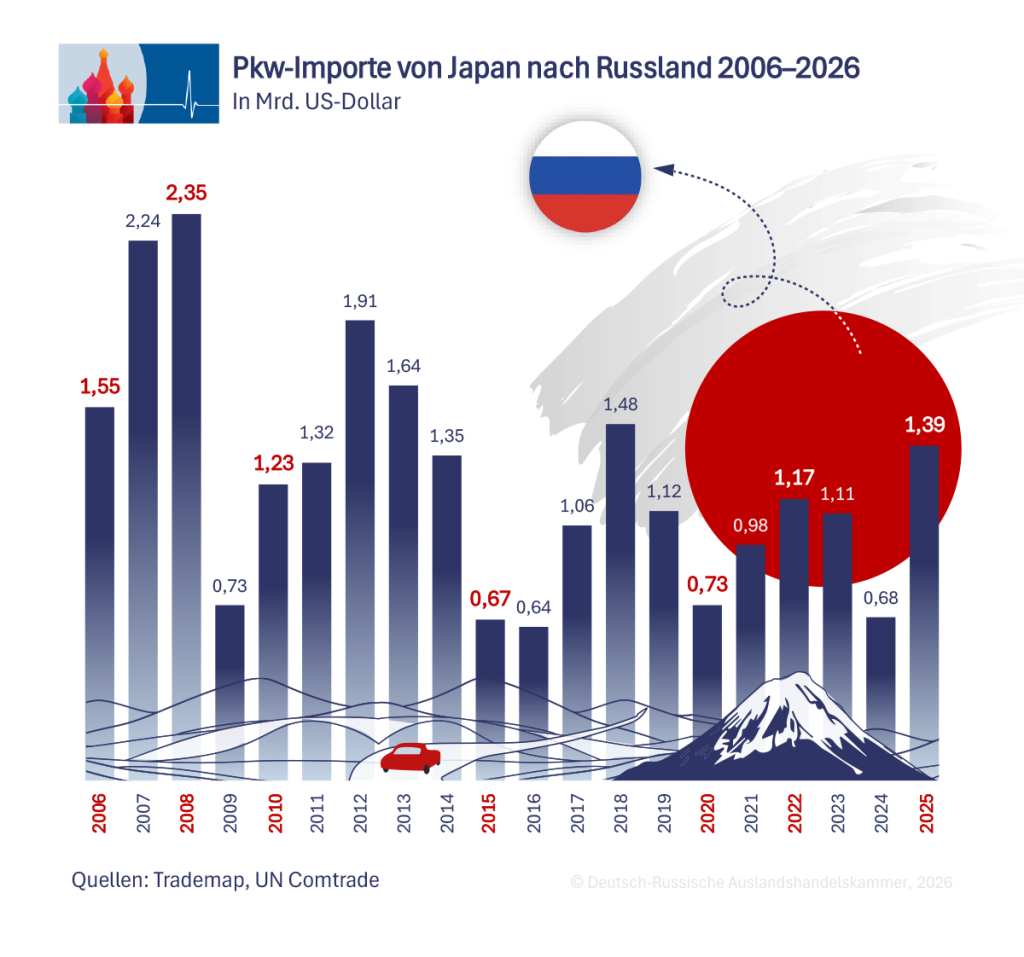
Until 2022, automotive exports from Japan to Russia played a major role in the economic relations between the two countries. Japanese cars are considered high-quality and reliable in Russia. The sale of Japanese cars in Russia, especially in its Asian part, was a growth factor in the economic exchange between the two countries for decades.
The market leaders were Mitsubishi, Toyota and Nissan. Their vehicles dominated the roads, particularly in the Russian Far East between Vladivostok and Khabarovsk. In 2011 alone, passenger cars accounted for 63% of Japanese exports to Russia. After Russia joined the World Trade Organization in 2012, Russian import duties on Japanese cars were gradually reduced from 30% to 15%. This strengthened the position of Japanese exporters.
However, after February 24, 2022, business collapsed completely due to the sanctions against Russia. Toyota, Nissan and other Japanese manufacturers ended their production in Russia. The share of Japanese brands in imports fell from 17.9% to 6.6% in 2022 compared to the previous year. Japanese companies had to accept billions in write-downs. Toyota alone posted a loss of 2.6 billion US dollars due to the sale of its plant in St. Petersburg.
Chinese manufacturers such as Chery, Great Wall (Haval) and Geely stepped into the gap left by the Japanese, Koreans and German and European car manufacturers and have now captured more than 60% of the Russian market. It is extremely unlikely that the Japanese will return to automobile production on Russian soil. On the other hand, Japanese cars are increasingly being supplied to Russia.
The exchange of goods between Russia and Japan grew by 25% between February 2025 and February of this year, mainly due to the import of Japanese cars to Russia. In January 2026 alone, deliveries of passenger cars from Japan to Russia increased by 45%. Cars and car parts accounted for around 60% of all Japanese exports to Russia in the first two months of 2026.
Medical equipment and medicines, artificial fertilizers and processed rubber also contributed to the increase in imports from Japan. Traditionally, tobacco and pharmaceutical products are the three largest Japanese exports to Russia, alongside essential oils and personal care products and cars. Japanese imports from Russia, on the other hand, consist mainly of fish and crustaceans, mineral fuels and wood and timber products, particularly from the forests of Eastern Siberia.
Historically determined special economic relationships
Despite geopolitical rivalry, there have been repeated attempts by both sides to find compromises based on economic interests in relations between Japan and Russia since the 19th century. In 1867, for example, Japan and Russia agreed on the joint use of Sakhalin. And after the Japanese-Russian War of 1904/05, which Russia lost, the Russian Empire and the Japanese Empire were allies. After the October Revolution in 1917, Japanese forces took part in the military intervention of Western countries, including the USA, against the new Soviet state. However, soon after the end of the Russian Civil War, in 1925, the two states concluded a treaty on cooperation, particularly in the economic field. The Soviet Union, which needed foreign currency for the development of its Far Eastern regions, granted concessions to the Japanese for fishing, logging and the mining of coal and gold. This economic cooperation continued until 1944, even during the Second World War, because although Japan was allied with Hitler's Germany, the Japanese Empire concluded a neutrality pact with the Soviet Union in April 1941. In 1941, Richard Sorge, a German journalist and Soviet military intelligence agent working in Tokyo, reported to a doubting Soviet leadership on the basis of his government contacts that Japan would remain neutral and would not attack the Soviet Union, and it was only after the capitulation of the German Reich in May 1945 that the Soviet armed forces attacked Japan in accordance with the agreements with the Western Allies. The Soviet Union annexed the southern Kuril Islands, which had belonged to Japan until 1945 and which the Japanese state claims for itself to this day. However, despite this territorial conflict, the two states concluded a trade agreement as early as 1957. The economic interests of both sides were stronger than the political differences. In 1979, the exchange of goods between the Soviet Union and Japan reached a volume of 4.1 billion US dollars, and Russia built on these trade relations from 1992, when Japan recognized the Russian Federation as the legal successor to the Soviet Union. Japanese exports grew from USD 1.1 billion in 1992 to USD 3.1 billion in 2004 and to USD 16.8 billion in 2008. This peak was never reached again afterwards. Driven by the rapid rise in oil and gas prices, bilateral trade experienced a strong upswing in the 2000s. Japan increasingly purchased crude oil and liquefied natural gas from the Russian Far East projects Sakhalin-1 and Sakhalin-2, while Russia became an important sales market for Japanese cars and machinery.
Following the conflict over Crimea in 2014, Japanese imports to Russia fell from USD 9.2 billion in 2014 to USD 5.1 billion in 2015. Although this was followed by an increase to USD 7.9 billion in 2021, the consequences of the Ukraine conflict caused Japanese imports to the Russian Federation to fall to USD 2.8 billion in 2023.
Japanese imports from Russia rose from USD 2.4 billion in 1992 to USD 13.4 billion in 2008, peaking at USD 20 billion in 2013 and 2014. In 2022, Russian imports to Japan still amounted to a value of 14.9 billion dollars. Russia's exports to the island state then fell by around half and amounted to 7.4 billion dollars in 2023. In 2025, they fell to 5.3 billion dollars. In the first few weeks after the start of the military conflict in Ukraine, Japan joined the G7 group of states in imposing sanctions against Russia.
By December 2025, Japan had adopted a total of 26 sanctions packages against Russia. However, since the start of a process of talks and negotiations on the Ukraine conflict initiated by US President Donald Trump, the Japanese business world's interest in trade relations with its Russian neighbor has been growing again. This interest is being intensified by soaring energy prices due to the Middle East war and the closure of the Straits of Hormuz. Japan covers around 80% of its oil requirements through imports via the straits.
The forthcoming visit by a Japanese government and business delegation also confirms the iron law that the pragmatic interest in economic benefits ultimately proves to be the dominant factor in Japanese-Russian relations. This article was prepared for the German-Russian Chamber of Commerce Abroad.
The post Japan buys Russian oil, Russians buy Japanese cars appeared first on ostwirtschaft.de.
Original article (German):
Read on ostwirtschaft.de →