Russia
Logistics sector in a tight spot: how internet blocking, Telegram ban and whitelisting are affecting the industry
Internet shutdowns, Telegram throttling and government "white lists" are increasingly interfering with the operational reality of the logistics industry in Russia. Although mobile internet in Moscow has largely been working again since the end of March, the latest restrictions have exposed the structural vulnerability of digitally controlled supply chains. As further regional shutdowns remain possible at any time, companies are already reacting by adapting their communication and IT structures. This makes the stability of digital infrastructure itself a key risk factor for transportation planning, communication and supply chain management.
Internet shutdowns and logistics processes
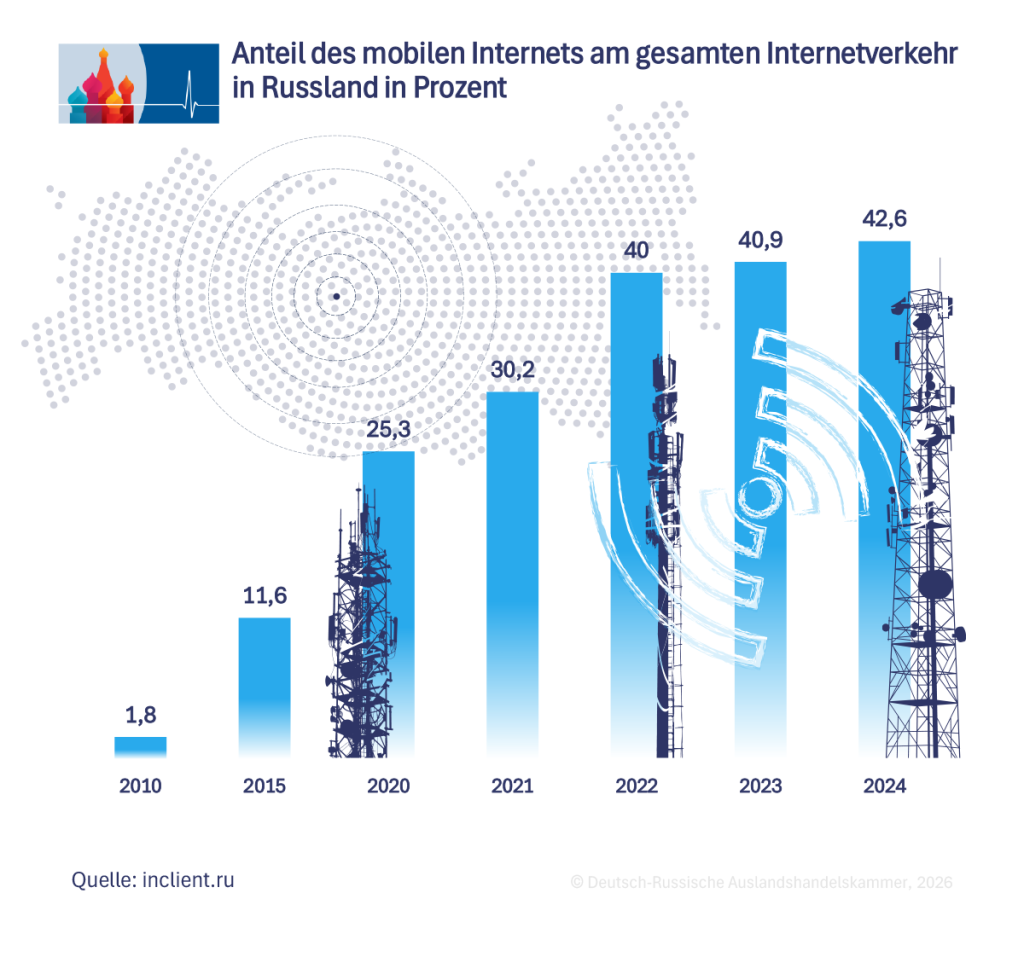
Recurring mobile internet shutdowns and tests of a more controlled network architecture are having an increasingly direct impact on operational logistics processes. Applications that rely on mobile data connections and real-time transmission are particularly affected, including GPS tracking, fleet management, digital freight exchanges and cloud-based transportation and warehouse management systems. Since, according to Telekom analyses by the business newspaper Kommersant, 50% to 70% of internet traffic in Russia runs via mobile networks, outages immediately lead to restrictions in tracking the position of vehicles, scheduling and coordinating time slots in warehouses and terminals. Shipping service companies such as SDEK report that position data is temporarily unavailable during regional shutdowns and short-term route adjustments are only possible to a limited extent.
A survey of affected companies carried out by the Russian Business Association RSPP underlines the high dependence of logistics processes on the mobile internet. Around 40% of respondents rated mobile networks as essential, with a further 45% rating them as important for operations. Only 10% see mobile connectivity as not crucial, while 5% classify it as unimportant.
Courier and logistics companies, whose processes are based on real-time communication between dispatchers, drivers, customers and packing stations, are particularly affected. Outages result in a loss of tracking options, communication breakdowns between courier, customer and pick-up station and an increase in support requests. As a result, there are additional burdens in the dispatch centers and operational bottlenecks, for example due to overloaded packing stations or delayed delivery processes.cybersecurity analyses by the Financial Times assume that internet restrictions can cause economic damage of around up to 2 billion rubles (the equivalent of 22.4 million euros) every day, including through outages of cloud infrastructure, payment systems and logistics-relevant platforms. At the same time, mobile data traffic in affected regions fell by around 20% during the shutdowns, highlighting the high dependency of transport-related processes on mobile networks. Specific regional restrictions also have a measurable economic impact: Mobile internet shutdowns in Moscow lasting several days caused losses of 3 to 5 billion roubles (33.7-56 million euros), according to the business magazine Forbes. Courier services, transportation services and the retail sector were particularly affected. The measures were not limited to the capital, but gradually expanded after restrictions in Moscow at the beginning of March were followed shortly afterwards by similar measures in St. Petersburg.export and import processes also react sensitively to interruptions in the mobile internet connection. Digital freight documents, slot bookings, customs communication and coordination with freight forwarders and warehouse operators are increasingly carried out via online platforms. If access to these systems fails, companies have to resort to telephone coordination or manual processes, which increases processing times and the susceptibility to errors. Recurring shutdowns therefore increase operational uncertainty, extend throughput times and make it more difficult to plan transport capacities precisely along the entire supply chain.
Overview of the Russian logistics sector
The Russian logistics sector has expanded significantly in recent years, while at the same time operational complexity has increased. Analyses by the Russian HR outsourcing service provider Sequoia and the logistics company STS Logistics show that the total turnover of companies in the logistics sector will reach around 24.3 trillion rubles (272.6 billion euros) in 2025. rubles (272.6 billion euros) in 2025, which corresponds to growth of around 17% compared to 2023. At the same time, the transport volume remained at a high level of around 9.4 billion tons, while freight throughput reached around 5.57 trillion tonne-kilometres. tonne-kilometres. Despite rising turnover, industry profitability fell: according to industry analyses, the profits of logistics companies fell by 9.8% to around 1.9 trillion roubles (21.3 trillion roubles). (21.3 billion euros), mainly due to higher personnel, fuel and financing costs. At the same time, total logistics costs rose by 20% to 25% according to the marketing agency MegaResearch, which significantly increased the cost pressure along the supply chains.structurally, the industry is increasingly shifting towards road transportation and e-commerce logistics. Industry figures show that car transportation increased by 21.2% in the first quarter of 2025, while rail transport fell by 12% and air freight by 59.3%. At the same time, according to market analyses, online trade grew by 19% to 28% and reached around 13.4 trillion (150.3 billion euros) with around 8.3 billion orders, further increasing the demand for fulfillment and last-mile logistics. Road transportation is increasingly taking on a dominant role and already accounts for more than 70% of transported goods in some segments. This development is leading to longer transport distances, more heavily utilized hubs and higher demands on coordination and scheduling, while structural bottlenecks are exacerbating the situation in the industry. Analyses by MegaResearch and industry reports by Sequoia Service predict a staff shortage of up to one million workers, with a shortage of category E truck drivers in particular. Companies are responding with rising wages and increased automation; according to industry studies, the use of transportation management systems can reduce costs by up to 21%. At the same time, supply chains are lengthening due to the shift to eastern transport corridors and additional transshipment points. The analysis of Russia's largest financial institution Sber on logistics development in 2025 shows that companies are increasingly relying on digital platforms, real-time tracking and cloud-based control to manage this complexity. This increases the industry's dependence on stable digital infrastructure, which is becoming a decisive factor for the functionality of logistics processes.
Telegram block and communication bottlenecks
The restriction of Telegram is hitting companies particularly hard, as the messenger has effectively become the operational communication standard in many industries. According to analyses by ppc.world based on data from the telecommunications provider MTS, around 105 million people in Russia were using Telegram in November 2025. Unlike email or traditional business software, Telegram enables fast communication with external partners, drivers, subcontractors, customs agents and warehouse operators via shared groups, often across national borders. Telegram also serves as an important customer acquisition tool for small and medium-sized companies in particular, for example via channels, groups and targeted advertising, making the platform relevant not only for operational communication but also for closing deals.
In logistics in particular, Telegram fulfills several functions simultaneously: dispatchers transmit last-minute route changes, drivers send location photos and documents, freight forwarders coordinate loading windows and customs agents share approvals in real time. These processes often run in parallel in groups with several participants and are partially replacing traditional transport management systems, especially for smaller freight forwarders and in cross-border trade. Technical limitations are already causing a significant proportion of requests to Telegram domains to fail. According to Kommersant, 80% to 90% of connection attempts do not reach the platform reliably at times. Telegram is throttled or file transfers and messages are delayed, causing immediate operational problems: Drivers receive instructions late, transhipments are not coordinated in time, and last-minute changes to border clearance or terminal slots cannot be communicated quickly.
The result is additional downtime, uncertain scheduling and delayed transport chains. Companies have to switch to telephone, SMS or alternative messengers, which fragments coordination and slows down the flow of information. At the same time, government agencies are pushing ahead with MAX, an alternative platform developed by the VK Group to replace Telegram and other messengers. However, according to Kommersant, expert Anastasia Bidelova assumes that a complete technical block will be difficult to implement; instead, ongoing restrictions could lead to users gradually switching to alternative services such as MAX. For companies, this means a phase of parallel communication channels, additional coordination and increasing organizational complexity in the daily management of logistical processes.
White lists and IT risks
The introduction of so-called white lists, on which those email and IP or domain addresses are listed that are considered secure and reputable, creates an additional IT risk for logistics and retail companies. The concept envisages that only previously approved platforms, cloud services and communication solutions will be reliably accessible during network restrictions or as part of a more tightly controlled internet architecture. Services outside of these lists may be slowed down, blocked or only function to a limited extent. For companies whose operational systems are based on international cloud infrastructures or software solutions, this creates the risk of sudden outages of central applications, and inclusion in such white lists is subject to certain conditions. According to current guidelines, services with a high social or economic priority are primarily considered, while at the same time requirements are placed on the technical infrastructure, including the use of servers and cloud solutions within Russia. For logistics companies, this means that applications with foreign hosting or international cloud connections may not be reliably accessible. Tracking platforms, transport management systems, ERP software or collaborative tools whose servers are located outside Russia are particularly affected. If access to such systems fails, shipment tracking, order management and document exchange can only take place to a limited extent, especially in the case of cross-border transports with several partners involved. the introduction of white lists therefore increases the pressure on companies to adapt their IT infrastructure. This includes migrating to locally hosted solutions, using Russian cloud services or redundant parallel structures in "friendly" countries that have not sanctioned Russia. At the same time, industry associations are warning against excessive restrictions. For example, the Russian e-commerce association AKIT writes: "Due to the regular shutdowns, the issue of the white list is critical for companies. In our opinion, every service provider operating legally in Russia and providing services to the population should maintain their availability. Otherwise, this situation could lead to serious distortions of competition, with only some of the largest services continuing to operate while all others cease to do so." From a business perspective, this creates additional uncertainty as to which platforms will remain available in the long term. Investment decisions are made more difficult, while dependency on approved local IT solutions increases and planning reliability in logistics and trade processes decreases.
How logistics chains are adapting
The increasing limitations of the digital infrastructure are forcing logistics companies to gradually adapt their processes and establish redundant structures. Many companies are responding by introducing additional communication channels, including parallel messengers, telephone dispatching and email-based coordination. At the same time, critical information is being communicated more frequently in advance in order to be able to cushion short-term changes, even in the event of temporary failures. In transport planning, this leads to larger time buffers, additional confirmation stages and greater manual control of operational processes. At the same time, many companies are shifting their internal communication channels to Russian providers such as Yandex 360 or VK Teams in order to reduce their dependence on potentially limited international services and ensure more stable accessibility.companies are also adapting their structures at IT level. This includes local server solutions, mirroring important data and moving individual applications to neutrally accessible or locally hosted cloud infrastructures. Some logistics companies are once again increasingly relying on offline tools, locally stored documents and paper-based backup processes to maintain operations with limited connectivity. This applies in particular to freight documents, loading instructions and contact details, which are also stored in non-digital formats. While such measures increase resilience, they also lead to higher administrative costs and slower decision-making processes, while transport networks are becoming more streamlined. Companies are reducing the number of partners involved, bundling shipments and preferring more stable routes with less dependence on short-term digital coordination. Transhipment points and warehouse locations are selected in such a way that operational interventions are possible even without a permanent online connection. These adjustments increase the stability of supply chains, but are accompanied by longer planning cycles, less flexibility and additional costs.
Survival risks for companies with servers in "unfriendly" countries
Companies whose IT infrastructure is wholly or partially based on servers in so-called "unfriendly" states that sanction Russia are increasingly facing existential risks. As part of the regulatory tightening and the introduction of white list mechanisms, there is a possibility that access to central systems will be restricted or completely shut down at short notice. Cloud-based ERP systems, transport management software, merchandise management systems and collaboration platforms, which are essential for managing logistics processes, are particularly affected. If access to these systems fails, orders cannot be processed, transports cannot be coordinated and invoicing processes cannot be handled, and the resulting risks go beyond operational disruptions and affect the fundamental ability to do business. Companies are faced with the decision of either switching to local or "friendly" IT solutions in a short space of time or accepting significant system failures. However, such a migration is associated with high costs, technical challenges and organizational effort, especially if existing systems are deeply integrated into international supply chains. At the same time, there is a risk of regulatory action if companies continue to use non-approved software or infrastructure, which in practice leads to strategic considerations about future market presence. Some companies invest in redundant IT structures and localized systems, while others reduce their activities or gradually withdraw from the market. Dependence on a stable and approved IT infrastructure is thus becoming a decisive competitive factor. Companies that are unable to establish resilient solutions run the risk of losing their operational ability to act and losing their position in the Russian market in the long term.
The post Logistics sector in a tight spot: How internet blocking, Telegram ban and whitelisting are affecting the industry appeared first on ostwirtschaft.de.
Original article (German):
Read on ostwirtschaft.de →