
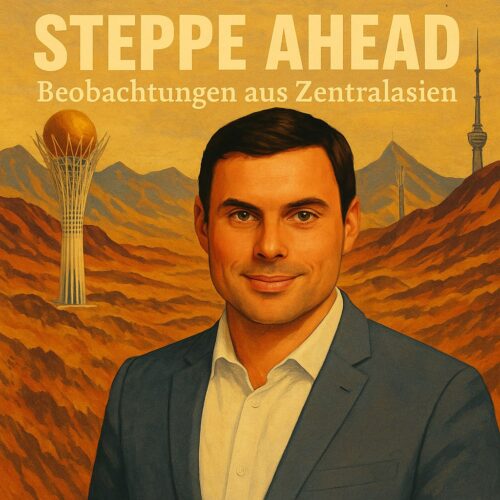
Central Asia column "Steppe Ahead"
Author: Thorsten Gutmann

The 80th session of the United Nations General Assembly in New York was dominated by multiple global crises: the war in Ukraine, the humanitarian catastrophe in Gaza, tensions in the Middle East, and the unresolved issue of international climate policy. Against this backdrop, a region that attracted little attention just a few years ago came to the fore: Central Asia.
For the first time, all five heads of state, Shavkat Mirziyoyev (Uzbekistan), Kassym-Jomart Tokayev (Kazakhstan), Sadyr Japarov (Kyrgyzstan), Emomali Rahmon (Tajikistan), and Serdar Berdimuhamedov (Turkmenistan), personally participated in the general debate. This united presence sends a political signal. It makes it clear that Central Asia no longer wants to be on the margins of world politics, but is consciously using the UN as a stage to make its own mark.
The region's central message was clear: the United Nations must reform in order to remain capable of acting in a fragmented world order. Uzbekistan and Kazakhstan spoke out in favor of expanding the Security Council to better represent the interests of middle powers and developing countries. Kyrgyzstan announced its candidacy for the 2027-2028 term. Turkmenistan, for its part, underscored the universal legitimacy of the UN, in keeping with its neutrality, which has been recognized since 1995.
The Central Asian states are thus taking up a global debate that was reinforced by this year's General Assembly's "Pact for the Future." Their tenor: the international order of the 20th century is no longer sufficient to meet the challenges of the 21st century.
In addition to institutional reforms, the presidents emphasized their regional security interests. Uzbekistan proposed a regional office for the UN counterterrorism unit, while Tajikistan warned of drug trafficking and cybercrime on its southern border. Kazakhstan and Kyrgyzstan called for a redirection of military spending toward social projects, a remarkable emphasis at a time of growing global armament.
At the same time, the heads of state made it clear that Afghanistan must be integrated into regional structures. This highlights the difference between their stance and that of the West: while many countries are keeping their distance, Central Asia's neighbors are pursuing a course of pragmatic cooperation without formally recognizing the Taliban government.
The speeches also reflected the diplomatic tightrope walk of the region. Uzbekistan and Kazakhstan called for a political solution to the war in Ukraine without sharply condemning either side. In doing so, they are maintaining a balance between their proximity to Russia and their desire for international recognition.
Kyrgyzstan chose more explicit words with regard to the Gaza conflict. It spoke of "genocide" and criticized double standards. In doing so, Bishkek positioned itself more openly than many Western states, which are sticking to more cautious wording.
In addition to acute crises, long-term challenges came to the fore. Uzbekistan presented its reforestation and water projects to save the Aral Sea, Tajikistan warned of the consequences of melting glaciers, and Turkmenistan pointed to its initiatives to combat desertification. Together, they made it clear that Central Asia is particularly affected by climate change, as the region is warming twice as fast as the global average.
Uzbekistan, Kazakhstan, and Tajikistan also emphasized the need for international regulation and cooperation in the field of artificial intelligence. They proposed regional centers of excellence to take advantage of the opportunities offered by new technologies without losing sight of the risks.
Overall, the appearances of the Central Asian presidents show a strategic reorientation. Instead of being seen as an object of geopolitical competition between Russia, China, and the West, the region is emerging as an independent co-creator. Kazakhstan presents itself as a transit hub for 80 percent of the goods traffic between Asia and Europe. Uzbekistan speaks of a "New Central Asia" that is to serve as a model for regional cooperation.
The message is clear: Central Asia is using the UN not only as a forum to articulate its own concerns, but also as a stage for self-assertion. In a multipolar world order increasingly characterized by bloc formation and rivalries, the region is positioning itself as a bridge builder between East and West, North and South.
Original column (German):
Read on ostwirtschaft.de →