
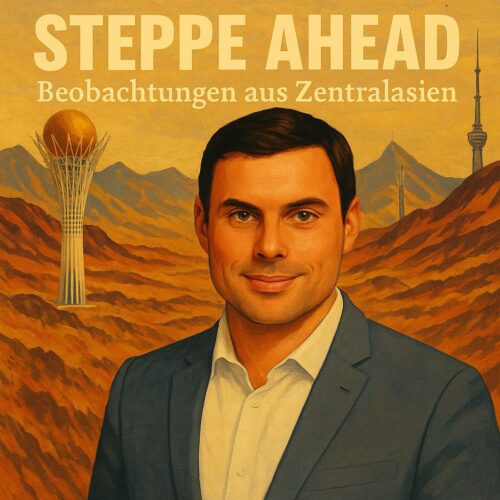
Central Asia column "Steppe Ahead"
Author: Thorsten Gutman

When people think of Afghanistan today, they rarely think of new rail connections. Instead, they think of decades of war, the Taliban, and the systematic oppression of women. They think of a country that for many has become synonymous with stagnation and regression. And yet it is precisely here that a railway line is to be built that has the potential to shift the economic geography of the whole of Eurasia.
Uzbekistan, Afghanistan, and Pakistan are planning a continuous rail link from Termez via Kabul to Peshawar. The so-called Trans-Afghan Railway is intended to create a direct land corridor between Central Asia and the seaports of Pakistan, covering over 700 kilometers. A framework agreement for a joint feasibility study was signed in Kabul. The project costs are estimated at around seven billion US dollars. This could reduce the transport time between Tashkent and Karachi from over a month to just a few days.
What seemed unthinkable just a few years ago is now within reach – not because political conditions have improved, but because economic reality is forcing new paths. Existing trade routes have become congested or geopolitically unstable. At the same time, the region is growing in confidence, not only demanding its own infrastructure projects, but also initiating and promoting them itself.
Uzbekistan first floated the idea of the Trans-Afghan Railway back in 2018. Today, it fits perfectly with the country's "Middle Corridor" strategy, which aims to position itself as a logistical bridge between China, South Asia, and Europe. Pakistan, for its part, is seeking access to the resource-rich markets of Central Asia – not just as a transit country, but as an economic player on an equal footing. And Afghanistan? For the first time, it is not playing the role of a disruptive factor in this project, but rather that of a connecting element – both geographically and politically.
The fact that these three countries – with all their differences and conflicts – are now working on a joint project is remarkable. It is a sign of pragmatism in a region that has long been characterized by bloc thinking and external control. One thing is clear: the risks are high. The security situation along the route remains fragile, and the administrative and technical hurdles are considerable. But the political will seems to be there – and the economic arguments are convincing.
The feasibility study that will now follow will show whether and how the project can be implemented. But one thing is already clear: the Trans-Afghan Railway is much more than a transport project. It represents a new phase of Eurasian cooperation – bottom-up, regionally supported, driven by real needs. It could become a symbol of something that has long been missing: the ability to create connections on our own – instead of waiting for solutions from outside.
Perhaps one day people will say: The first railroad laid through Afghanistan was not just a logistical event – it was a political signal. A line through the uncertainty. And a step toward our own power to shape our future.
Original column (German):
Read on ostwirtschaft.de →