
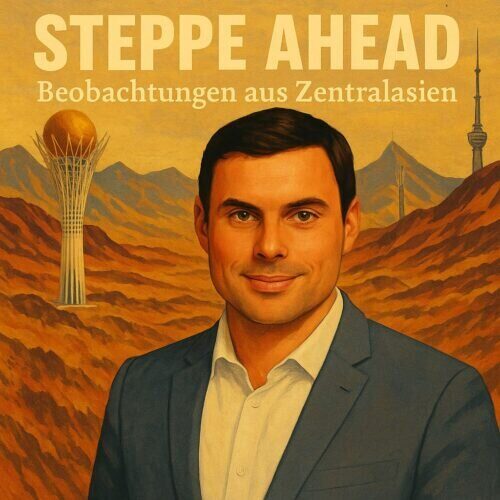
Central Asia column "Steppe Ahead"
Author: Thorsten Gutmann

In recent years, Uzbekistan has developed into one of the most dynamic economic regions in Central Asia. Where structural inertia and isolationist foreign policy long prevailed, an investor-friendly environment has now emerged that is increasingly attracting strategic attention from Europe.
In the first half of 2025, 1,829 new companies with foreign capital participation were registered nationwide – a historic high. This brought the total number of international companies in Uzbekistan to over 16,600. Growth in the technology sector is particularly striking: there are now over 9,700 IT companies operating in the country, with an estimated annual turnover of around 4.1 billion euros. At the same time, the expansion of renewable energies is progressing rapidly. Eleven new solar power plants are under construction or have already been connected to the grid, supported by investments of more than 22 billion euros.
Politically, this economic awakening has been accompanied by a series of reforms that have been gradually implemented under President Shavkat Mirziyoyev since 2017. These include tax breaks, the opening up of previously state-dominated industries, and selective privatization in the banking sector. International capital flows also reflect the changed investment climate: the European Bank for Reconstruction and Development (EBRD) has invested more than €3 billion in Uzbek projects over the past five years – more than in any other country in the region.
Geopolitically, Uzbekistan benefits from a location that is increasingly perceived as strategically relevant. The country borders all Central Asian republics, has functioning connections to China, and is seeking closer economic ties with South Asia. It has close economic relations with Russia, but deliberately maintains a more distant political relationship. Against this backdrop, the growing attention of European actors – particularly in the context of the Global Gateway initiative – is both understandable and calculated.
At the first EU-Central Asia Summit in Samarkand in April 2025, the European Union announced an investment package worth €12 billion. The focus is on energy, infrastructure, and digital connectivity. The agreement reflects a growing convergence of interests: Europe is seeking alternative supply and transit routes, while Uzbekistan is systematically pushing ahead with its integration into global supply chains.
This opens up concrete opportunities for European companies. Cluster-capable structures are increasingly emerging in the solar industry, digitalization, mechanical engineering, and textile processing. The state-sponsored "IT Park" in Tashkent now employs around 200,000 people and serves as a platform for technology imports, know-how transfer, and export preparation.
Uzbekistan currently offers investors a relatively stable macroeconomic environment, predictable regulatory conditions, and political interest in long-term cooperation. The country is in the process of establishing itself as a logistical and industrial corridor in a region that is redefining itself between global centers.
Whether it will be able to maintain this course in the long term depends not only on foreign policy integration and capital inflows, but also on infrastructure development and institutional professionalization. For now, however, Uzbekistan is no longer just an object of international interest – it is increasingly becoming an actor in its own right.
Original column (German):
Read on ostwirtschaft.de →