Hormuz shock: How big will Russia's unexpected oil windfall be?
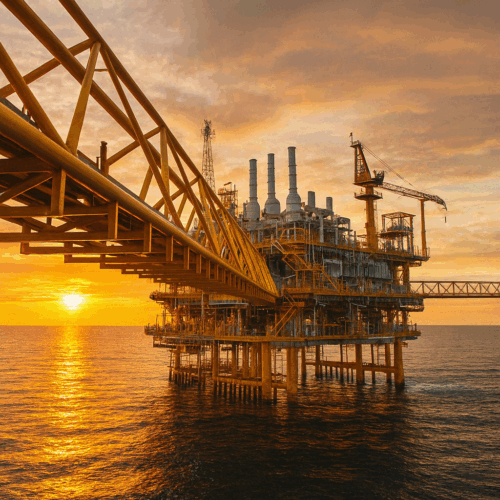
The attack by the US and Israel at the end of February began as a military operation and became an energy crisis within days.
The US consulting firm Rapidan Energy Group, a Washington think tank specializing in energy policy, described last week's event as the biggest disruption to global oil supplies in history.
20% oil shortfall - The strait on which everything depends
The British business newspaper Financial Times reported that around 20% of global oil supplies are currently affected by the closure of the Strait of Hormuz. More than 20% of global oil passes through the strait in peacetime. Bordering the Strait are not only Iran, but also Bahrain, Iraq, Qatar, Kuwait, Saudi Arabia and the United Arab Emirates. The countries of the Asia-Pacific region are the hardest hit, with 46% of their oil imports coming from the Persian Gulf.
The impact on the financial markets was immediate and massive. The price of Brent crude oil - the relevant benchmark for Europe - rose from around 60.3 euros per barrel before the start of the war to more than 90 euros in the meantime. At the time of going to press on Wednesday, March 11, the price of North Sea Brent crude was around EUR 79 - USD 91.
Analysts at JPMorgan, the largest US investment bank, estimated the potential global supply losses by the third week of the crisis at 4.7 million barrels per day - 5% of global demand. Saudi Arabia, the largest producer in the region, had to cut its export capacity from the Persian Gulf to 2.5 million barrels per day, according to analysis reports.
In Tokyo, the Nikkei index plunged by 7% at times. The South Korean stock exchange also recorded heavy losses. Since the beginning of the attacks, the Dax has lost up to 2000 points or a good 8%, a loss of around 150 billion euros in stock market value for the 40 Dax companies. Handelsblatt quoted capital market strategist Ed Yardeni, founder of the independent New York research firm Yardeni Research:
"Fears that a worsening economic situation could weigh on corporate profits have increased significantly."
Iran war costs: scenarios of 100 to 200 dollars
Rory Johnston is the author of the Commodity Context newsletter, one of the most influential independent commodity publications in North America, and is regarded in the industry as an extremely sober analyst. This makes it all the more remarkable that he explicitly sounded the alarm on the American business news site's "Odd Lots" podcast.
The permanent closure of the Strait of Hormuz, Johnston said on the podcast, is "the worst-case scenario that is typically only used as a thought experiment in industry circles. "It's the kind of question you only ask hypothetically: What if this were to happen? And now that worst-case scenario has happened."
The American analyst believes it is realistic that oil could rise to 200 dollars, the equivalent of 172 euros, and beyond: with severe consequences for fuel prices and possible serious supply shortages in the rest of the world.
Johnston explained the crucial point in the podcast: since the global oil supply is relatively inelastic, oil fields cannot be ramped up at the push of a button, demand must be rationed by prices in the event of a permanent supply shortfall. A historical comparison was made in the podcast: A loss of 20% of oil exports is comparable in magnitude to the decline in global oil consumption during the peak of the Covid lockdown in 2020:
"If 20% of supply disappears, demand must also fall by 20%. And that can only happen through price. This means price levels that most market participants previously considered unthinkable."
In various scenarios, the German-Russian Chamber of Commerce has used oil export and import data to calculate what the oil price shock triggered by the Iran war would mean for Russia and Germany. Hundreds of billions of euros are at stake.
The Russian state budget for 2026 is based on a Urals price of 50.8 euros, 59 dollars, per barrel at an exchange rate of 92.2 roubles per dollar. Kirill Rodionov, energy analyst at the Moscow Center for Economic and Political Reforms, told the business daily RBC: "In recent months, the average price has been around $40 -a level that was critical for the budget."
The discount of Urals against the global benchmark Brent widened to as much as 30 dollars, the equivalent of 26 euros, the highest since April 2023, according to Bloomberg. The main reason was the slump in Russian oil exports to India after Washington imposed punitive tariffs on India's purchases. Following the US-Israeli attacks on Iran, Urals even traded above Brent at times.
According to the British market information company Argus Media, Indian refineries bought Russian oil at a premium of 1 to 5 dollars per barrel. The US Treasury Department granted India a 30-day sanctions waiver on March 8 to buy Russian oil. Analysts estimate that this 30-day waiver allowed Russia to resell around 125 million barrels - and the price jump brought Moscow additional revenues of over one billion dollars within a few days.
The German Chamber of Commerce's own calculations based on export data from the International Energy Agency (IEA) and with the help of AI programs show the impact of higher oil prices on the Russian economy.

At an average Urals price of 50 dollars, Russia's annual gross revenue from crude oil exports would be around 87.6 billion dollars - 15.8 billion dollars below the budget estimate. At a Urals price of 75 dollars, Russia's annual gross revenue from crude oil exports would be around 131.4 billion dollars - already 28 billion dollars more than planned in the state budget. At 100 dollars, it would already be 175.2 billion dollars, an increase of 71.8 billion compared to the planned price. At USD 130, revenues would rise to USD 227.8 billion, an increase of USD 124.4 billion. At USD 150, revenues would rise to USD 262.8 billion, an increase of USD 159.4 billion. And in the extreme scenario of USD 200 per barrel, the total would be USD 350.4 billion: USD 247 billion more than planned in the budget. By comparison, the Russian military budget for 2026 amounts to around 145 billion dollars, around 125 billion euros.
Russian estimates remain conservative
Since the beginning of 2026, Russia's state budget has been under considerable pressure: the price of Russian oil was lower than expected and the rouble was strong against the dollar. In contrast to Western experts, who believe extreme prices for oil are possible, Russian experts are cautious, but also forecast higher revenues for the Russian budget.
Finam analyst Sergei Kaufman, Finam is one of Russia's largest online brokers and runs its own macro research team, expects the price discount for Urals against Brent to fall below 17 euros per barrel.
"In recent months, price discounts have widened due to competition between Russian and Iranian oil - but now, for obvious reasons, Iranian supplies have virtually come to a standstill," says Kaufman. This means that not only is the absolute price of oil rising for Russia, but also the relative price of Russian oil compared to grades such as Brent and WTI.
His colleague Nikolai Dudchenko, also at Finam, did the math: If the average Urals price remains in the range of 51.7 to 55.9 euros by the end of 2026, Russia's oil and gas revenues would exceed the planned figures by up to 775.0 billion roubles, around 9 billion euros.
Alexander Frolov, Deputy Director General of the Institute of National Energy is more optimistic: "I expect oil and gas revenues to increase by 30 to 50% compared to January and February 2026."
The Ministry of Finance had reported revenues of 825 billion rubles for these two months - so an increase of 30 to 50% would mean an additional 247.5 to 412.5 billion rubles, 2.7-4.5 billion euros.
Ruble, dollar, barrel: the three important variables
The effect of the rise in oil prices on Russia's public finances is inextricably linked to the ruble exchange rate - and this interaction is more complex than it appears at first glance. The budget is denominated in roubles; export revenues are generated in dollars and then converted into roubles. A weaker rouble strengthens the rouble equivalent of dollar revenues. A rising oil price tends to strengthen the rouble, which partially erodes the positive effect.
At the exchange rate of 92.2 roubles per dollar assumed in the budget and a Urals price of 50.8 euros, this results in a barrel revenue of around 5440 roubles. In the market environment before the war - with an exchange rate of around 80 roubles and a Urals price of 45 euros - the rouble revenue is around 3600 roubles: well below the planned value.
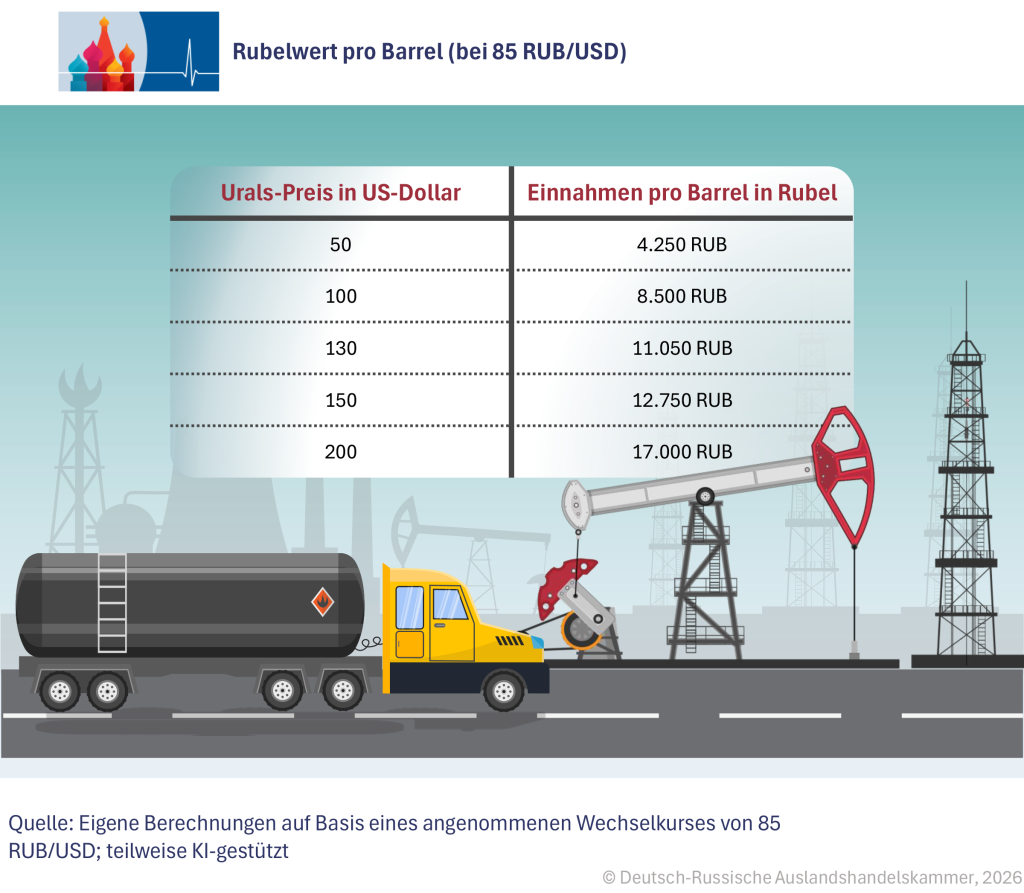
If the Urals price rises to 100 dollars and the rouble exchange rate to 85 roubles, the rouble revenue climbs to 8500 roubles per barrel - more than twice as much as the budget figure. At 130 dollars it would be 11,050 roubles; at 150 dollars 12,750 roubles. In the extreme scenario of 200 dollars per barrel, the ruble revenue per barrel would be 17,000 - more than three times the budget figure.
After the shutdown, Politico, Bloomberg, The Guardian and Associated Press all reported that Russia was the main beneficiary of the crisis among oil suppliers. Politico also noted that, in parallel with events in Iran, the US continues to maintain control of Venezuelan oil - meaning that key buyers such as India and China will have to turn increasingly to Moscow for additional supplies.
Autarkic versus dependent: Why America hardly feels what hits Germany
Gabor Steingart, publisher and founder of the Berlin-based media house The Pioneer and long-time editor-in-chief of Handelsblatt, commented pointedly on the asymmetry of the effects of the crisis in his Morning Briefing on March 10: "Crazy, but true: the US, which started the war in the Middle East, is hardly affected. Germany, which neither wanted nor started this war, is suffering like a dog." The reason, according to Steingart, lies primarily in energy policy: America has made itself almost independent of the world market by pushing ahead with the production of liquefied natural gas, while Germany, after the nuclear phase-out, is more dependent on fossil fuel imports than ever before.
A recent analysis by the Cologne Institute for Economic Research (IW Köln) shows that an increase in the price of oil to 100 dollars per barrel would cost the German economy 0.3% of gross domestic product in 2026 and 0.6% in 2027 - a total loss in economic output of around 40 billion euros over two years. In the extreme scenario of a permanently high oil price, this damage increases considerably: in absolute terms, this would correspond to a loss of over EUR 80 billion in real terms over two years, with consumer prices rising by 1.6% in 2026 and 1.9% in 2027.
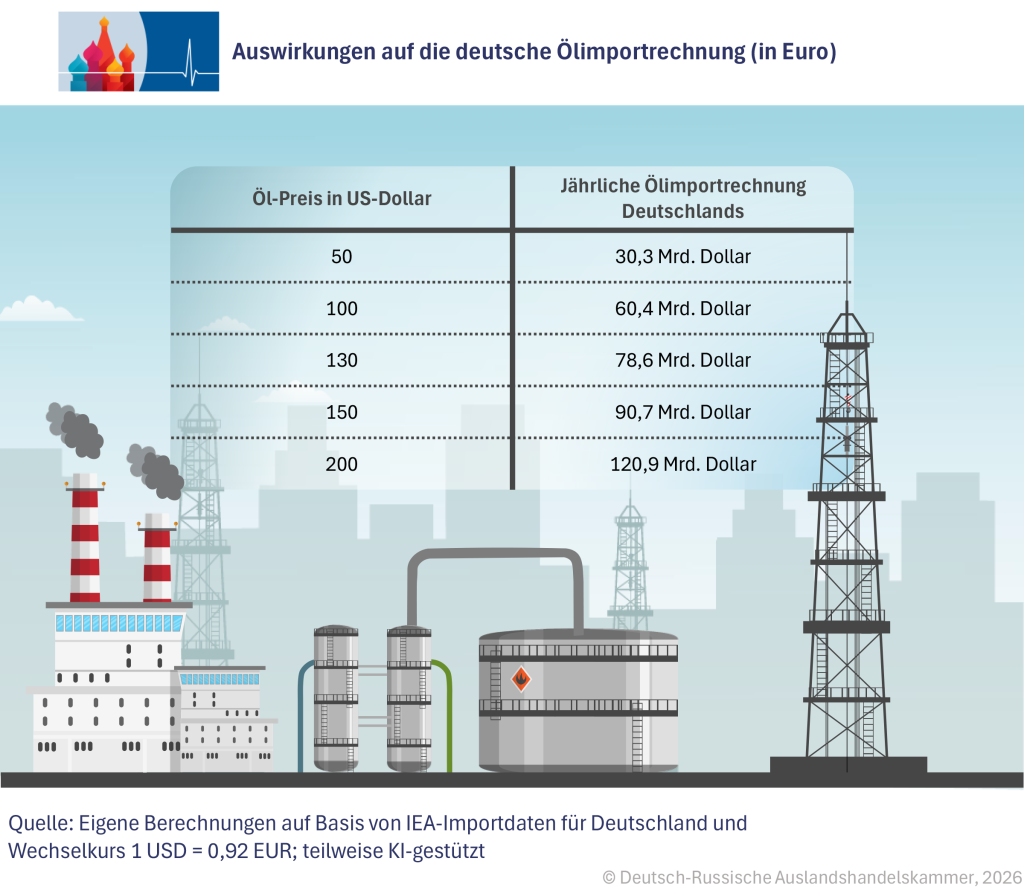
Calculations by the German-Russian Chamber of Commerce show how much the oil price increase could impact the German import bill. According to the International Energy Agency (IEA), Germany imports around 1.8 million barrels of crude oil per day. At an oil price of 50 dollars and an exchange rate of 1 dollar equals 0.92 euros, the annual import bill would be around 30.3 billion euros. At 100 dollars, it would already be 60.4 billion euros - a doubling of costs. At 130 dollars, the costs would rise to 78.6 billion euros, and at 150 dollars to 90.7 billion euros. In the extreme scenario of 200 dollars per barrel, Germany would spend 120.9 billion euros annually on crude oil imports.
For comparison: the entire federal budget for 2026 includes expenditure of around 480 billion euros. An oil import bill of 120 billion euros would therefore correspond to a quarter of the entire federal budget.
The figures are model calculations based on simplifying assumptions: constant import volumes, a fixed exchange rate and gross prices without processing margins. The reality is more complex. Nevertheless, they clearly illustrate the structural dilemma facing Germany: as one of the most energy-import-dependent economies in the world, Germany is heavily exposed to an oil price shock.
Sebastian Dullien, Scientific Director of the Düsseldorf Institute for Macroeconomics and Business Cycle Research (IMK), put it succinctly: "Until the outbreak of war, the tendency was to raise our expectation of 1.2% economic growth for 2026 a little further. That has now definitely come to an end." Should the war last longer and oil and LNG supplies from the region remain interrupted for a longer period of time, the energy price shock could be large enough to bring the recovery of the German economy hoped for in 2026 to a standstill.
The crisis is already being felt directly at filling stations: Super E10 cost around 20.6 cents more than before the start of the Iran war on a nationwide daily average, diesel even 37.1 cents more, averaging over 2.10 euros per liter. The motorists' association ADAC accused the oil industry of exploiting the price increase beyond what was justifiable.
What the Iran war means for peace in Ukraine
The Iran war has not only shaken the oil markets, it may also throw the fragile efforts to find a diplomatic solution to the Ukraine conflict off course.
A peace in Ukraine is now a distant prospect, according to Jennifer Kavanagh, Director of Military Analysis at the Washington-based think tank Defense Priorities, in the American journal Responsible Statecraft: "The Trump administration had hoped to slowly dry up Russia's oil revenues in order to force Moscow to make greater compromises at the negotiating table. That leverage is now lost."
The analysts at Dutch ING Bank show why this is the case: In the base scenario - four weeks of disruption to the passage through the Strait of Hormuz - Brent stabilizes at an average of 68 dollars over the course of the year. In a three-month partial blockade, the price rises to 89 dollars in the second quarter. In the extreme scenario of a full three-month closure, Brent would climb to 110 dollars in the second quarter and remain at an average of 95 dollars in 2026.
Eurosintelligence, a Brussels-based economic service, writes: "Unfortunately for Trump and for all of us, there is no easy solution to his Hormuz problem. Oil markets are likely to struggle with disruption for as long as this war lasts. The oil crisis will not be over any time soon."
For Russia, this is news that could hardly be better. "So far, there is only one winner in this war: Russia," said EU Council President António Costa in Brussels on Tuesday. Russia is gaining new resources to finance its military, as energy prices are rising. It is benefiting from the diversion of military capacities that could otherwise have been used to support Ukraine. And it benefits from the fact that attention is being diverted away from the Ukrainian conflict while the conflict in the Middle East takes center stage.
James Henderson of the Oxford Institute for Energy Studies told the American news channel NBC: "It wouldn't surprise anyone if Russian military spending increased as a result. More money is available, and therefore more money is available for military spending."
This article first appeared in the exclusive newsletter of the German-Russian Chamber of Commerce.